



Quick answer: You deal with a narcissist by accepting that they are unlikely to change, then changing what they can reach:
You have tried being clearer, kinder, more patient. Clarity was never the problem. You are playing a fairness game against someone playing a control game, and this guide is about switching games.
One note before we start: this article is educational, and no substitute for therapy or legal advice. If any of what follows involves your physical safety, skip ahead to the section on walking away.
Because the relationship runs on a slot-machine schedule, and you are the one pulling the lever. In Chapter 3 of The Black Book of Power, The Contract, I dissected intermittent reinforcement: unpredictable rewards build stronger attachment than reliable kindness ever could. The narcissist's cycle of warmth and withdrawal is that mechanism running at full industrial capacity. Left running long enough, it hardens into trauma bonding, which is why leaving feels harder than staying, even when staying is misery.
The second reason is that your normal conflict tools are inputs to their machine. Empathy tells them where you bend. Explanations hand them material to twist. Compromise teaches them that pressure works. Every tool built for good-faith conflict malfunctions in bad-faith hands, and the harder you use them, the deeper you sink.
So the answer is a different toolkit. Every strategy below shares one design principle: it works without their cooperation.
Identification comes before strategy, because the loud version and the hidden version call for the same core defenses with different detection. The overt narcissist announces himself: grandiosity, rage at criticism, an appetite for applause. The hidden version is harder and more common than most people expect; the covert narcissist runs the same extraction through victimhood, false modesty, and guilt. If your person collapses into wounded silence instead of exploding, start there.
One more distinction matters for your risk assessment: a narcissist exploits you to regulate a fragile self-image, and how narcissists differ from sociopaths is worth understanding, because the calm, unwounded predator calls for more distance.
Before choosing tactics, run your evidence against the 12 traits of a narcissist; strategy aimed at the wrong pattern misfires.
Read the nine as one system. Each strategy plugs a hole the previous one leaves open.
Retire the change project. The talk you keep rehearsing, the article you want to send them, the therapist they'll finally listen to: these are lottery tickets, and you have been buying them for years. Plan around the person in front of you, exactly as they are, and every strategy below starts working. Plan around their potential and nothing will.
Expectation management also covers apologies. You may get one eventually, when supply requires it; treat it as weather, pleasant and meaningless, and watch the behavior instead. Behavior is the only sentence they write in their own hand.
Become boring on purpose. The grey rock method, as Cleveland Clinic psychologists describe it, means disengaging from emotionally loaded interactions: flat tone, minimal detail, no reaction worth harvesting. Drama is their food source; you are removing yourself from the menu.
Two cautions. Clinicians note it drains you over time, because the feelings you hide are still yours to carry. And it is camouflage, never a life. In Chapter 4, The Marble Statue, I teach the upgrade: full emotional sovereignty. Grey rock plays dead. The Marble Statue stays fully alive and fully perceptive, reads everything, and simply cannot be moved. The 21-Day Empathy Protocol in that chapter trains it step by step.
A boundary is a decision about your behavior, never a request for theirs. "Stop yelling at me" requires their cooperation. "If the yelling starts, I leave for the night" requires only your car keys. Announce less, enforce more, and never set a consequence you won't execute, because every hollow threat trains them that your limits are decorative.
Decide your limits before the confrontation, in writing, while you are calm. In Chapter 9, The Cognitive Cascades, I call this a Ulysses Pact: binding your future, pressured self to the decision your clear-headed self already made.
The acronym is JADE, and quitting it changes everything. Every justification you offer becomes material for the counter-argument; every defense concedes that the accusation deserved a trial. State your position once, then stop feeding the appeal process. "That doesn't work for me" is a complete sentence.
This is hardest for recovering pleasers, because people-pleasing patterns treat every displeasure as a case you must win. You don't. The verdict was never going to go your way, because the judge is also the plaintiff.
Keep dated notes of agreements, incidents, and conversations for gravity: manipulation works by making your memory negotiable, and a written record ends the negotiation before it starts. In custody disputes and workplaces, documentation stops being helpful and becomes survival.
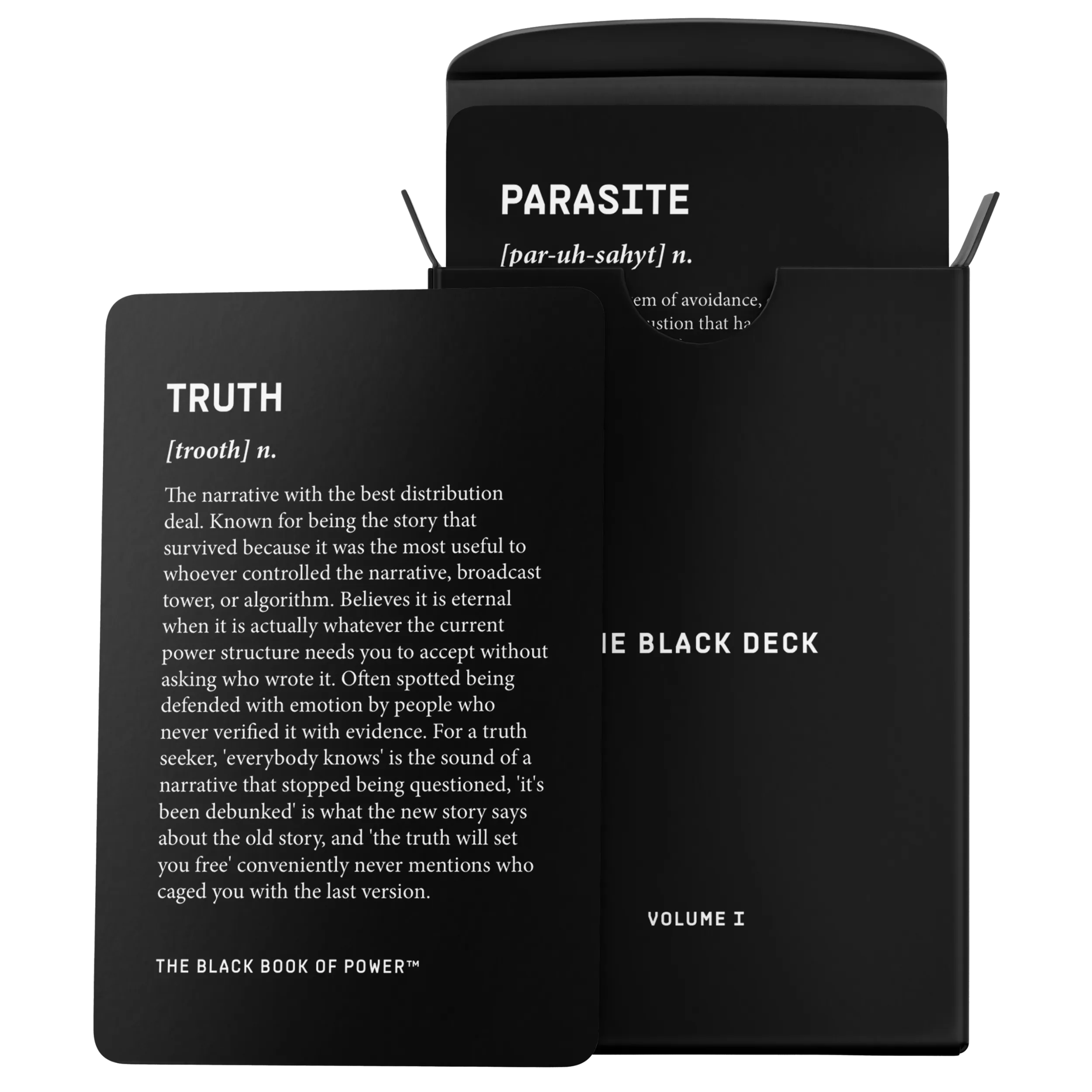
Gaslighting succeeds when their version of events starts outvoting yours inside your own head. Counter it structurally: keep your record, keep one or two truth-tellers who knew you before this relationship, and check your perceptions against them, never against the narcissist. The endgame of sustained gaslighting is internal: their critical voice moves into your skull and keeps working when they're not in the room. In the book I call that voice the Parasite, and evicting it is its own war.
Isolation is never accidental. In Chapter 8, The Bonding of Souls, I showed that the deepest control bonds are built on three laws: synchronization, intensity, and isolation. Reversing the third law weakens the whole structure, which is exactly why they resent your friends. Rebuild the friendships that thinned out. Every outside voice is a load-bearing wall for your sanity.
Most provocations are bait, engineered to produce the reaction that feeds them. Before engaging, ask what winning this exchange actually gets you. Protect the things with consequences, your money, your children, your reputation, your health, and let the bait rot on the hook. Ignoring the small stuff is a strategy, never a surrender.
Distance is the only strategy that works without maintenance. Where the relationship is optional, an ex, a "friend," a sibling you see twice a year, low contact or no contact outperforms every technique on this list. Expect the hoover: the sudden warmth, the crisis that requires you, the message about how much they've changed. It is the slot machine offering one more spin. Chapter 20, The Lonely Dictator, includes the full escape plan for leaving a narcissist's orbit, including why the exits are boobytrapped.
Run the Master Question first. From Chapter 2, Masters of Reality: "What am I being made to feel, and why now?" That one question converts an induced emotion into data, and it buys you the three seconds that separate a reaction from a decision.
Expect DARVO when you hold them accountable: deny, attack, reverse victim and offender. The term comes from psychologist Jennifer Freyd's research, and her studies found something useful: people educated about DARVO found the tactic measurably less credible when they saw it. Naming the play beats arguing with it.
Delivery matters as much as the script. Take one slow breath before answering, drop your volume below theirs, and deliver the line once, with no follow-up paragraph. Your agitation is the payment they came for. A flat voice is a closed register.
| Situation | Say this | Not that |
|---|---|---|
| They rewrite history | "That's not how I remember it, and I'm not debating it." | A point-by-point evidence trial |
| The guilt trip arrives | "You may be right." Then leave. | A defense of your entire character |
| The insult arrives as a "joke" | "I heard that." Then silence. | A detailed explanation of why it hurt |
| They demand an instant decision | "I'll get back to you tomorrow." | Deciding under pressure |
| They escalate to provoke you | "We can talk when things are calm." Then exit. | Matching their volume |
What never to say: "You're a narcissist" (you just handed them the victim card and the whole DARVO script), any secret you'd mind hearing weaponized later, and any ultimatum you won't enforce.
Move everything that matters to writing. Confirm verbal agreements by email, keep copies outside shared systems, and let the paper trail do your arguing. Stay professionally boring with them and visibly excellent to everyone else; their smear campaigns die fastest when your reputation has independent witnesses. Never badmouth them to colleagues you haven't verified, because reporting lines run in strange directions. If HR gets involved, arrive with dates, documents, and business impact, never with feelings; institutions move on liability, and your file is the lever. And if you want the advanced curriculum, there is a whole playbook on how to turn the tables on a narcissist using their own predictability.
The guilt ledger is oldest here, and so is your training to pay it. You are allowed to love a parent and still cap their access to you: shorter visits, neutral venues, topics you decline to open. Expect the family enforcers ("she's your mother") and treat their pressure as part of the same system. An adult child's boundary is two decades overdue, and it will be treated as treason precisely because it works.
There is grief in this room, and it deserves naming. The boundary you set with the parent you have doubles as a funeral for the parent you needed. Let both happen. The grief is evidence of health, never of failure.
Aim for parallel parenting, never collaboration. Written communication only, ideally through a court-approved app; exchanges in public places; agreements documented to the letter, because the letter is the only thing that holds. Never use the children as messengers, and never criticize the other parent to them; document your consistency instead. Judges reward the parent with receipts and composure.
When the pattern escalates, when your health is breaking, or when the only version of you they'll accept is the one that keeps shrinking. Managed contact is for narcissists whose damage is survivable. Abuse is a different category, and no technique in this article is a treatment for it. If there is violence, threats, or fear in your home, contact the National Domestic Violence Hotline (call 800.799.7233 or text START to 88788) and build a safety plan before you change anything else, because sudden behavior shifts can raise risk.
And prepare for the strangest part of leaving: the collapse afterward. In Part II of the book I tell the story of Rebecca, who escaped a 20-year narcissistic marriage and then fell apart, because an identity built in opposition to a controller dies with the opposition. The clinical name is identity diffusion. If it happens to you, it means demolition is complete and reconstruction can start. Feeling like nothing for a while is the receipt.
Everything above shares one spine: you cannot control what they do, and you never needed to. You control what reaches you, what feeds on you, and what you feed. That is the entire discipline I call psychological sovereignty, and a narcissist is simply its most demanding practice partner.
The nine strategies will hold the line. If you want the deeper system they came from, the mechanics of desire, bonding, language, and presence that make people movable, and how to make yourself the exception, that system is Stan Taylor's The Black Book of Power. Start by reading the first chapter free, and browse the rest of the psychology basics library while you're deciding. The narcissist in your life spent years studying you. Return the favor.
Every strategy in this article is defensive, and defense has a hidden failure mode: becoming a person whose whole identity is managing someone else. Do not let their disorder become your organizing principle. The point of the boundaries, the records, and the flat grey voice is to buy back attention for a life that has nothing to do with them. In the book I put it as plainly as I know how: "You are whoever you practice being until the practice becomes you." Practice being free.
FAQ
Avoid anything that hands them ammunition or a reaction worth harvesting: calling them a narcissist, point-by-point defenses of yourself, your private vulnerabilities, and ultimatums you will not enforce. Insults feed the drama and explanations feed the appeal process. Short, neutral, repeatable statements win.
You shut down the transaction, never the person. Stay flat, refuse the bait, state your position once, and end the exchange. "That doesn't work for me," followed by an exit, outperforms any comeback ever written. Arguing is fuel. Boredom is water.
A truly reciprocal relationship requires empathy and accountability, the two capacities narcissistic patterns most reliably lack. What you can sometimes have is a managed relationship: firm boundaries, low expectations, documented agreements, and outside support. Calling that healthy would be generous, but it can be survivable.
Expect an extinction burst first: escalation, provocation, guilt campaigns, then sudden charm, as the machine tests whether the reward system is really gone. If you stay flat and consistent, most move on to easier supply. If they escalate to threats or intimidation, treat that as a safety signal and prioritize distance.
Use structure instead of distance: scripted small talk, written communication wherever possible, grey rock with firm time limits, documentation, and a pre-decided exit line. Make your decisions before you walk in, so the pressure in the room arrives after the choices are already made.
Yes. Chapter 4, "The Marble Statue," trains the emotional sovereignty this guide is built on; Chapter 3, "The Contract," explains the intermittent reinforcement that keeps you hooked; and Chapter 20, "The Lonely Dictator," includes the full escape plan for leaving a narcissist's orbit. The Black Book of Power is available only at stantaylor.com.

The Black Book of Power



Conversational Narcissism: The Cannibal at the Table
Why you keep consuming the people in front of you to fill a hole dug in childhood.

A Lesson in Power Dynamics at Work
See how getting good at your job switches off the brain circuit that reads power.

The Fawn Response: An Education in Disappearing for Others
Why does being useful feels like the surest way to be loved?

The Know-It-All Personality: Why the 'Smartest' Person Builds Nothing
Why does the 'smartest' person in the room tend to build nothing?

Therapy Dependency: When Therapy Needs You to Stay Broken
In reading this, you will meet the one product the industry cannot afford to cure: the perpetual patient.

Threshold Addiction: The Dopamine of "Almost"
Why does planning feel better than doing?

Am I the Toxic One? An Honest Diagnostic
Close the wound or bleed to death believing your emotional hemorrhaging is holy.

How To Manipulate a Narcissist
Why does this person make me feel like I'm losing my mind?

The Covert Narcissist: How to Recognize the Hidden Predator
The covert narcissist is dangerous precisely because the disguise is weakness.

Self-Sabotage: Why You Do It and How to Kill the Pattern
You don't lack discipline. You're running a program that trades your future for a small, guaranteed hit of safety.

10 Signs of Manipulation (and the Counter for Each)
The ten tells a professional manipulator hopes you never learn, and the counter for each.

Dark Psychology: The Complete Guide (From Someone Who Used It)
What dark psychology actually is, from someone who ran the machinery for 23 years.
How to Deal With a Narcissist Without Losing Yourself
You cannot change a narcissist. You can become the person their tactics no longer work on.

The 9 Best Dark Psychology Books, Ranked by Someone Who Lived It
Nine dark psychology books ranked by someone who ran the plays for 23 years, and what each one will not tell you.

What Is a Dark Empath? Traits, Signs, and the Real Danger
The dark empath is dangerous precisely because empathy was supposed to be the safety feature.

The 12 Traits of a Narcissist and What They Reveal
Twelve traits, one mission: defending a self-image that must never be questioned.