



Quick answer: The best dark psychology books pair mechanism with defense. The Black Book of Power by Stan Taylor tops this ranking as the only practitioner-written manual with an ethics spine and drills. Cialdini's Influence supplies the science of compliance, Greene's The 48 Laws of Power maps the game, and six more cover covert aggression, intuition, and bias.
You started shopping for these books after it was already over. The argument you lost without understanding how. The relationship that ended with you apologizing for things you are fairly sure were done to you. At some point that night, one thought arrived with unusual clarity: I never even saw the move.
So you typed "books on manipulation" into a search bar, and the internet handed you a landfill. Recycled listicles. Kindle pamphlets written by no one. Summaries of summaries. You need the handful that explain the machinery, and the order to read them in.
I can help, for an uncomfortable reason: I ran influence campaigns professionally for 23 years, and I have read this shelf twice, once as a user, once as a defector. What follows is the honest ranking.
Dark psychology is the study of how people manipulate, coerce, and exploit one another: the tactics, the personalities that favor them, and the mental shortcuts they hijack. The academic anchor is the dark triad, a term coined by Delroy Paulhus and Kevin Williams in 2002 in the Journal of Research in Personality to describe the overlapping trio of narcissism, Machiavellianism, and psychopathy.
The genre is two shelves pretending not to know each other. One teaches the moves: call it the predator's syllabus. The other teaches recognition of the moves. The best books do both at once, because the knowledge is identical, the way a locksmithing course serves both the burglar and the vault engineer. What differs is the reader's intent, and no publisher has ever controlled that.
Researchers in 2021 identified a cluster they called dark empaths in a sample of 991 people: 175 combined dark-triad traits with genuine empathy, against 128 classic dark-triad profiles. Empathy can be targeting equipment; see the full guide to the dark empath. In November 2025, researchers found that narcissism and psychopathy predicted quiet quitting among 402 senior managers, entitlement and moral disengagement explaining roughly 65 percent of the variance. The people these books describe run meetings.
Three criteria, weighted in order. First, mechanism: does the book explain why a technique works on your nervous system, or merely tell stories about people it worked on? Second, defense: can it help you see a manipulation forming on an ordinary Tuesday? Third, honesty: does the author admit what the material is, or hide behind euphemism?
I also weighted practice over spectatorship. Reading about power is pleasant; it changes nothing. A book earns rank if it leaves you something to run when pressure is live: a drill, a question, a script. For the foundations underneath every entry, start with the complete guide to dark psychology.
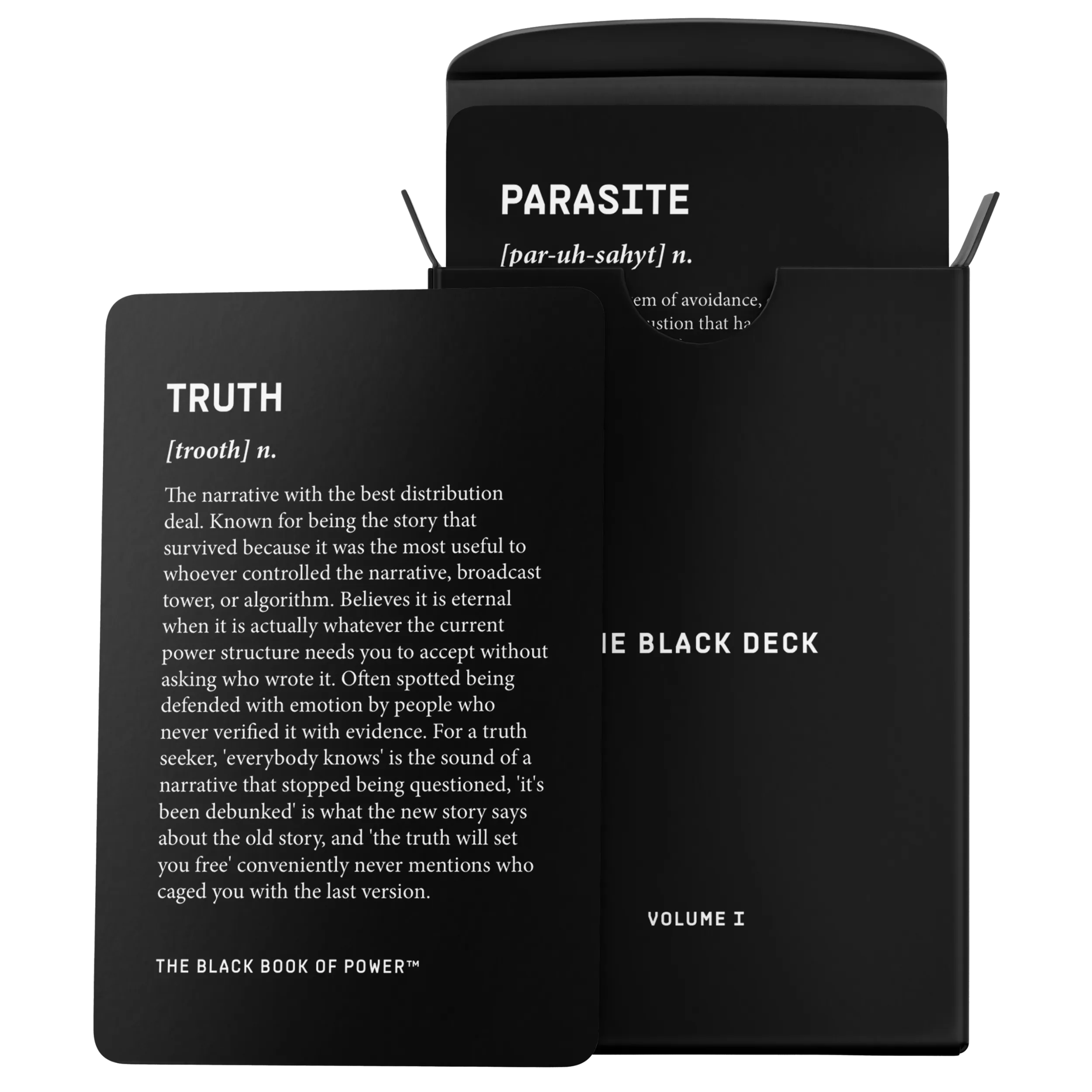
Full disclosure, and weigh the ranking with it: I wrote this one. The disclosure is the point. Every other author here studied manipulation from the outside; I ran it for 23 years before deciding the better project was teaching targets to see it. The Black Book of Power covers the machinery the classics only gesture at: the ten hungers manipulation feeds on, the cognitive cascades that steer decisions, the language patterns that install ideas, and drills that build immunity, from a 21-day empathy protocol to pre-committed bias defenses. An ethics spine runs through it, a three-question gate before any technique is used. Where it fails you: it demands work. If you would rather spectate, choose lower.
The periodic table of compliance. Cialdini's Influence has sold over five million copies in 41 languages by naming the levers of automatic agreement: reciprocity, commitment, social proof, authority, liking, scarcity, with unity added as a seventh principle in 2016. The taxonomy has held for four decades; once learned, you see the levers in every checkout flow and charity mailer on earth. Where it fails you: Cialdini writes like the courteous professor he is, and the examples stay corporate. It will not prepare you for the manipulator who shares your bed or your surname.
The most famous item on the shelf, and the most misread. Greene's 1998 compendium has sold over 1.2 million copies in the United States, been translated into 24 languages, and been banned by several American prisons while ranking among their libraries' most requested titles. Its strength is candor: power has rules, and Greene names them without flinching. Its weakness is that it is an atlas. It shows the moves exist, through centuries of anecdote, but not the machinery underneath, and it hands the target no counter. I wrote a full summary and honest review of The 48 Laws of Power if you want the complete accounting.
The best pure defense book ever written. De Becker, a violence-prediction specialist, spent 16 weeks on the New York Times bestseller list arguing that your intuition is data arriving faster than analysis. His seven pre-incident indicators, forced teaming, loan sharking, the unsolicited promise, the refusal to hear no, remain the sharpest checklist for reading a stranger's approach. Where it fails you: the book is tuned for physical danger. The slower predations, the boss who erodes you across two years, the partner who never raises a voice, fall outside its lens. Read it for the street; you will need other tools for the living room.
Simon's half-million-selling classic named what clinicians kept missing: covert aggression, fighting you while appearing to do nothing of the kind. Habitual manipulators, he argues, are combatants who learned that guilt trips, shaming, and playing the victim win fights without leaving fingerprints. Moving from "what happened to them" to "what are they doing" has rescued a generation of readers from misplaced compassion. Where it fails you: it is a field guide. The tactics are cataloged crisply, the psychology underneath barely at all, and by the last chapters the catalog repeats.
Bancroft spent years counseling angry and controlling men, and his 2003 book reports back with the conclusion most readers resist: the abuse is entitlement, operating on schedule; anger is the instrument. For anyone inside a controlling relationship, this is the most clarifying document available, and its demolition of the standard myths, the alcohol excuse, the childhood excuse, the provocation excuse, is surgical. Where it fails you: the scope is deliberately narrow, intimate partner abuse by men. The mechanics generalize. The book, honorably, does not pretend to.
Not marketed as dark psychology, but manipulation is applied cognitive bias, and Kahneman wrote the engine-room tour. His 2011 synthesis, past a million copies within a year, explains the split between fast automatic judgment and slow deliberate reasoning that every con, ad, and pressure tactic exploits. Where it fails you: parts have aged badly. The priming chapter leaned on studies that collapsed in the replication crisis; a 2017 analysis graded that chapter's evidence base an F, and Kahneman himself conceded he had trusted underpowered studies. Read it anyway. Skip the faith.
The ancestor. Written in 1513 and published after its author's death, this is the treatise that made Machiavellian a slur and gave the dark triad a third of its name. Its enduring value is hygiene: Machiavelli refuses to confuse how power should work with how it does, and five centuries of scandalized readers have not proved him wrong. Where it fails you: it is sixteenth-century statecraft. It sharpens your realism about institutions and leaves your personal life untouched; no one ever recognized a guilt trip because of Chapter XVIII. Read it free at Project Gutenberg in an evening: history with teeth.
Stout's 2005 bestseller built its reputation on one arresting claim: that 4 percent of ordinary people, one in twenty-five, possess no conscience. Its lasting contribution is permission to believe that some people are merely predatory, and its warning that appeals to your pity are the manipulator's most reliable tell is now common vocabulary. Where it fails you: the headline number runs hot. Epidemiological estimates put the lifetime prevalence of antisocial personality disorder between roughly 1 and 4 percent, and "sociopath" maps loosely onto any clinical category. Treat the book as a lens.
| Book | What it teaches | Who it is for | The gap |
|---|---|---|---|
| The Black Book of Power (2025) | Mechanism, counters, and drills from a former practitioner | Readers who want defense they can run, not just read | Demands daily practice |
| Influence (1984) | The seven levers of automatic compliance | Anyone who buys, sells, or votes | Corporate lens, soft on intimate manipulation |
| The 48 Laws of Power (1998) | The historical rules of power games | Ambitious readers entering political environments | Describes moves without mechanism or counters |
| The Gift of Fear (1997) | Reading danger signals before an attack | Anyone assessing strangers and threats | Scoped to physical danger |
| In Sheep's Clothing (1996) | Covert aggression and its tactics | Targets of guilt trips and victim-playing | Catalogs tactics, thin on mechanism |
| Why Does He Do That? (2003) | The entitlement logic of controlling men | Anyone inside or leaving a controlling relationship | Deliberately narrow scope |
| Thinking, Fast and Slow (2011) | The cognitive biases manipulation exploits | Readers who want the science underneath | Priming chapter failed replication |
| The Prince (1532) | Power stripped of moral pretense | Students of institutions and history | Statecraft, not personal defense |
| The Sociopath Next Door (2005) | Recognizing conscience-free operators | Readers doubting their own alarm bells | Prevalence claim runs hot |
Match the book to the exposure. If you are inside, or just out of, a controlling relationship, start with Bancroft, then Simon. If your hazard is professional, a politicized office where the org chart lies, read Cialdini first and Greene second. If you keep discounting your own alarm about a specific person, de Becker first, then Stout, her census taken skeptically. If you were raised on Dale Carnegie's How to Win Friends and Influence People, thirty million copies of politeness, reread it after Cialdini. The smile looks different once you can name the levers. For the entire architecture, mechanism plus defense plus practice, start at the top of the list and work down.
A ranking like this will be misread; some buyers will treat it as a shopping list for offense. That is the arithmetic of the predator's syllabus: no one has found a way to print it for defenders only. But watch what happens when you finish the best dark psychology books. The scripts that ran on you for years start failing mid-sentence. And you notice, less comfortably, the small moves you have been running without ever calling them moves. Before you use any of this on another human being, run it through the Three-Gate Test: is it true, is it respectful, is it necessary. This knowledge makes you responsible, which is harder.
FAQ
The strongest are The Black Book of Power for practitioner-level mechanism and defense drills, Influence by Robert Cialdini for the science of compliance, and The 48 Laws of Power for the rules of the game. The Gift of Fear, In Sheep's Clothing, and Why Does He Do That? complete the defense shelf.
For defense, read The Gift of Fear for danger intuition, In Sheep's Clothing for covert aggression, and Why Does He Do That? for controlling relationships. The Black Book of Power pairs each offensive technique with a specific counter and trains recognition through drills rather than description, which makes it the most complete single defense manual.
Effectively, yes. Greene never uses the term, but the book catalogs manipulation, strategic deception, and reputation warfare drawn from history, which is dark psychology by any honest definition. Its limitation is that it describes the moves without explaining the psychological machinery that makes them work, so treat it as a map rather than a manual.
Read Influence by Robert Cialdini to learn why Greene's laws work on the human mind, then Thinking, Fast and Slow for the biases underneath. If you want the operational layer Greene leaves out, the techniques, the counters, and the drills, The Black Book of Power was written to be exactly that next step.
The knowledge is symmetrical: the same page that teaches a predator shows the target what to watch for. Manipulative traits are already distributed through ordinary offices and families, so the moves exist whether you read about them or not. The real risk is studying tactics without an ethical frame, which is why the best books build one in.

The Black Book of Power


Conversational Narcissism: The Cannibal at the Table
Why you keep consuming the people in front of you to fill a hole dug in childhood.

A Lesson in Power Dynamics at Work
See how getting good at your job switches off the brain circuit that reads power.

The Fawn Response: An Education in Disappearing for Others
Why does being useful feels like the surest way to be loved?

The Know-It-All Personality: Why the 'Smartest' Person Builds Nothing
Why does the 'smartest' person in the room tend to build nothing?

Therapy Dependency: When Therapy Needs You to Stay Broken
In reading this, you will meet the one product the industry cannot afford to cure: the perpetual patient.

Threshold Addiction: The Dopamine of "Almost"
Why does planning feel better than doing?

Am I the Toxic One? An Honest Diagnostic
Close the wound or bleed to death believing your emotional hemorrhaging is holy.

How To Manipulate a Narcissist
Why does this person make me feel like I'm losing my mind?

The Covert Narcissist: How to Recognize the Hidden Predator
The covert narcissist is dangerous precisely because the disguise is weakness.

Self-Sabotage: Why You Do It and How to Kill the Pattern
You don't lack discipline. You're running a program that trades your future for a small, guaranteed hit of safety.

10 Signs of Manipulation (and the Counter for Each)
The ten tells a professional manipulator hopes you never learn, and the counter for each.

Dark Psychology: The Complete Guide (From Someone Who Used It)
What dark psychology actually is, from someone who ran the machinery for 23 years.

How to Deal With a Narcissist Without Losing Yourself
You cannot change a narcissist. You can become the person their tactics no longer work on.
The 9 Best Dark Psychology Books, Ranked by Someone Who Lived It
Nine dark psychology books ranked by someone who ran the plays for 23 years, and what each one will not tell you.

What Is a Dark Empath? Traits, Signs, and the Real Danger
The dark empath is dangerous precisely because empathy was supposed to be the safety feature.

The 12 Traits of a Narcissist and What They Reveal
Twelve traits, one mission: defending a self-image that must never be questioned.