



Quick answer: The 12 traits of a narcissist are:
Twelve traits, one mission. Every item on this list defends the same fragile monument: a self-image that must never be questioned, at a price paid entirely by the people nearby.
A narcissist is someone whose personality is organized around protecting a grandiose self-image. The core traits are an inflated sense of importance, a constant hunger for admiration, entitlement, and a lack of empathy for the people who supply both. The behavior varies from person to person. The mission, defending the image at everyone else's expense, never does.
Two clarifications before the list. Clinically, narcissistic personality disorder is defined by nine DSM-5 criteria, of which at least five must be present, and only a professional can diagnose it; the traits below describe patterns, never verdicts. And the traits wear two costumes: the loud, obvious version, and the hidden one that presents as humility and victimhood, which I mapped fully in the guide to the covert narcissist.
One more thing about the lens here. In The Black Book of Power I treat narcissism as a power system rather than a personality quirk, because systems can be mapped, and a mapped system stops being frightening. So each trait below comes with the move underneath it: what the behavior is actually doing.
Read for patterns, never single incidents. One trait proves nothing; most of the twelve, sustained across months, is a different conversation.
A scoring note before you begin. Track each trait across three settings, home, work, and public, and across time. Narcissistic patterns show loudest at home and most charming in public, and the gap between the two audiences is itself diagnostic. Write down what you observe as you go, because the eighth trait on this list specializes in making you doubt the first seven.
An inflated sense of importance that outruns all evidence. The colleague who narrates routine work as heroism, the relative whose stories keep promoting him to protagonist. The power move: pre-claiming rank. In Chapter 13, The Halo Effect, I showed that people judge status in the first seconds, long before competence gets checked. Grandiosity exploits that gap: bill first, deliver never.
A hunger for applause that no amount of applause fills. They fish for compliments, deflate in rooms that don't notice them, and punish the ones that don't clap. The power move: recruiting supply. In Chapter 7, The Strings of the Heart, I mapped the ten hungers that drive behavior; validation is one of them, and the narcissist's version is bottomless. Your role becomes feeder, and the job was never posted.
Your inner life registers as scenery. Your bad news bores them, your illness inconveniences them, your tears are a scheduling problem. The power move: one-way empathy. In the book's preface I confessed to what I call weaponized empathy, deep listening used as intelligence-gathering. The narcissist runs the same tool: they read you well enough to use you, and feel none of it.
The rules are for the audience. They expect favors without reciprocity, service without patience, forgiveness without apology. The power move: a one-way contract. Chapter 3, The Contract, shows how most of us trade autonomy for approval; the narcissist writes contracts only you are expected to honor, and calls the arrangement fairness.
Relationships function as resource extraction. Help arrives exactly one favor before the ask, and generosity converts to obligation on contact. The power move: obligation engineering. In Chapter 14, The Power Webs, I described the Favor Bank, the ledger of social debts that real operators trade in. The narcissist runs a predatory branch: every deposit is a lien on you.
Your win registers as their theft. Good news gets a flat "must be nice," achievements get an asterisk, and they assume everyone burns with envy of them in return. The power move: leveling. Status is another of the ten hungers, and when they cannot rise, lowering you is the budget option.
Contempt as a posture: the condescension to waiters, the boredom with "ordinary" people, the tone that grades everyone it addresses. The power move: cheap rank signaling. Sneering at the crowd implies membership in something above it, and costs nothing but the room's comfort.
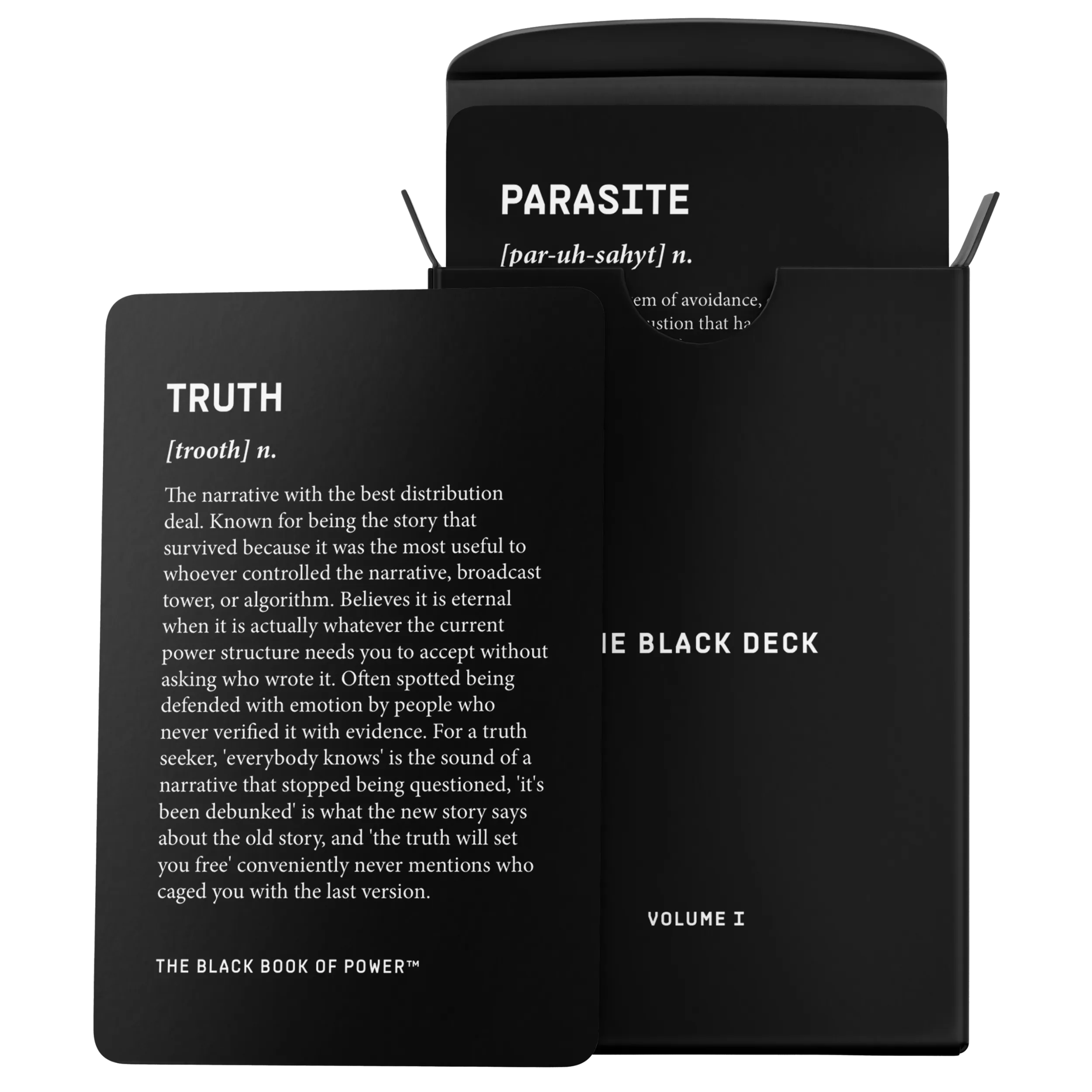
Reality gets edited to keep the image intact. "I never said that. You're too sensitive. Everyone agrees with me." The power move: authorship. Chapter 12, The Dream Weaver, is built on one principle: whoever controls the story controls reality. Gaslighting is narrative control at kitchen-table scale, and its endgame is installing their editor in your head, the voice I call the Parasite.
Feedback lands as attack. A remark about dishes costs you a weekend of rage or wounded silence. The power move: punishment conditioning, teaching you that honesty is expensive. It is also the crack in the wall. As I wrote in Chapter 20, The Lonely Dictator: "Narcissism is inefficient. Unsustainable. A power structure that consumes itself." A structure that cannot survive a comment is already failing.
Your limits are treated as opening offers. They show up unannounced, read what wasn't theirs, override your parenting, spend what you didn't agree to. The power move: clause testing. Every crossed line that goes unenforced is written into the contract as precedent, and they are meticulous record-keepers of your surrenders.
Nothing is ever their fault. Jobs are lost to politics, relationships to crazy exes, and their apology arrives as "I'm sorry you feel that way." The power move: villain casting. Chapter 10, The Enemy's Gift, shows how enemies supply identity, motivation, and cohesion. The narcissist keeps a rotating cast of villains for exactly that reason, and casting you is only ever one disagreement away.
The opening act is dazzling: attention, mirroring, soulmate talk. Then the warmth is withdrawn, the comparisons begin, and you start auditioning for a role you already had. The power move: intermittent reinforcement, the slot-machine schedule from Chapter 3 that builds stronger attachment than consistent kindness ever could. Chapter 18 names the dating version Flood, then Famine. Run long enough, the cycle hardens into trauma bonding, which is why the exit feels impossible right when it matters most.
| Trait | First sighting |
|---|---|
| Grandiosity | Stories that keep promoting them to hero |
| Need for admiration | Fishing, deflating, punishing unimpressed rooms |
| Lack of empathy | Your pain lands as an inconvenience |
| Entitlement | Expects what they never reciprocate |
| Exploitation | Favors that arrive just before the ask |
| Envy | "Must be nice," with an asterisk on your wins |
| Arrogance | Contempt for waiters, staff, and "ordinary" people |
| Manipulation and gaslighting | "I never said that. You're too sensitive." |
| Hypersensitivity to criticism | A weekend lost to one remark |
| Boundary-trampling | Your limits treated as suggestions |
| Blame-shifting | Apologies shaped like accusations |
| Charm-then-devalue | Dazzling start, slow demotion, sudden return |
Yes, and this distinction is where responsible identification lives. Everyone runs a few of these behaviors under stress; a bad month is never a personality. Clinical literature describes narcissistic personality disorder as a pervasive pattern holding across situations and years, and diagnosis belongs to professionals. Your job is different from a clinician's anyway: you are assessing behavior for your own protection, and a pattern that harms you justifies boundaries with or without a label. It also pays to know how narcissists differ from sociopaths, because the calm predator without the wounded ego is a different risk category.
Same twelve traits, two costumes. The overt narcissist wears them loud: open bragging, visible rage, demands for the spotlight. The covert version inverts the packaging: grandiosity becomes hidden-genius fantasy, the admiration hunger feeds on sympathy instead of applause, and the aggression goes passive. If the person you're assessing looks humble, wounded, and perpetually victimized while the damage keeps landing anyway, read the hidden covert type before deciding this list doesn't apply.
Naming the pattern is half the work, and the wrong half to stop at. The full defensive system, grey rock, enforceable boundaries, documentation, and the exit plan, is in how to deal with a narcissist; start there today.
For live identification, carry the field test from Chapter 2, Masters of Reality: "What am I being made to feel, and why now?" Induced guilt, induced awe, induced smallness: all of it is data about the inducer. And if you want to train the deeper skill, Chapter 4's protocol teaches emotional cartography, reading the pressure systems and fault lines of the people around you before they get to use yours.
Two more habits compound your safety. Share your observations with one outside person you trust, because isolation is where these traits do their best work. And set your limits in writing before the next incident, while your head is clear; decisions made under pressure default to their script, never yours.
Here is the uncomfortable summary. All twelve traits are surface symptoms of one underlying game: manufacturing a reality where they hold rank, and recruiting your emotions to fund it. That game has rules, and the rules can be learned by the defense.
Learning them is the entire project of Stan Taylor's The Black Book of Power: desire, bonding, language, presence, and the counter-moves for each. You can read the first chapter free, and the psychology basics library covers the individual mechanisms while you decide. Twelve traits took you this far. The machinery underneath them is worth the rest of the map.
The same map also works in reverse, and that is the part most readers don't expect. Once you can name the hunger under a behavior, you spot it in negotiations, marketing, politics, and the mirror. Pattern literacy is general; the narcissist was simply your first tutor.
This list is a tool for seeing, and tools for seeing get repurposed as weapons with depressing speed. A difficult person is not automatically a narcissist, and a painful relationship is not automatically abuse; hold the pattern to the twelve-trait standard. Then aim the lens at the mirror, because every hunger on this list lives in you at lower voltage, and knowing yours is the difference between reading this list and being read by it. In the book's final chapter I put the whole argument in five words: power is identity as choice. Choose one that doesn't need an audience.
FAQ
The four load-bearing traits are grandiosity, a constant need for admiration, entitlement, and lack of empathy. The rest of the twelve, exploitation, envy, arrogance, gaslighting, hypersensitivity to criticism, boundary-trampling, blame-shifting, and the charm-then-devalue cycle, are those four expressed under different conditions.
Lack of empathy is the one the others depend on. Exploitation, entitlement, and gaslighting all require not feeling what the behavior costs you. If you can only test for one trait, watch what happens to their attention when your pain is the topic.
Yes. These traits sit on a spectrum, and most people show a few under stress without the pervasive, years-long pattern that defines narcissistic personality disorder. The difference is consistency and cost: a pattern across settings and time, paid for by the people around them.
The DSM-5 criteria are: grandiose self-importance; fantasies of unlimited success, power, brilliance, beauty, or ideal love; belief in being special; need for excessive admiration; entitlement; exploitation of others; lack of empathy; envy of others or belief that others envy them; and arrogance. At least five must be present for a diagnosis, made by a professional.
Dependence. The whole structure runs on external validation, which makes them predictable, hypersensitive to criticism, and easy to starve: no reaction, no supply. Their need for you is the leverage; a person who cannot generate their own worth is at the mercy of whoever stops providing it.
Chapter 20, "The Lonely Dictator," maps narcissism as a power structure that consumes itself, and Chapter 7, "The Strings of the Heart," explains the hungers underneath every trait on this list. The Black Book of Power is available only at stantaylor.com.

The Black Book of Power


Conversational Narcissism: The Cannibal at the Table
Why you keep consuming the people in front of you to fill a hole dug in childhood.

A Lesson in Power Dynamics at Work
See how getting good at your job switches off the brain circuit that reads power.

The Fawn Response: An Education in Disappearing for Others
Why does being useful feels like the surest way to be loved?

The Know-It-All Personality: Why the 'Smartest' Person Builds Nothing
Why does the 'smartest' person in the room tend to build nothing?

Therapy Dependency: When Therapy Needs You to Stay Broken
In reading this, you will meet the one product the industry cannot afford to cure: the perpetual patient.

Threshold Addiction: The Dopamine of "Almost"
Why does planning feel better than doing?

Am I the Toxic One? An Honest Diagnostic
Close the wound or bleed to death believing your emotional hemorrhaging is holy.

How To Manipulate a Narcissist
Why does this person make me feel like I'm losing my mind?
The Covert Narcissist: How to Recognize the Hidden Predator
The covert narcissist is dangerous precisely because the disguise is weakness.

Self-Sabotage: Why You Do It and How to Kill the Pattern
You don't lack discipline. You're running a program that trades your future for a small, guaranteed hit of safety.

10 Signs of Manipulation (and the Counter for Each)
The ten tells a professional manipulator hopes you never learn, and the counter for each.
Dark Psychology: The Complete Guide (From Someone Who Used It)
What dark psychology actually is, from someone who ran the machinery for 23 years.

How to Deal With a Narcissist Without Losing Yourself
You cannot change a narcissist. You can become the person their tactics no longer work on.

The 9 Best Dark Psychology Books, Ranked by Someone Who Lived It
Nine dark psychology books ranked by someone who ran the plays for 23 years, and what each one will not tell you.

What Is a Dark Empath? Traits, Signs, and the Real Danger
The dark empath is dangerous precisely because empathy was supposed to be the safety feature.
The 12 Traits of a Narcissist and What They Reveal
Twelve traits, one mission: defending a self-image that must never be questioned.