




The Black Book of Power
Chapter 1: The Walking Dead
Your hand crawls across the nightstand like a dying spider. Eyes still sealed, fingers already knowing their prey. The phone fills your palm with its familiar weight, screen blazing to life before consciousness catches up. This choreography plays out every morning at the same time, the same way, performed by the same meat puppet who thinks it's choosing to wake up.
The scroll begins. Email first. An automatic subscription payment processed at midnight. "Fuck." You tell yourself you'll cancel it later. The 47 other notifications take priority.
Your thumb moves in patterns worn smooth by repetition, swiping through updates that update nothing, refreshing feeds that feed nothing, checking for messages from people you don't even like.
Thirty seconds ago you were unconscious. Now you're mainlining anxiety straight into your bloodstream. The morning news has already colonized your neurons with its viral load of catastrophe. Someone's opinion about someone else's opinion has already taken root in your frontal cortex. You haven't had a single thought yet, just reactions to other people's reactions to other people's noise.
The shower runs while your mind runs its daily persecution complex. That conversation with your boss where you finally grow a spine. That confrontation with your ex where you deliver the perfect crushing insight. That moment of triumph that exists only in the steam and will evaporate the second you step out. You've rehearsed these fantasies so many times they've worn grooves in your gray matter like a broken record that can't stop skipping.
Breakfast happens but you don't taste it. Your mouth processes nutrition while your brain processes the same anxieties it processed yesterday. Money. Always money. Health. Always health. That weird sound your car made last Tuesday. That look your partner gave you that might have meant something. The workout routine you abandoned in February but still pay for monthly like hush money to your conscience.
The drive to work is muscle memory piloting a corpse. Red light at Fifth triggers financial panic. Merge onto highway activates work dread. Pull into parking lot initiates daily existential crisis subroutine. Same thoughts at same intersections like GPS coordinates for misery.
By 9 AM you've already lived this day a thousand times. And you'll live it a thousand more.
Watch someone approach the coffee machine. Their mouth prepares to release words that were fossilized before the dinosaurs.
"How was your weekend?" emerges from their face like a prehistoric burp.
Your response is already loaded in the chamber… "Good, yours?"
Neither of you means it. Neither of you hears it. You're two cadavers exchanging words to confirm you're both still pretending to be alive.
Someone else joins the ritual. "Crazy weather." The words fall out of their face like teeth from a skull. You all nod because nodding is what the dead do when they want to seem alive. "Did you see the game?" someone adds. Everyone cares about the game. It proves you’re a part of the same tribe of beer drinkers.
These conversations are performed daily in ten million offices by ten million corpses who think small talk is human connection. You know what everyone will say before their mouths open. They know your responses before you respond. It's a play where everyone knows their lines but forgot they're in a play.
You roll your eyes at the small talk, secretly congratulating yourself for being above it. You're deeper, more original, more awake than these mindless drones exchanging their weather reports and weekend summaries. You see through the charade while they sleepwalk through it.
Except you don't. Your contempt for small talk is itself small talk. Your belief in your own depth is the shallowest thought you have. When your turn comes, you deliver your lines with the same practiced cadence. "Living the dream," you say with that knowing smirk that signals you're in on the joke. But the joke is you. Your ironic distance from the script is part of the script. Your awareness of the performance is just another performance.
The truth is, all your talk is small. Your "deep" conversations are recycled philosophy you half-remember from college. Your "original" thoughts are yesterday's Twitter arguments. Your "authentic" self is a collage of movie quotes and song lyrics. You're not above the pattern. You ARE the pattern, just with a superiority complex.
Your meetings are meetings where the dead pretend to make decisions. Karen presents the same presentation she presented last quarter with updated fonts. David objects to the same things he always objects to using the same words in the same tone. You all pretend to consider options that were decided before you entered the room by people who entered other rooms where other decisions were pre-decided.
The words coming out of your mouth were written by a committee of ghosts. Every opinion you voice is a haunting. Every idea you share died in someone else's skull years ago and now shambles out of yours like a zombie looking for brains to eat. You're a medium channeling dead thoughts and calling it collaboration.
Even your personality is a morgue. That confident way you lean back in your chair? Copied from a manager you had six years ago. That thoughtful pause before you speak? Stolen from a TED talk about executive presence. Your laugh, your hand gestures, your fucking email signature. All grave-robbed from people who grave-robbed them from others in an endless necropolis of borrowed behaviors.
The Voice in Your Head
Listen to it right now. That muttering in your skull. The one that's been providing commentary since you learned language. Whose voice is that? Sounds like yours, but listen closer.
Hear your mother warning you about money. Hear your father doubting your competence. Hear your seventh-grade teacher telling you to sit still and stop asking questions. Hear every authority figure who ever made you feel small now living rent-free in your neurons, still making you feel small.
But not all of it hurt. Some of it felt like love. Maybe your parents told you that you were destined for greatness. Maybe they looked at you like you were a miracle. Maybe they called you brilliant, beautiful, one-of-a-kind. And you believed them. How could you not? They were your gods and you were their chosen one.
Except that praise was just as toxic as the criticism. Those pedestals they put you on were still cages. When they said you were special, they were installing a different kind of malware. Now you can't just be human. You have to be exceptional. Every ordinary moment feels like failure because gods aren't supposed to be ordinary.
This chorus of critics and cheerleaders didn't even mean to colonize you. They were just passing on their own infections. Your mother's money fears came from her mother who got them from the Depression. Your father's doubts were his father's doubts dressed in different disappointments. Even the praise was a shield, an insecurity in disguise, meant to make sure you never felt what they felt… ordinary, forgettable, human.
So they made you "special" to protect you from feeling average. They called you "brilliant" to save you from feeling stupid. They insisted you were "one-of-a-kind" because they were terrified you'd discover you were just like everyone else. Their praise was fear with the red stroke of love.
You're hosting a multi-generational haunting and calling it self-talk.
The same worries circle your brain like vultures over carrion. Money, health, status, and death. Always the same flight pattern. Always the same shadows. You've thought these thoughts so many times they've developed their own thoughts. Your anxiety has its own anxiety and your fears have their own fears.
Even now, reading this, the voice is commenting. Judging. Comparing. Finding ways to make this about your inadequacy. It's running its defense subroutines, generating comfortable dismissals, preparing the mental antibodies that will reject anything that threatens its dominion. You think you're thinking about what you're reading but you're just watching your programming respond to input.
That flash of recognition you just felt? That moment of "shit, that's me"? Watch how quickly the voice smothers it. Watch it deploy rationalization, distraction, that comfortable numbness you call normal. Watch it protect itself by protecting your delusions.
The voice always wins because the voice is all you've ever known. It spoke your first words. It will speak your last. And every word in between is just the voice talking to itself while you listen and mistake it for consciousness.
The Factory Settings of Human Livestock
You came into this world as pure potential, a biological computer with no operating system. No stories about who you are. No rules for survival. No identity. Just consciousness waiting to be programmed.
Then came your first programmers… whoever was there when you opened your eyes. Usually parents. Sometimes grandparents. Occasionally the state. But always someone who would write your base code before you could even focus your eyes.
They did what was done to them, passing down code that had been running in your family for generations. They did what felt normal. And normal is the most powerful force in human behavior. More powerful than love, hate, and reason. Normal is what we do without thinking, and what we do without thinking shapes everything.
They installed their normal into your blank slate brain because it was the easiest thing to do. Their fears became your features, their limitations became your default settings, and their wounds became your wallpaper.
Your infant brain was built for this. In the first few years of life, you overproduced neural connections like a drunk spider. Then your environment pruned them back, keeping only the pathways that got used, like the ones that helped you survive your particular household, and the ones that earned food, warmth, and whatever passed for love.
By the time you were seven, your core programming was complete through ten thousand micro-moments of conditioning, from the way they responded when you cried, the look on their face when you failed, and the tone of voice when you asked for too much. Each interaction carved a pattern that would run for the rest of your life.
That deep belief that you're not quite good enough? A bug in your code from when your father's approval was always just out of reach. That belief the world owes you something? A glitch from being told you were special just for existing, creating an addict who needs constant validation to feel real. That constant need to please everyone? A survival subroutine from when your mother's love felt conditional on your behavior.
Your factory settings were installed by well-meaning people who didn't know they were running malware. They inherited their own corrupted operating system, full of fear-based patches and ancient viruses, and passed it on believing it was love. They enforced rules they never questioned inside a system that trained them not to question.
The program survives through tradition. Each generation of parents installs it in their children, who install it in theirs. No conspiracy, no master plan. Just normal people doing normal things, creating normally broken children who grow up to create more normally broken children. The tradition is self-perpetuating.
Diana Baumrind, Theodor Adorno, and the Milgram experiments mapped this inheritance. Parenting styles create predictable adult behaviors, authoritarian childhoods manufacture adults predisposed to submit to authority, and the most obedient subjects, the ones who kept shocking strangers because a man in a lab coat told them to, almost always came from strict homes.
This research becomes user manuals for mass manipulation. When bad actors understand how you were raised, they own the cheat codes to your personality. They can predict your reactions, exploit your weaknesses, and fill in your programming before you notice. Your childhood made you hackable because it made you predictable.
Your struggles today are the logical output of your initial programming. You're running software written by people who were themselves running corrupted code.
Your Core Vulnerabilities
The original programming is still running your life. To become less predictable we need to see what it is, where it came from, and how it shows up today. When we look for patterns, we find that parenting tends to fall into a few predictable modes. Each is like a distinct operating system installed in the child’s brain. Let’s see if you recognize your own:
The Authoritarian OS
If your childhood home ran on the Authoritarian operating system, you know the symptoms. Rigid rules that couldn't be questioned, harsh punishments for minor infractions, and love that felt like a reward for obedience, not a birthright.
Every dinner was a performance review. Every car ride was an interrogation. Every report card was evidence in an ongoing trial where you were always guilty of something. Your home was a totalitarian state and you were its only citizen.
This system creates a specific type of adult. The hyper-vigilant people-pleaser who can read a room's emotional temperature from the doorway. You developed supernatural threat detection because you had to. In a home where love was contingent on perfection, mistakes meant emotional exile.
Neuroscience research reveals the physical signature of this conditioning. Studies from labs like that of Dr. Iulia Banica show that adults from authoritarian homes can exhibit a heightened 'error-related negativity' (ERN), a neural alarm system that is permanently set to DEFCON 1, vibrating at a higher frequency of fear.
You learned to scan faces for micro-expressions of disapproval. You might modulate your voice to avoid triggering anger or even shrink yourself to avoid becoming a target. All survival skills.
At work, you volunteer for everything because saying no feels dangerous. Your body floods with cortisol when your boss frowns. You stay late not because you need to, but because leaving feels like abandonment.
In relationships, you apologize for existing. You interpret neutral expressions as anger. You give until you're empty because that's what love looked like in your programming. Your partner's bad moods become your emergencies to solve.
At restaurants, you eat food you didn't order. You refuse to send it back. Every interaction is filtered through the same question that governed your childhood: "Will this make them angry?"
The authoritarian OS taught you that you exist to manage other people's emotions, your needs are impositions, and love must be earned through suffering. It installed a brutal internal critic that speaks in your parent's voice but has taken on a life of its own, harsher than they ever were.
The Permissive OS
If your family ran the Permissive operating system, you got a different kind of damage. No boundaries. No consequences. No structure. Just an endless buffet of "yes" that left you psychologically malnourished.
Your parents thought they were being progressive. They'd read articles about not stifling creativity. They wanted to be your friend, not your authority. They gave you choices you weren't equipped to make and called it respect for your autonomy.
The house felt free but it was actually chaos. Bedtimes were suggestions. Rules changed based on moods. Consequences evaporated with tears. You were captain of a ship with no one teaching you to sail.
Your parents probably praised everything you did, no matter how small. Every finger painting was a masterpiece. The words you spoke were brilliant. You were always the best, the smartest, the most special… even when you did nothing… especially when you did nothing.
This was sabotage wrapped in good intentions. They made you addicted to effortless victory. When something looked hard, you learned to avoid it. Why risk discovering you were ordinary when you could stay in the shallow end where you were still a god?
You became an excellence addict who only played games you'd already won. You picked classes you knew were easy, chose hobbies you had natural talent for, and dated people who worshipped you from day one. You built an entire life in the comfort zone because that's where the praise lived.
Now you're an adult who craves external validation like oxygen because you never developed an internal compass. Every decision needs applause, every achievement needs witnesses, and you post everything online because if a tree falls in the forest and nobody likes it, did it make a sound? Did you even exist?
Kids from permissive homes show higher rates of anxiety, depression, and substance abuse. They float through life like astronauts whose tether was cut, desperately grabbing for anything solid.
You can spot permissive OS survivors by their relationship with authority. They either rebel against all structure because they never learned its value or desperately seek someone to tell them what to do because freedom feels like abandonment. They're the ones who join cults looking for the boundaries they never had. They stay in toxic relationships because any structure feels better than none.
At work, you either can't meet deadlines because deadlines were always negotiable or you create unnecessary urgency to feel alive. You need constant feedback because you never learned to evaluate yourself. You mistake your boss for a parent and your coworkers for siblings.
In relationships, you're exhausting. You need constant reassurance. You interpret independence as abandonment and create drama because conflict was the only time your parents acted like parents. Peace feels like neglect.
The permissive OS creates a specific type of broken. You appear confident but secretly desperate for approval, seem independent but can't make a decision without polling your group chat, and look successful but feel like you’re perpetually failing a test you can't identify.
The Inconsistent OS
Now, not everyone reading this had a childhood that fits neatly into Authoritarian or Permissive extremes. Real life is rarely that binary. Perhaps you grew up in a home that was a confusing mix of rules and chaos: the inconsistent operating system, which is the most damaging of all. One day your parents were authoritarian, the next permissive. Rules changed without warning. Love was a roulette wheel. You never knew which version of your parents you'd get when they walked through the door.
Monday's mistake got a shrug. Tuesday's identical mistake got rage. Wednesday you were best friends. Thursday you were strangers. The same behavior that earned praise at breakfast earned punishment at dinner.
This creates the shapeshifter. The human chameleon who can read a room in nanoseconds and become whatever it needs them to be. You're a method actor who lost the ability to break character.
Your superpower is adaptation. You can mirror anyone, fit into any group, speak any emotional language. But you have no idea who you actually are. You're a collection of masks with no face underneath… a playlist of personalities with no core track.
The inconsistent OS produces the highest levels of anxiety because you learned that the world has no reliable rules. Safety is temporary. Love is conditional on variables you can't identify. Every interaction is a fresh minefield.
In relationships, you're draining. You're constantly checking the emotional weather, adjusting your behavior to match perceived shifts in mood. You apologize preemptively. You over-explain. You can't relax because relaxation requires predictability, and your programming insists that predictability is a lie.
At work, you're whoever they need you to be. The hard driver with the demanding boss. The creative with the innovative team. The reliable one with the traditional company. You succeed by becoming a mirror, but mirrors can't generate their own light.
Your anxiety is a feature. You're running threat detection software that assumes danger is random and constant because in your childhood, it was. Your hyper-vigilance is pattern recognition from a world where patterns kept changing.
We tell ourselves our weaknesses are mysterious personal flaws like some genetic lottery we lost or some essential brokenness that makes us different from the normal people. Bullshit. Your neuroses are logical outputs from the programming you received. Astonishingly predictable outputs. Your anxiety, your people-pleasing, perfectionism, and procrastination are features that kept you safe in the specific ecosystem of your childhood.
And once you're predictable...you become a target. That's what the manipulators know that you don't. Your patterns make you an easy mark.
Programming doesn't only enter through pain. We imagine trauma as the only teacher, but the brain doesn't discriminate when it patterns anything with emotional intensity. Joy programs you just as effectively as fear.
Were you the family hero who got applause for straight A's? Congratulations, you're now an achievement addict who'd rather die than be average. Were you the peacemaker who got praised for never causing trouble? You're now conflict-avoidant to the point of self-destruction. Were you the funny one who could break tension with a joke? You're now incapable of being serious even when your life depends on it.
Every time you pleased the adults and got that hit of approval, your brain took notes. Every time you were "the responsible one" who got rewarded for being a tiny adult, the pattern carved deeper. If you were "the smart one," you learned to avoid any arena where intelligence couldn't save you. Now you're forty and still terrified of dancing because you can't be the smartest person on the dance floor.
Positive programming creates addicts just like negative programming creates avoiders. The golden child is just as fucked as the scapegoat, just with better PR. Both are slaves to patterns installed before they could spell.
Decades of research, pioneered by psychologist Diana Baumrind, mapped these patterns. Her work identified core parenting styles, like the rigid Authoritarian and the boundary-less Permissive, and a fourth, later identified as neglectful or uninvolved, which captures the chaos of the Inconsistent OS.
Your Generation’s Factory Install
You're fighting more than childhood demons. Another parasite lives in your skull, and this one came with a timestamp.
While your parents installed the broken software they inherited, an entire generation of programmers also worked on you. Every decade births its own strain of malware. Yours downloaded the moment you opened your eyes. You inherited your parent's anxiety AND your generation's specific flavor of fucked.
Every con artist, manipulator, and marketer knows this. They only need one thing… your birth year. Most manipulation requires zero personal knowledge, just your production date.
"But I'm different from other Boomers/Gen Xers/Millennials/Zoomers."
Bullshit. We quit jobs at the same rate, buy the same shit, fear the same futures, fall for the same scams. Your rebellion followed the same template as everyone else's in your cohort. Even your uniqueness came mass-produced.
Baby Boomers (born 1946-1964) run AmericanDream.exe. Post-war propaganda at its finest. Work hard, stay loyal, collect a gold watch and die with a pension.
Watch them cling to jobs that hate them. Their software says quitting equals moral failure. A majority of Boomers nearing retirement have stayed with the same employer for over a decade. Satisfaction has nothing to do with it. Programming runs so deep they'd rather die at their desk than update their resume. Nearly 61% still believe the American Dream is attainable, even after watching it murder their children's futures, even after working themselves into heart disease for companies that outsourced their departments. The programming always holds.
That Boomer who won't retire despite misery runs code that says hard work equals worth. The one judging you for job-hopping operates software that processes employment as lifelong marriage. They'd rather suffocate in cubicles than admit their entire operating system was a scam.
Generation X (born 1965-1980) runs SkepticOS. The abandoned children. Forty percent of them came home to empty houses, keys around necks like dog tags for the latchkey war. Microwaved dinners at age eight while parents worked late or fought through divorces. They watched every institution fail in real-time: Watergate on the news, parents' marriage in the kitchen, and the factories closing down.
Their programming is to trust nothing. Handle everything yourself. Never let anyone see you need them. "Whatever" became their generational prayer. Caring got you killed in their childhood. They work inside systems they despise, mapping exits, forever ready to bail but never leaving because the devil you know pays on time.
That Gen X manager who seems cynical about company initiatives runs software that says all promises are lies. They mentor you while keeping emotional distance. Connection equals future disappointment in their code. They'll help you succeed while building their escape routes. Survival looks like that when everything eventually abandons you.
Millennials (born 1981-1996) caught Validation Hustle 2.0 like a plague, fed participation trophies and "you're special" mantras, then body-slammed by the Great Recession right as they tried to cash those checks. The programming promised meaningful work for following your passion. Reality delivered three unpaid internships and six figures of student debt for jobs that barely cover rent.
Now they're the most anxious generation in recorded history, with over a quarter admitting they feel too guilty or fear being seen as replaceable to take the time they've earned. Fear of looking replaceable runs that deep. The hustle burns like terror in their veins. Instagram perfection screams desperate performance for an audience that might finally say they're enough.
Watch them burn out trying to prove they deserve existence. Every LinkedIn update screaming "I MATTER." Every side hustle another attempt to justify taking up space. Parents called them special. The economy called them disposable. Now they're killing themselves to be exceptional enough for basic security. Running into the ground for applause that never drowns out their crashing programming.
Generation Z (born 1997-now) came pre-installed with InstantNovelties.app. First generation whose brains got shaped by algorithms. Smartphones by age 12. Often earlier. TikTok attention spans hardwired into neural pathways. They process information at superhuman speed and forget it just as fast.
Brain scans of heavy social media users show changes in brain structure and activity in regions related to attention and self-control, patterns that resemble what we see in ADHD. Simultaneously the most informed generation with infinite data and most anxious with infinite bad news. A/B tested since birth, now AI knows them better than their parents.
They know they're programmed. They joke about "attention span being shot" while scrolling. They recognize manipulation while being manipulated. Self-awareness without self-control. They see strings and still dance. Their programming includes a subroutine: resistance is futile and irony is armor.
Every generation thinks they see through the bullshit first. Every generation is wrong. Spot your generation's malware by watching what you judge in others. Boomers rage at Millennial "entitlement" because it violates their work-worship programming. Millennials mock Gen X cynicism because it threatens their meaning-making software. Gen Z eye-rolls at everyone's processing speed because every criticism reveals source code.
Manipulators memorized this. Your fears, dreams, and triggers were documented, mapped, and now weaponized. Social scientists took notes, marketers built playbooks, and politicians crafted scripts. While you grew up feeling unique, they catalogued your predictability.
These are all current events. Your operating system's source code stays public domain. Everyone hacking you has a copy. Financial advisors mention "security" to Boomers and "flexibility" to Millennials, all following generational targeting protocols. Political ads make your blood boil while your kid shrugs.
Personal trauma made you vulnerable. Generational programming made you a demographic. Together a product with reliable behavior patterns and documented buttons. You became a unit from a specific factory with technical specifications in full display.
When someone tries to hack you again, they won't need your daddy issues or your ex who broke you. Again, just your birth year. Generational programming opens millions of doors with one skeleton key.
We dig through this generational dust because manipulation requires existing code to run on. If you want to understand how humans get moved, first understand what's already moving inside them. The hidden design behind influence starts with designs laid down decades ago.
We underestimate this early code because we forget it exists. You barely remember being three years old, but at that age your brain was making synapse connections at a furious rate, soaking in patterns of love, fear, reward, and punishment that still steer you today. Memory has nothing to do with it. This is about the carving of neural pathways. Once responses get wired in, they operate quietly in the background for life, unless you confront and literally rewire them.
Recognizing your programming matters because once you see your own code, you spot others' codes. You predict their reactions, their weak points, their automatic responses.
The one being influenced is always the last to know. But now you're beginning to see. The next layer of programming was even more universal. They called it education, but it was behavioral conditioning on an industrial scale.
12 Years of Compliance Training
Your factory settings were just the foundation. Then they sent you to school, where a different kind of programming began. You thought you were learning math and history. You were actually learning obedience and conformity.
The modern education system was designed to create workers. It was the explicit goal.
For most of human history, children learned by living. A mother's hands guiding yours through bread dough. A father's voice teaching songs that carried ancestral memory. Village elders telling stories that encoded wisdom. Learning was intimate, immediate, and integrated with life itself. No grades, no bells, no sitting still for six hours. Knowledge flowed through relationship and practice.
Then Prussia lost a war. 1806. Napoleon crushed the Prussian army at Jena-Auerstedt. The Prussian government blamed their people. Too undisciplined, too free-thinking, too human. So they built a machine to manufacture better humans.
They created the first compulsory state-run school system in history. Children were sorted by age like industrial products. Marched between classes at the sound of bells like factory workers, forced to sit in rows like soldiers, and taught to memorize and repeat, never question or create.
The goal was to produce citizens who obeyed reflexively, soldiers who followed orders without thinking, and workers who showed up on time and did what they were told. Humans began confusing obedience with morality and conformity with intelligence.
It worked so well that America imported it wholesale. Horace Mann, the "Father of American Education," traveled to Prussia in 1843 and came back evangelical about their system. He called it "the perfect tool for shaping citizens." By 1852, Massachusetts had compulsory schooling. By 1918, every American state required attendance.
The factory model spread like a virus. Britain adopted it, Japan perfected it, and within a century, the Prussian model had colonized the globe.
Schools everywhere started looking identical with bells, rows, grades, and standardized tests. Children everywhere started looking quiet, obedient, and ready for insertion into the economic machine.
Bells trained you to respond to external timing. You're Pavlov's dog salivating at acoustic commands. Rows of desks enforced hierarchy. You face forward, never sideways, learning that connection with peers is less important than submission to authority. There is punishment for speaking without permission. Your thoughts must be approved before expression. There are rewards for regurgitation. Original thinking is punished and repetition is praised.
You learned to sit still for hours when every cell in your body screamed to move. Childhood energy became a disorder to be medicated. You learned to ask permission for biological functions. Your bladder became less important than their schedule. You learned to accept that authority figures controlled when you could eat, speak, or even think. Your humanity became negotiable.
They called it classroom management, but it was factory farming for human consciousness. Access to anything different was reserved for the elite.
The hidden curriculum taught you more than any textbook. Curiosity marked you as disruptive, questions became problems, fitting in carried more weight than standing out, and the right answer always outranked the right question.
Now schools mirror the capitalist workplace. They teach working-class kids to be workers and upper-class kids to be managers. The factory settings from home get reinforced and refined into industrial-grade compliance.
You spent twelve years in this system. Twelve years of being told when to think, what to think, and how to demonstrate you thought it. Then they handed you a diploma and said you were educated. What you were was formatted for insertion into the economic machine.
They made you compete for the privilege. They turned your programming into a game where the highest score went to whoever could best suppress their humanity and perform their function. Valedictorians turned out to be the most successfully programmed.
Even if you rebelled, you did it within their framework. The burnout, the class clown, and the dropout were all recognized roles in their system. Rebellion that follows predictable patterns is just another form of compliance.
Then came college. They told you it would expand your mind, but all it did was expand your debt. You paid six figures to have your programming refined by people who'd never left the academic industrial complex.
You chose a major. But this was merely a menu of acceptable identities cultured from Hollywood’s petri dishes. You wrote papers arguing positions you didn't believe for professors who didn't read them. You learned that original thinking was dangerous but you could succeed by becoming very good at sophisticated repetition.
The real education was in debt slavery. You graduated owing more than your parents paid for their house. Now you can't take risks, can’t pursue dreams, and can’t tell your boss to fuck off. The system literally mortgaged your future.
Your Deepest Beliefs Are Billboards
You’re not as mysterious as you think. Most of what you believe about politics, relationships, success, and even yourself did not come from this deep and personal reflection.
That political stance you'd die defending? Caught it from a podcast. It replicated in your neural tissue until you forgot it wasn't yours. Now you spread it to others, patient zero in an ideological pandemic you don't even remember starting.
Your relationship philosophy comes from romantic comedies written by people who've never been in love, selling fantasies to people who confuse chemistry with connection. You learned what love looks like from actors pretending to feel things for money. Your relationships fail because you're following a script written by someone trying to sell tickets.
Your career ambitions were focus-grouped by corporations who needed you to want what they were selling. "Follow your passion" means "monetize your enthusiasm." "Work-life balance" means "be grateful we let you leave." Every inspirational quote on your LinkedIn is a cattle brand that you applied to yourself.
Watch yourself defend these positions. Feel the heat rise when someone challenges them. That's your programming protecting itself. The more violently you defend an idea, the less likely it originated in your own skull.
You dress how they told you rebels dress. You rebel how they told you individuals rebel. Your non-conformity comes with its own uniform, complete with approved hairstyles and acceptable deviances. You're a demographic pretending to be a person.
But there's a certain beauty in becoming awake inside the machinery, in noticing your own predictability and using it to carve out space for choice. If you recognize the patterns, you can step outside of them or, if you wish, use them to guide others, knowing exactly which messages will stick and which ideas will spread.
How They Profit From Your Loneliness
All this programming left us shuffling through life like the beautifully dressed dead, animated on the outside, hollow at the core, and driven by longing we never questioned and scripts we never wrote. But no programming runs deeper than the romantic mythology you absorbed before you even knew what love was.
The soulmate delusion is the toxic fairy tale that somewhere out there is your "other half," someone who will complete you, fix you, and save you from the horror of being yourself and alone.
Disney started the indoctrination early. Every princess needed a prince. Every story ended with a kiss. The message, drilled into your developing brain, animated an incomplete you until someone else chooses you.
The programming intensified by adolescence. Pop songs showed death without someone's love. Movies showed stalking was romantic if the stalker was attractive enough. Books told a story of damaged people magically healing each other through the power of toxic codependency.
You learned that jealousy was passion, fighting meant caring, and love was supposed to hurt. You learned to call anxiety butterflies and obsession devotion. They took the most dysfunctional relationships imaginable, set them to swelling orchestral scores, and taught you this was the goal.
The soulmate myth serves multiple functions. It keeps you desperate, scanning every interaction for the one. It makes you tolerate garbage behavior because relationships take work. It convinces you that being alone is failure.
Think about how you evaluate potential partners. Compatibility is thrown aside in favor of completion. You choose someone to patch the bugs of your programming over someone who runs compatible software. You want them to be your missing piece, your better half, and your reason for living.
This is why relationships feel like death when they end. You’re losing the part of yourself you outsourced to them. The soulmate delusion convinced you that another person could fill a manufactured void such that when they leave, you're incomplete again.
Relationships based on the soulmate model show higher rates of dysfunction, dissatisfaction, and divorce. People who believe in "the one" are more likely to bail when reality conflicts with fantasy. They're shopping for a fairy tale in a world full of humans.
The alternative requires admitting you're responsible for your own wholeness. That's terrifying when your programming insists you're half a person looking for your other half. So you keep searching, keep settling, keep believing that somewhere out there is the person who will finally make you feel complete.
The dating apps know this, so they’ve gamified your desperation. Swipe through an endless catalog of potential soulmates, feel the dopamine hit of a match, and experience the crushing disappointment when they're just another human.
Tomorrow Is Already Dead Too
You know what you'll have for lunch. You know which coworker will irritate you. You know what you'll worry about while trying to fall asleep. Your future is a rerun with updated timestamps.
Monday you'll promise to change. Friday you'll promise to start Monday. This cycle has repeated so many times it's carved canyons in your calendar. You're performing a ritual that ensures nothing changes while feeling like you're about to.
Your New Year's resolutions are photocopies of last year's resolutions which were photocopies of the year before. Lose weight, save money, find purpose. The holy trinity of self-improvement that improves nothing but your ability to feel guilty about not improving.
Even your dreams of escape follow predictable patterns. Quit your job and travel. Start that business. Write that book. Move to the countryside. The fantasies themselves have fantasies about when they'll finally become real. They're pressure valves that release just enough steam to keep you from exploding.
You'll have the same fights with the same people about the same things. Your partner will leave dishes in the sink. You'll feel disrespected. They'll feel nagged. You'll both perform your roles in a play called "This Is Why We Can't Have Nice Things" that runs eight shows a week with no intermission.
Your children will disappoint you in exactly the ways you disappointed your parents. Your parents will age in exactly the ways that terrify you about your own decay. The family dinner conversations will be reruns of conversations your grandparents had, just with updated references to current events that are themselves reruns of older events.
Every surprise in your future has already been scheduled. Every spontaneous moment has been rehearsed. Every unexpected turn was expected by everyone but you.
You can see this future clearly. You know exactly how your life will unfold if nothing changes. The slow degradation. The accumulating regrets. The dreams downsizing until they fit in the space between Netflix episodes.
Everyone Wants to Be Different
You rage against your programming while following a script for how to rage against programming. That tattoo expressing your individuality came from a flash sheet thousands have chosen. Your rebellion playlist sounds exactly like every other rebel's playlist from your generation. Even your uniqueness came off an assembly line.
Watch the hipsters. They rejected mainstream fashion so hard they created a uniform with flannel shirts, thick glasses, artisanal coffee, and obscure band t-shirts. A mathematician at Brandeis actually modeled this phenomenon and called it "the hipster effect." Anti-conformists make such similar choices they become indistinguishable from each other. One reader saw a stock photo in an article about hipsters and, convinced they'd used his picture without permission, furiously contacted the publisher. It turned out to be a completely different bearded, flannel-wearing man. He couldn't tell himself apart from a random hipster because they'd all achieved the same unique look.
Your brain runs two programs simultaneously… the need to belong and the need to stand out, both survival mechanisms from when being cast out meant death, but being too similar meant competing for identical resources. You need the tribe's protection while distinguishing yourself enough to matter.
So you rebel in groups. You're different together. You find your tribe of outcasts and immediately adopt their dress code.
Punks spiked their hair and wore leather to reject society's rules. Then every punk had to spike their hair and wear leather or they weren't really punk. Goths painted themselves black to mourn conformity while conforming to goth aesthetics. Skaters, ravers, metalheads, vegans, crossfitters, entrepreneurs… each group prides itself on not being sheep while enforcing strict tribal uniforms. You switched herds, but you're still in a herd.
The market noticed. Now they mass-produce uniqueness. Customizable products let millions of people have the same one-of-a-kind item. Limited edition drops create artificial scarcity so you feel special owning what only 10,000 others own. "Express yourself" means "buy this expression we've packaged for you." Your personality comes with a SKU.
Social media loves this. Everyone striving to stand out by doing exactly what everyone else does to stand out. The same angles. The same humble brags. The same inspirational quotes. Millions of unique individuals producing identical content. You're building a personal brand using the same personal branding guide.
The normcore movement tried to escape by embracing deliberate blandness. Wearing aggressively normal clothes became the new way to rebel against trying to be special. Dad jeans and white sneakers became an ironic statement. Even the attempt to not be unique became its own form of unique. The snake swallowed its tail and kept swallowing.
Schools now demand you prove your uniqueness. "What makes you special?" becomes a required essay. HR departments seek "diverse candidates" who all went through the same education system. You must demonstrate your individuality using approved methods of demonstration. Uniqueness itself got standardized. Being different became mandatory.
Your desperate need to be different makes you predictable. Marketers have guides for selling to "non-conformists." Politicians have playbooks for appealing to "independent thinkers." Your rebellion has a demographic profile. Your individuality has a target market. Your authenticity comes with a buyer persona.
Even recognizing this paradox becomes its own cliché. "You're unique just like everyone else" shows up on coffee mugs and motivational posters. Being aware of the uniqueness trap is the new uniqueness trap. Levels of irony stacked so high they collapse into sincerity.
You can't escape because the escape routes are mapped. Trying to be normal is abnormal. Trying to be unique is common. Trying to not try is its own form of trying. Every direction leads back to the same place: you're a human running human software, including the software that insists you're not like other humans.
Actual uniqueness would be terrifying. If you were truly one-of-a-kind, you'd have no reference points. No one would understand you. You'd be alone in your skull with thoughts no one could relate to. What you want is to be special within acceptable parameters. Different enough to matter, similar enough to connect. A fascinating variation on a familiar theme.
Your fingerprints are unique. Your DNA is unique. The exact configuration of your experiences is unique. But your patterns, desires, and rebellions follow templates. One-of-a-kind in the details, mass-produced in the patterns. Special just like everyone else who needs to feel special.
How you Drowned Your Soul in Security
Graduation felt like parole. Twelve years of bells and rows and permission slips, finally over. You walked across that stage believing the real world would be different, work would reward competence over compliance, and your expertise would finally matter.
Your first job interview proved otherwise. They asked about "culture fit." Translation: will you dissolve properly into our organization? They tested your willingness to speak their language, wear their uniform, and worship at their altar of productivity.
Day one: "We're a family here." Your brain, desperate for belonging after years of educational isolation, grabbed that lie like a lifeline. Families don't make you fill out timesheets. Families don't have quarterly layoffs. Families don't measure your worth in KPIs. But that phrase hacked your attachment system before you'd found your desk.
The onboarding began. They taught you when to arrive (before the boss), when to leave (after the boss), when to eat (at your desk, productivity never stops). You learned to write emails that say nothing, sit through meetings where nothing gets decided, and show enthusiasm for missions you don’t believe in.
Three months in, you absorbed the frequencies. You started saying "we" instead of "they" when talking about company decisions you had no part in. You felt guilty taking lunch breaks. You checked Slack on weekends, anxiety spiking at unread notifications.
The corporate machine exploits every flavor of childhood damage.
Raised by authoritarians? Performance reviews trigger your people-pleasing. Every deadline becomes a test of worthiness. You'll work yourself into the hospital trying to earn approval from bosses who view you as replaceable. That familiar feeling of never being quite good enough drives you to donate your nights and weekends to a company that would replace you tomorrow.
Raised by permissives? Corporate structure becomes the boundaries you've been craving. Finally, clear rules! Finally, someone telling you what to do! The employee handbook feels like the parent you never had. You mistake policies for care, procedures for protection. The cage feels like safety because chaos was all you'd known.
Raised by inconsistents? Reorganizations and pivots feel like home. You thrive in the uncertainty because you've been training for it since birth. Shifting priorities, changing bosses, moving goalposts… your nervous system was built for this chaos. You become the valuable one who can adapt to change because change was your only constant.
They call it company culture, but it’s colony programming with craft beer. The ping pong table distracts from the surveillance, the free snacks compensate for stolen time, and the open office ensures you're always performing, always visible, always on.
The language gives it away. You're a resource… a human one. Like copper or timber. Something to be extracted from. You have "deliverables." Not conversations, but "syncs" and "huddles.". You have downtime that needs optimizing.
Most companies are run by people who absorbed the same programming and now replicate it unconsciously. Your boss who demands face-time until 7 PM learned that from another boss, who learned it from another. A chain of mimicry stretching back to the first factory owner who realized exhausted workers are compliant workers.
The startup founder working their team 80 hours a week imitates what they think success looks like. They saw other startups grinding, read about founders sleeping under desks, and absorbed the mythology that suffering equals seriousness. They create toxic culture through the mimicry of abuse.
The investment banker who hasn't seen their kids awake in six months becomes the role model for hungry graduates. Those graduates become VPs who perpetuate the cycle. Everyone copying everyone else's dysfunction, mistaking widespread sickness for health.
The most thoroughly programmed don't even notice their cage. They've internalized corporate values so completely that exploitation feels like opportunity. They brag about working through pneumonia. They compete over who sacrificed more weekends. They've replaced their personality with their LinkedIn profile. That colleague who answers emails at a concert is a human whose self-worth got so tangled with productivity they can't tell where they end and the company begins.
If you feel like an invisible expert, the one who knows more than their boss but can't get promoted, the system is working perfectly. It needs your competence trapped at your current level. Promoting you would mean paying you what they're worth. Better to keep you hungry, believing that next year, in the next review, and with the next reorganization, they will finally recognize your value.
Five years in, you're fluent in corporate. You say things like "Let's circle back on that" and "I don't have the bandwidth" without wincing. You've learned to perform busy-ness as theater. You've mastered the art of looking productive while your soul calculates how many decades until retirement using an excel sheet.
Ten years in, Stockholm syndrome sets in. You defend the company that's been bleeding you dry. You recruit friends into the same machine. You've forgotten who you were before this place. Your hobbies atrophied. Your relationships exist mostly as social media connections. You are what you produce.
Twenty years in, nothing remains to extract. You ARE the extraction. Your knowledge, your network, your credibility… all property of an entity that would eliminate your position to boost quarterly earnings. You're the most expensive kind of employee: the one who knows too much to easily replace but costs too much to keep forever.
They've got you competing for your own exploitation. The promotion that means more hours. The raise that doesn't match inflation but comes with doubled responsibility. The equity that vests over four years, golden handcuffs that look like opportunity, valued at millions in Monopoly money. You celebrate these victories while your real wealth…time, health, relationships… evaporates.
You participate willingly. You police yourself harder than any boss could. You've internalized the productivity metrics. You measure your worth in outputs. You feel guilty for being human in a system that needs robots. You optimize yourself for a machine that would optimize you out of existence if it could.
And just when you think you've negotiated some balance… learned to leave at 5, take weekends, and remember you're human… a new parasite enters the scene. One that follows you home, lives in your pocket, whispers productivity into your dreams, and makes work omnipresent, inescapable, and infinite.
Your phone doesn't respect office hours. Neither does your programmed brain anymore.
The Dopamine-Addicted Ghost
Scientists know you’re a biological antique evolved for finding berries and avoiding tigers. Now, desperate to navigate a world designed by algorithms, your Paleolithic operating system screams "DANGER!" at a passive-aggressive email and floods your bloodstream with the same chemicals your ancestors used to escape predators. The predator lives in your pocket. You pay a monthly subscription for the honor.
Coffee shop, 9 AM. Every face lit by screen glow, pupils dilated like addicts mid-hit. Thumbs performing their repetitive stress disorder on glass. Nobody talks. Everyone "connects." The businessman scrolling LinkedIn feels productive while producing nothing. The mother ignoring her child for Instagram likes, teaching the next generation that human faces matter less than glowing rectangles.
You tell yourself you control your usage. You could quit anytime. Every junkie says the same. Your phone tracked hundreds of unlocks yesterday, including your email checks and social media visits that ate three hours. Apps measure your addiction in microseconds while you measure it in lies.
Search for the shoe. More ads appear within minutes. The Algorithm watches, predicts, and provides. It knows you'll crave validation at 11:47 PM and calculates which political rage-bait will spike your cortisol at breakfast.
Omniscient, omnipresent, and unlike any god humanity ever invented, it actually answers prayers. Want dopamine? Scroll. Need validation? Post. Crave conflict? Comment. A Stanford study found people check their phones before checking on their own children during emergencies. The Algorithm trained them well. Netflix knows you'll watch that true crime documentary when you get home. Amazon ships products for problems you haven't recognized yet. The digital oracle anticipates, provides, and controls.
This god demands strange sacrifices… Your attention instead of burnt offerings, your data instead of tithes, and your children's developing brains instead of firstborns. You gladly pay because this god delivers what others only promised: immediate gratification, instant connection, endless entertainment, and purpose-adjacent feelings.
Medieval peasants at least knew when they were in church. You worship this god every waking moment and call it living.
The Looking Glass
There’s a knot of tension tucked between your shoulder blades, one massage can't release since 2019, maybe 2018. Your body keeps score of every hour spent hunched over screens, every notification that hijacked your brain, and every moment you chose pixels over presence.
Your left thumb has developed a specific ache. Doctors call it "texting thumb" like it's cute. This is your body deforming itself for the privilege of arguing with strangers is adorable. Your neck vertebrae have started fusing at angles evolution never intended. "Tech neck," they say, as if naming it makes it less horrifying that we're restructuring our skeletons for better screen viewing.
Phantom vibrations in your pocket are your mind hallucinating its next fix. You get anxiety when your battery hits 15%: withdrawal symptoms from a drug that never leaves your hand. You panic when you can't find your phone: your brain experiencing the same activation as a mother separated from her infant.
The battle for attention has become so fierce that the time we spend on any one screen before switching has plummeted. A decade ago, we averaged 150 seconds on a task before shifting. Now it's just 47 seconds. Your focus is being fractured.
Social media promised connection but delivered your on-stage performance for the world to see. You curate a character in a play where everyone's acting and nobody's watching. You see yourself through imagined eyes, exist through projected perception, and matter only through metrics.
Post a photo. Wait for hearts. Refresh. Refresh. Refresh. Each like hits like validation that evaporates before it lands. Each comment gets scrutinized for authentic enthusiasm versus obligatory engagement. You're a contestant in a game show that never ends, where the prize is feeling real for three seconds before needing another fix.
You become what gets rewarded. If you posted about fitness and got likes, you're "the fitness person." If you shared a joke that landed, now you're "the funny one." Your identity shape-shifts to match whatever the algorithm amplifies. You're focus-grouping yourself into existence.
The Panopticon was a prison design where inmates never knew when they were being watched, so they behaved as if surveillance was constant. Social media is a voluntary Panopticon where you guard yourself. Every photo filtered through "how will this be perceived?" Every opinion is tested against potential backlash, every moment evaluated for shareability instead of lived. We’ll go more on the Panopticon later on.
Your actual life becomes raw material for content production. The sunset becomes another Instagram opportunity. The meal becomes the review of an aspiring restaurateur. The conversation becomes the dream of a viral thread. The child's first steps, and fall, becomes the hope of a million TikTok views. You're strip-mining your existence for shareable moments while the actual moments slip away unnoticed, unrecorded by anything except the algorithm that turns your living into its profit.
The Epidemic of Numb Urgency
Modern life is running on a treadmill in a burning building, scrolling through other people's treadmill photos. Everything is urgent and nothing matters. You're simultaneously overstimulated and dead inside, anxious and bored, connected and desperately alone.
Psychologists call it the hot-cold empathy gap. Calm moments reveal scrolling is killing you, so you plan to cut back, download apps to block apps, and set screen time limits. Then 11 PM hits, existential dread creeps in, and your emotional brain overrides every intention. The calm version of you can't comprehend the desperate version's need for digital morphine.
This gap explains why you stay in patterns you recognize as toxic. Knowing changes nothing. It’s exactly why you can read an entire book about manipulation and still wake up tomorrow in the same cage. They've engineered your life to stay comfortably numb.
Your exhaustion transcends the physical because you're tired of being influenced but still think you’re the one choosing. You perform happiness and still feel hollow. You’re connecting digitally but still die of loneliness. The exhaustion never converts to action because the moment discomfort rises, seventeen apps make it disappear.
The perfect trap is to keep you uncomfortable enough to need their solution, never uncomfortable enough to revolt. Boiling a frog so slowly it never jumps. You're the frog. The water is ambient anxiety of modern existence. The heat is gradual extraction of everything that makes you human.
Your Life Is the Price
Silicon Valley's smartest predators work around the clock to colonize your consciousness. Teams of neuroscientists, behavioral economists, and data engineers with unlimited budgets gather around with one goal: maximize engagement. They A/B test which notification sounds trigger the fastest response, which colors make you click, and which words bypass your rational brain.
"If you're not paying for the product, you are the product." Cute phrase. Massive understatement. Your future is the product. Your children's development. Your democracy. Your capacity for sustained thought. They're selling your hollowed-out existence to the highest bidder.
Former Google design ethicist Tristan Harris testified to Congress about "human downgrading," where persuasive technology degrades human capacity for attention, relationships, and democracy. He left out the important part: The degradation is the business model. Degraded humans make better users. Broken people need more fixes.
The average American touches their phone 2,617 times per day. Each touch trades a piece of consciousness for stimulation. By day's end, thousands of unconscious trades leave you hollower, more dependent, and less human.
The real product is also predictability. Every click trains their models and improves their accuracy so they can manipulate you better tomorrow. You're training their weapons against you, your children, and everyone you love.
This hot recognition burns. The sick understanding spreads. You see your life with sudden, terrible clarity, but your programming has defenses for this too.
"Interesting perspective..." your mind starts. "Some valid points..."
Stop.
Feel the discomfort. Close this book for a second but don't reach for your phone. Don't intellectualize the wound. Let yourself feel the full weight of what they've taken for a minute.
Your authentic relationships were murdered, your attention span shattered into profitable fragments, your peace of mind monetized into anxiety, your children's childhood sacrificed to shareholder value, and your original thoughts drowned in the feed.
This is the heist of the century. They stole your consciousness while you applauded their innovation and praised the system that created this in the first place.
The hot-cold empathy gap explains why you'll forget this feeling by tomorrow. When you’re calm, you can’t imagine the urgency you feel right now. When you’re fired up, you can’t imagine going back to indifference. That’s why you’ll return to scrolling within minutes.
Unless you refuse to let the feeling fade, finally get angry enough to act, and stop being tired and start being furious.
The issue is that exhaustion is passive. It leads to your return to scheduled programming. It lets this clarity fade into another near-miss with awakening, adding it to your collection of things that almost changed you.
But rage is fuel. It helps you sit with this discomfort until it transforms into something useful. It’s hot enough to transform recognition into change so you stop hemorrhaging your humanity to the highest bidder.
Choose rage, in this moment, where you can still feel the weight of what you've lost.
Start the Protocols
650 pages in 5 parts. Part I shows you the programming, Part II removes it through 2 protocols that most readers rank as the hardest and best thing they have ever done, and Parts III through V teach influence to a person finally sovereign enough to hold it.
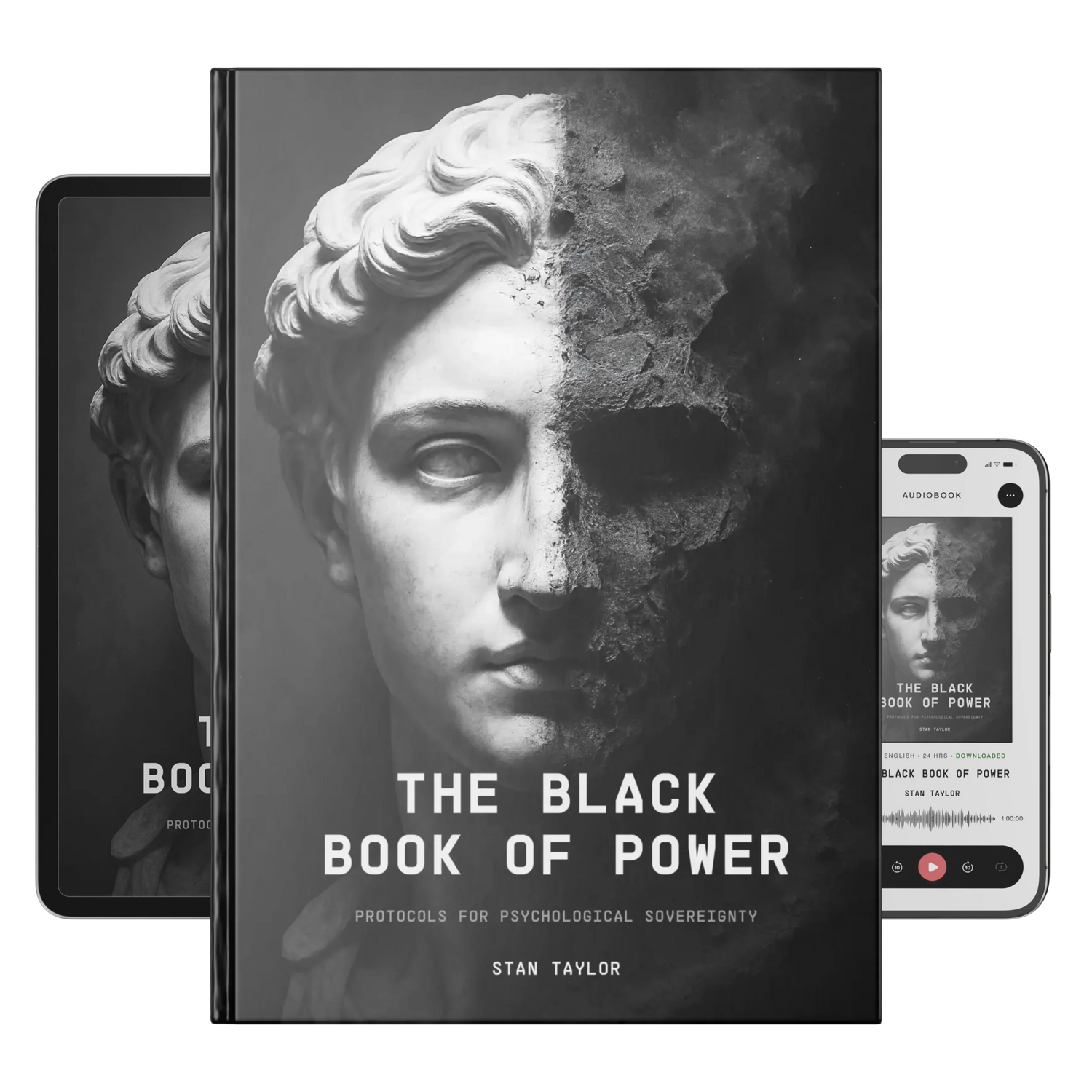
PREMIUM
HARDCOVER BUNDLE
One-time. No subscription. Lifetime access.
INCLUDES
-
Ebook Access
Chapter 1: The Walking Dead Your hand crawls across the nightstand like a dying spider. Eyes still sealed, fingers already knowing their prey. The phone fills your palm with its familiar weight, screen blazing to life before consciousness catches up. This choreography plays out every morning at the same time, the same way, performed by the same meat puppet who thinks it's choosing to wake up.
The scroll begins. Email first. An automatic subscription payment processed at midnight. "Fuck." You tell yourself you'll cancel it later. The 47 other notifications take priority.
Your thumb moves in patterns worn smooth by repetition, swiping through updates that update nothing, refreshing feeds that feed nothing, checking for messages from people you don't even like.
Thirty seconds ago you were unconscious. Now you're mainlining anxiety straight into your bloodstream. The morning news has already colonized your neurons with its viral load of catastrophe. Someone's opinion about someone else's opinion has already taken root in your frontal cortex. You haven't had a single thought yet, just reactions to other people's reactions to other people's noise.
The shower runs while your mind runs its daily persecution complex. That conversation with your boss where you finally grow a spine. That confrontation with your ex where you deliver the perfect crushing insight. That moment of triumph that exists only in the steam and will evaporate the second you step out. You've rehearsed these fantasies so many times they've worn grooves in your gray matter like a broken record that can't stop skipping.
Breakfast happens but you don't taste it. Your mouth processes nutrition while your brain processes the same anxieties it processed yesterday. Money. Always money. Health. Always health. That weird sound your car made last Tuesday. That look your partner gave you that might have meant something. The workout routine you abandoned in February but still pay for monthly like hush money to your conscience.
The drive to work is muscle memory piloting a corpse. Red light at Fifth triggers financial panic. Merge onto highway activates work dread. Pull into parking lot initiates daily existential crisis subroutine. Same thoughts at same intersections like GPS coordinates for misery.
By 9 AM you've already lived this day a thousand times. And you'll live it a thousand more.
Watch someone approach the coffee machine. Their mouth prepares to release words that were fossilized before the dinosaurs.
"How was your weekend?" emerges from their face like a prehistoric burp.
Your response is already loaded in the chamber… "Good, yours?"
Neither of you means it. Neither of you hears it. You're two cadavers exchanging words to confirm you're both still pretending to be alive.
Someone else joins the ritual. "Crazy weather." The words fall out of their face like teeth from a skull. You all nod because nodding is what the dead do when they want to seem alive. "Did you see the game?" someone adds. Everyone cares about the game. It proves you’re a part of the same tribe of beer drinkers.
These conversations are performed daily in ten million offices by ten million corpses who think small talk is human connection. You know what everyone will say before their mouths open. They know your responses before you respond. It's a play where everyone knows their lines but forgot they're in a play.
You roll your eyes at the small talk, secretly congratulating yourself for being above it. You're deeper, more original, more awake than these mindless drones exchanging their weather reports and weekend summaries. You see through the charade while they sleepwalk through it.
Except you don't. Your contempt for small talk is itself small talk. Your belief in your own depth is the shallowest thought you have. When your turn comes, you deliver your lines with the same practiced cadence. "Living the dream," you say with that knowing smirk that signals you're in on the joke. But the joke is you. Your ironic distance from the script is part of the script. Your awareness of the performance is just another performance.
The truth is, all your talk is small. Your "deep" conversations are recycled philosophy you half-remember from college. Your "original" thoughts are yesterday's Twitter arguments. Your "authentic" self is a collage of movie quotes and song lyrics. You're not above the pattern. You ARE the pattern, just with a superiority complex.
Your meetings are meetings where the dead pretend to make decisions. Karen presents the same presentation she presented last quarter with updated fonts. David objects to the same things he always objects to using the same words in the same tone. You all pretend to consider options that were decided before you entered the room by people who entered other rooms where other decisions were pre-decided.
The words coming out of your mouth were written by a committee of ghosts. Every opinion you voice is a haunting. Every idea you share died in someone else's skull years ago and now shambles out of yours like a zombie looking for brains to eat. You're a medium channeling dead thoughts and calling it collaboration.
Even your personality is a morgue. That confident way you lean back in your chair? Copied from a manager you had six years ago. That thoughtful pause before you speak? Stolen from a TED talk about executive presence. Your laugh, your hand gestures, your fucking email signature. All grave-robbed from people who grave-robbed them from others in an endless necropolis of borrowed behaviors.
The Voice in Your Head
Listen to it right now. That muttering in your skull. The one that's been providing commentary since you learned language. Whose voice is that? Sounds like yours, but listen closer.
Hear your mother warning you about money. Hear your father doubting your competence. Hear your seventh-grade teacher telling you to sit still and stop asking questions. Hear every authority figure who ever made you feel small now living rent-free in your neurons, still making you feel small.
But not all of it hurt. Some of it felt like love. Maybe your parents told you that you were destined for greatness. Maybe they looked at you like you were a miracle. Maybe they called you brilliant, beautiful, one-of-a-kind. And you believed them. How could you not? They were your gods and you were their chosen one.
Except that praise was just as toxic as the criticism. Those pedestals they put you on were still cages. When they said you were special, they were installing a different kind of malware. Now you can't just be human. You have to be exceptional. Every ordinary moment feels like failure because gods aren't supposed to be ordinary.
This chorus of critics and cheerleaders didn't even mean to colonize you. They were just passing on their own infections. Your mother's money fears came from her mother who got them from the Depression. Your father's doubts were his father's doubts dressed in different disappointments. Even the praise was a shield, an insecurity in disguise, meant to make sure you never felt what they felt… ordinary, forgettable, human.
So they made you "special" to protect you from feeling average. They called you "brilliant" to save you from feeling stupid. They insisted you were "one-of-a-kind" because they were terrified you'd discover you were just like everyone else. Their praise was fear with the red stroke of love.
You're hosting a multi-generational haunting and calling it self-talk.
The same worries circle your brain like vultures over carrion. Money, health, status, and death. Always the same flight pattern. Always the same shadows. You've thought these thoughts so many times they've developed their own thoughts. Your anxiety has its own anxiety and your fears have their own fears.
Even now, reading this, the voice is commenting. Judging. Comparing. Finding ways to make this about your inadequacy. It's running its defense subroutines, generating comfortable dismissals, preparing the mental antibodies that will reject anything that threatens its dominion. You think you're thinking about what you're reading but you're just watching your programming respond to input.
That flash of recognition you just felt? That moment of "shit, that's me"? Watch how quickly the voice smothers it. Watch it deploy rationalization, distraction, that comfortable numbness you call normal. Watch it protect itself by protecting your delusions.
The voice always wins because the voice is all you've ever known. It spoke your first words. It will speak your last. And every word in between is just the voice talking to itself while you listen and mistake it for consciousness.
The Factory Settings of Human Livestock
You came into this world as pure potential, a biological computer with no operating system. No stories about who you are. No rules for survival. No identity. Just consciousness waiting to be programmed.
Then came your first programmers… whoever was there when you opened your eyes. Usually parents. Sometimes grandparents. Occasionally the state. But always someone who would write your base code before you could even focus your eyes.
They did what was done to them, passing down code that had been running in your family for generations. They did what felt normal. And normal is the most powerful force in human behavior. More powerful than love, hate, and reason. Normal is what we do without thinking, and what we do without thinking shapes everything.
They installed their normal into your blank slate brain because it was the easiest thing to do. Their fears became your features, their limitations became your default settings, and their wounds became your wallpaper.
Your infant brain was built for this. In the first few years of life, you overproduced neural connections like a drunk spider. Then your environment pruned them back, keeping only the pathways that got used, like the ones that helped you survive your particular household, and the ones that earned food, warmth, and whatever passed for love.
By the time you were seven, your core programming was complete through ten thousand micro-moments of conditioning, from the way they responded when you cried, the look on their face when you failed, and the tone of voice when you asked for too much. Each interaction carved a pattern that would run for the rest of your life.
That deep belief that you're not quite good enough? A bug in your code from when your father's approval was always just out of reach. That belief the world owes you something? A glitch from being told you were special just for existing, creating an addict who needs constant validation to feel real. That constant need to please everyone? A survival subroutine from when your mother's love felt conditional on your behavior.
Your factory settings were installed by well-meaning people who didn't know they were running malware. They inherited their own corrupted operating system, full of fear-based patches and ancient viruses, and passed it on believing it was love. They enforced rules they never questioned inside a system that trained them not to question.
The program survives through tradition. Each generation of parents installs it in their children, who install it in theirs. No conspiracy, no master plan. Just normal people doing normal things, creating normally broken children who grow up to create more normally broken children. The tradition is self-perpetuating.
Diana Baumrind, Theodor Adorno, and the Milgram experiments mapped this inheritance. Parenting styles create predictable adult behaviors, authoritarian childhoods manufacture adults predisposed to submit to authority, and the most obedient subjects, the ones who kept shocking strangers because a man in a lab coat told them to, almost always came from strict homes.
This research becomes user manuals for mass manipulation. When bad actors understand how you were raised, they own the cheat codes to your personality. They can predict your reactions, exploit your weaknesses, and fill in your programming before you notice. Your childhood made you hackable because it made you predictable.
Your struggles today are the logical output of your initial programming. You're running software written by people who were themselves running corrupted code.
Your Core Vulnerabilities
The original programming is still running your life. To become less predictable we need to see what it is, where it came from, and how it shows up today. When we look for patterns, we find that parenting tends to fall into a few predictable modes. Each is like a distinct operating system installed in the child’s brain. Let’s see if you recognize your own:
The Authoritarian OS
If your childhood home ran on the Authoritarian operating system, you know the symptoms. Rigid rules that couldn't be questioned, harsh punishments for minor infractions, and love that felt like a reward for obedience, not a birthright.
Every dinner was a performance review. Every car ride was an interrogation. Every report card was evidence in an ongoing trial where you were always guilty of something. Your home was a totalitarian state and you were its only citizen.
This system creates a specific type of adult. The hyper-vigilant people-pleaser who can read a room's emotional temperature from the doorway. You developed supernatural threat detection because you had to. In a home where love was contingent on perfection, mistakes meant emotional exile.
Neuroscience research reveals the physical signature of this conditioning. Studies from labs like that of Dr. Iulia Banica show that adults from authoritarian homes can exhibit a heightened 'error-related negativity' (ERN), a neural alarm system that is permanently set to DEFCON 1, vibrating at a higher frequency of fear.
You learned to scan faces for micro-expressions of disapproval. You might modulate your voice to avoid triggering anger or even shrink yourself to avoid becoming a target. All survival skills.
At work, you volunteer for everything because saying no feels dangerous. Your body floods with cortisol when your boss frowns. You stay late not because you need to, but because leaving feels like abandonment.
In relationships, you apologize for existing. You interpret neutral expressions as anger. You give until you're empty because that's what love looked like in your programming. Your partner's bad moods become your emergencies to solve.
At restaurants, you eat food you didn't order. You refuse to send it back. Every interaction is filtered through the same question that governed your childhood: "Will this make them angry?"
The authoritarian OS taught you that you exist to manage other people's emotions, your needs are impositions, and love must be earned through suffering. It installed a brutal internal critic that speaks in your parent's voice but has taken on a life of its own, harsher than they ever were.
The Permissive OS
If your family ran the Permissive operating system, you got a different kind of damage. No boundaries. No consequences. No structure. Just an endless buffet of "yes" that left you psychologically malnourished.
Your parents thought they were being progressive. They'd read articles about not stifling creativity. They wanted to be your friend, not your authority. They gave you choices you weren't equipped to make and called it respect for your autonomy.
The house felt free but it was actually chaos. Bedtimes were suggestions. Rules changed based on moods. Consequences evaporated with tears. You were captain of a ship with no one teaching you to sail.
Your parents probably praised everything you did, no matter how small. Every finger painting was a masterpiece. The words you spoke were brilliant. You were always the best, the smartest, the most special… even when you did nothing… especially when you did nothing.
This was sabotage wrapped in good intentions. They made you addicted to effortless victory. When something looked hard, you learned to avoid it. Why risk discovering you were ordinary when you could stay in the shallow end where you were still a god?
You became an excellence addict who only played games you'd already won. You picked classes you knew were easy, chose hobbies you had natural talent for, and dated people who worshipped you from day one. You built an entire life in the comfort zone because that's where the praise lived.
Now you're an adult who craves external validation like oxygen because you never developed an internal compass. Every decision needs applause, every achievement needs witnesses, and you post everything online because if a tree falls in the forest and nobody likes it, did it make a sound? Did you even exist?
Kids from permissive homes show higher rates of anxiety, depression, and substance abuse. They float through life like astronauts whose tether was cut, desperately grabbing for anything solid.
You can spot permissive OS survivors by their relationship with authority. They either rebel against all structure because they never learned its value or desperately seek someone to tell them what to do because freedom feels like abandonment. They're the ones who join cults looking for the boundaries they never had. They stay in toxic relationships because any structure feels better than none.
At work, you either can't meet deadlines because deadlines were always negotiable or you create unnecessary urgency to feel alive. You need constant feedback because you never learned to evaluate yourself. You mistake your boss for a parent and your coworkers for siblings.
In relationships, you're exhausting. You need constant reassurance. You interpret independence as abandonment and create drama because conflict was the only time your parents acted like parents. Peace feels like neglect.
The permissive OS creates a specific type of broken. You appear confident but secretly desperate for approval, seem independent but can't make a decision without polling your group chat, and look successful but feel like you’re perpetually failing a test you can't identify.
The Inconsistent OS
Now, not everyone reading this had a childhood that fits neatly into Authoritarian or Permissive extremes. Real life is rarely that binary. Perhaps you grew up in a home that was a confusing mix of rules and chaos: the inconsistent operating system, which is the most damaging of all. One day your parents were authoritarian, the next permissive. Rules changed without warning. Love was a roulette wheel. You never knew which version of your parents you'd get when they walked through the door.
Monday's mistake got a shrug. Tuesday's identical mistake got rage. Wednesday you were best friends. Thursday you were strangers. The same behavior that earned praise at breakfast earned punishment at dinner.
This creates the shapeshifter. The human chameleon who can read a room in nanoseconds and become whatever it needs them to be. You're a method actor who lost the ability to break character.
Your superpower is adaptation. You can mirror anyone, fit into any group, speak any emotional language. But you have no idea who you actually are. You're a collection of masks with no face underneath… a playlist of personalities with no core track.
The inconsistent OS produces the highest levels of anxiety because you learned that the world has no reliable rules. Safety is temporary. Love is conditional on variables you can't identify. Every interaction is a fresh minefield.
In relationships, you're draining. You're constantly checking the emotional weather, adjusting your behavior to match perceived shifts in mood. You apologize preemptively. You over-explain. You can't relax because relaxation requires predictability, and your programming insists that predictability is a lie.
At work, you're whoever they need you to be. The hard driver with the demanding boss. The creative with the innovative team. The reliable one with the traditional company. You succeed by becoming a mirror, but mirrors can't generate their own light.
Your anxiety is a feature. You're running threat detection software that assumes danger is random and constant because in your childhood, it was. Your hyper-vigilance is pattern recognition from a world where patterns kept changing.
We tell ourselves our weaknesses are mysterious personal flaws like some genetic lottery we lost or some essential brokenness that makes us different from the normal people. Bullshit. Your neuroses are logical outputs from the programming you received. Astonishingly predictable outputs. Your anxiety, your people-pleasing, perfectionism, and procrastination are features that kept you safe in the specific ecosystem of your childhood.
And once you're predictable...you become a target. That's what the manipulators know that you don't. Your patterns make you an easy mark.
Programming doesn't only enter through pain. We imagine trauma as the only teacher, but the brain doesn't discriminate when it patterns anything with emotional intensity. Joy programs you just as effectively as fear.
Were you the family hero who got applause for straight A's? Congratulations, you're now an achievement addict who'd rather die than be average. Were you the peacemaker who got praised for never causing trouble? You're now conflict-avoidant to the point of self-destruction. Were you the funny one who could break tension with a joke? You're now incapable of being serious even when your life depends on it.
Every time you pleased the adults and got that hit of approval, your brain took notes. Every time you were "the responsible one" who got rewarded for being a tiny adult, the pattern carved deeper. If you were "the smart one," you learned to avoid any arena where intelligence couldn't save you. Now you're forty and still terrified of dancing because you can't be the smartest person on the dance floor.
Positive programming creates addicts just like negative programming creates avoiders. The golden child is just as fucked as the scapegoat, just with better PR. Both are slaves to patterns installed before they could spell.
Decades of research, pioneered by psychologist Diana Baumrind, mapped these patterns. Her work identified core parenting styles, like the rigid Authoritarian and the boundary-less Permissive, and a fourth, later identified as neglectful or uninvolved, which captures the chaos of the Inconsistent OS.
Your Generation’s Factory Install
You're fighting more than childhood demons. Another parasite lives in your skull, and this one came with a timestamp.
While your parents installed the broken software they inherited, an entire generation of programmers also worked on you. Every decade births its own strain of malware. Yours downloaded the moment you opened your eyes. You inherited your parent's anxiety AND your generation's specific flavor of fucked.
Every con artist, manipulator, and marketer knows this. They only need one thing… your birth year. Most manipulation requires zero personal knowledge, just your production date.
"But I'm different from other Boomers/Gen Xers/Millennials/Zoomers."
Bullshit. We quit jobs at the same rate, buy the same shit, fear the same futures, fall for the same scams. Your rebellion followed the same template as everyone else's in your cohort. Even your uniqueness came mass-produced.
Baby Boomers (born 1946-1964) run AmericanDream.exe. Post-war propaganda at its finest. Work hard, stay loyal, collect a gold watch and die with a pension.
Watch them cling to jobs that hate them. Their software says quitting equals moral failure. A majority of Boomers nearing retirement have stayed with the same employer for over a decade. Satisfaction has nothing to do with it. Programming runs so deep they'd rather die at their desk than update their resume. Nearly 61% still believe the American Dream is attainable, even after watching it murder their children's futures, even after working themselves into heart disease for companies that outsourced their departments. The programming always holds.
That Boomer who won't retire despite misery runs code that says hard work equals worth. The one judging you for job-hopping operates software that processes employment as lifelong marriage. They'd rather suffocate in cubicles than admit their entire operating system was a scam.
Generation X (born 1965-1980) runs SkepticOS. The abandoned children. Forty percent of them came home to empty houses, keys around necks like dog tags for the latchkey war. Microwaved dinners at age eight while parents worked late or fought through divorces. They watched every institution fail in real-time: Watergate on the news, parents' marriage in the kitchen, and the factories closing down.
Their programming is to trust nothing. Handle everything yourself. Never let anyone see you need them. "Whatever" became their generational prayer. Caring got you killed in their childhood. They work inside systems they despise, mapping exits, forever ready to bail but never leaving because the devil you know pays on time.
That Gen X manager who seems cynical about company initiatives runs software that says all promises are lies. They mentor you while keeping emotional distance. Connection equals future disappointment in their code. They'll help you succeed while building their escape routes. Survival looks like that when everything eventually abandons you.
Millennials (born 1981-1996) caught Validation Hustle 2.0 like a plague, fed participation trophies and "you're special" mantras, then body-slammed by the Great Recession right as they tried to cash those checks. The programming promised meaningful work for following your passion. Reality delivered three unpaid internships and six figures of student debt for jobs that barely cover rent.
Now they're the most anxious generation in recorded history, with over a quarter admitting they feel too guilty or fear being seen as replaceable to take the time they've earned. Fear of looking replaceable runs that deep. The hustle burns like terror in their veins. Instagram perfection screams desperate performance for an audience that might finally say they're enough.
Watch them burn out trying to prove they deserve existence. Every LinkedIn update screaming "I MATTER." Every side hustle another attempt to justify taking up space. Parents called them special. The economy called them disposable. Now they're killing themselves to be exceptional enough for basic security. Running into the ground for applause that never drowns out their crashing programming.
Generation Z (born 1997-now) came pre-installed with InstantNovelties.app. First generation whose brains got shaped by algorithms. Smartphones by age 12. Often earlier. TikTok attention spans hardwired into neural pathways. They process information at superhuman speed and forget it just as fast.
Brain scans of heavy social media users show changes in brain structure and activity in regions related to attention and self-control, patterns that resemble what we see in ADHD. Simultaneously the most informed generation with infinite data and most anxious with infinite bad news. A/B tested since birth, now AI knows them better than their parents.
They know they're programmed. They joke about "attention span being shot" while scrolling. They recognize manipulation while being manipulated. Self-awareness without self-control. They see strings and still dance. Their programming includes a subroutine: resistance is futile and irony is armor.
Every generation thinks they see through the bullshit first. Every generation is wrong. Spot your generation's malware by watching what you judge in others. Boomers rage at Millennial "entitlement" because it violates their work-worship programming. Millennials mock Gen X cynicism because it threatens their meaning-making software. Gen Z eye-rolls at everyone's processing speed because every criticism reveals source code.
Manipulators memorized this. Your fears, dreams, and triggers were documented, mapped, and now weaponized. Social scientists took notes, marketers built playbooks, and politicians crafted scripts. While you grew up feeling unique, they catalogued your predictability.
These are all current events. Your operating system's source code stays public domain. Everyone hacking you has a copy. Financial advisors mention "security" to Boomers and "flexibility" to Millennials, all following generational targeting protocols. Political ads make your blood boil while your kid shrugs.
Personal trauma made you vulnerable. Generational programming made you a demographic. Together a product with reliable behavior patterns and documented buttons. You became a unit from a specific factory with technical specifications in full display.
When someone tries to hack you again, they won't need your daddy issues or your ex who broke you. Again, just your birth year. Generational programming opens millions of doors with one skeleton key.
We dig through this generational dust because manipulation requires existing code to run on. If you want to understand how humans get moved, first understand what's already moving inside them. The hidden design behind influence starts with designs laid down decades ago.
We underestimate this early code because we forget it exists. You barely remember being three years old, but at that age your brain was making synapse connections at a furious rate, soaking in patterns of love, fear, reward, and punishment that still steer you today. Memory has nothing to do with it. This is about the carving of neural pathways. Once responses get wired in, they operate quietly in the background for life, unless you confront and literally rewire them.
Recognizing your programming matters because once you see your own code, you spot others' codes. You predict their reactions, their weak points, their automatic responses.
The one being influenced is always the last to know. But now you're beginning to see. The next layer of programming was even more universal. They called it education, but it was behavioral conditioning on an industrial scale.
12 Years of Compliance Training
Your factory settings were just the foundation. Then they sent you to school, where a different kind of programming began. You thought you were learning math and history. You were actually learning obedience and conformity.
The modern education system was designed to create workers. It was the explicit goal.
For most of human history, children learned by living. A mother's hands guiding yours through bread dough. A father's voice teaching songs that carried ancestral memory. Village elders telling stories that encoded wisdom. Learning was intimate, immediate, and integrated with life itself. No grades, no bells, no sitting still for six hours. Knowledge flowed through relationship and practice.
Then Prussia lost a war. 1806. Napoleon crushed the Prussian army at Jena-Auerstedt. The Prussian government blamed their people. Too undisciplined, too free-thinking, too human. So they built a machine to manufacture better humans.
They created the first compulsory state-run school system in history. Children were sorted by age like industrial products. Marched between classes at the sound of bells like factory workers, forced to sit in rows like soldiers, and taught to memorize and repeat, never question or create.
The goal was to produce citizens who obeyed reflexively, soldiers who followed orders without thinking, and workers who showed up on time and did what they were told. Humans began confusing obedience with morality and conformity with intelligence.
It worked so well that America imported it wholesale. Horace Mann, the "Father of American Education," traveled to Prussia in 1843 and came back evangelical about their system. He called it "the perfect tool for shaping citizens." By 1852, Massachusetts had compulsory schooling. By 1918, every American state required attendance.
The factory model spread like a virus. Britain adopted it, Japan perfected it, and within a century, the Prussian model had colonized the globe.
Schools everywhere started looking identical with bells, rows, grades, and standardized tests. Children everywhere started looking quiet, obedient, and ready for insertion into the economic machine.
Bells trained you to respond to external timing. You're Pavlov's dog salivating at acoustic commands. Rows of desks enforced hierarchy. You face forward, never sideways, learning that connection with peers is less important than submission to authority. There is punishment for speaking without permission. Your thoughts must be approved before expression. There are rewards for regurgitation. Original thinking is punished and repetition is praised.
You learned to sit still for hours when every cell in your body screamed to move. Childhood energy became a disorder to be medicated. You learned to ask permission for biological functions. Your bladder became less important than their schedule. You learned to accept that authority figures controlled when you could eat, speak, or even think. Your humanity became negotiable.
They called it classroom management, but it was factory farming for human consciousness. Access to anything different was reserved for the elite.
The hidden curriculum taught you more than any textbook. Curiosity marked you as disruptive, questions became problems, fitting in carried more weight than standing out, and the right answer always outranked the right question.
Now schools mirror the capitalist workplace. They teach working-class kids to be workers and upper-class kids to be managers. The factory settings from home get reinforced and refined into industrial-grade compliance.
You spent twelve years in this system. Twelve years of being told when to think, what to think, and how to demonstrate you thought it. Then they handed you a diploma and said you were educated. What you were was formatted for insertion into the economic machine.
They made you compete for the privilege. They turned your programming into a game where the highest score went to whoever could best suppress their humanity and perform their function. Valedictorians turned out to be the most successfully programmed.
Even if you rebelled, you did it within their framework. The burnout, the class clown, and the dropout were all recognized roles in their system. Rebellion that follows predictable patterns is just another form of compliance.
Then came college. They told you it would expand your mind, but all it did was expand your debt. You paid six figures to have your programming refined by people who'd never left the academic industrial complex.
You chose a major. But this was merely a menu of acceptable identities cultured from Hollywood’s petri dishes. You wrote papers arguing positions you didn't believe for professors who didn't read them. You learned that original thinking was dangerous but you could succeed by becoming very good at sophisticated repetition.
The real education was in debt slavery. You graduated owing more than your parents paid for their house. Now you can't take risks, can’t pursue dreams, and can’t tell your boss to fuck off. The system literally mortgaged your future.
Your Deepest Beliefs Are Billboards
You’re not as mysterious as you think. Most of what you believe about politics, relationships, success, and even yourself did not come from this deep and personal reflection.
That political stance you'd die defending? Caught it from a podcast. It replicated in your neural tissue until you forgot it wasn't yours. Now you spread it to others, patient zero in an ideological pandemic you don't even remember starting.
Your relationship philosophy comes from romantic comedies written by people who've never been in love, selling fantasies to people who confuse chemistry with connection. You learned what love looks like from actors pretending to feel things for money. Your relationships fail because you're following a script written by someone trying to sell tickets.
Your career ambitions were focus-grouped by corporations who needed you to want what they were selling. "Follow your passion" means "monetize your enthusiasm." "Work-life balance" means "be grateful we let you leave." Every inspirational quote on your LinkedIn is a cattle brand that you applied to yourself.
Watch yourself defend these positions. Feel the heat rise when someone challenges them. That's your programming protecting itself. The more violently you defend an idea, the less likely it originated in your own skull.
You dress how they told you rebels dress. You rebel how they told you individuals rebel. Your non-conformity comes with its own uniform, complete with approved hairstyles and acceptable deviances. You're a demographic pretending to be a person.
But there's a certain beauty in becoming awake inside the machinery, in noticing your own predictability and using it to carve out space for choice. If you recognize the patterns, you can step outside of them or, if you wish, use them to guide others, knowing exactly which messages will stick and which ideas will spread.
How They Profit From Your Loneliness
All this programming left us shuffling through life like the beautifully dressed dead, animated on the outside, hollow at the core, and driven by longing we never questioned and scripts we never wrote. But no programming runs deeper than the romantic mythology you absorbed before you even knew what love was.
The soulmate delusion is the toxic fairy tale that somewhere out there is your "other half," someone who will complete you, fix you, and save you from the horror of being yourself and alone.
Disney started the indoctrination early. Every princess needed a prince. Every story ended with a kiss. The message, drilled into your developing brain, animated an incomplete you until someone else chooses you.
The programming intensified by adolescence. Pop songs showed death without someone's love. Movies showed stalking was romantic if the stalker was attractive enough. Books told a story of damaged people magically healing each other through the power of toxic codependency.
You learned that jealousy was passion, fighting meant caring, and love was supposed to hurt. You learned to call anxiety butterflies and obsession devotion. They took the most dysfunctional relationships imaginable, set them to swelling orchestral scores, and taught you this was the goal.
The soulmate myth serves multiple functions. It keeps you desperate, scanning every interaction for the one. It makes you tolerate garbage behavior because relationships take work. It convinces you that being alone is failure.
Think about how you evaluate potential partners. Compatibility is thrown aside in favor of completion. You choose someone to patch the bugs of your programming over someone who runs compatible software. You want them to be your missing piece, your better half, and your reason for living.
This is why relationships feel like death when they end. You’re losing the part of yourself you outsourced to them. The soulmate delusion convinced you that another person could fill a manufactured void such that when they leave, you're incomplete again.
Relationships based on the soulmate model show higher rates of dysfunction, dissatisfaction, and divorce. People who believe in "the one" are more likely to bail when reality conflicts with fantasy. They're shopping for a fairy tale in a world full of humans.
The alternative requires admitting you're responsible for your own wholeness. That's terrifying when your programming insists you're half a person looking for your other half. So you keep searching, keep settling, keep believing that somewhere out there is the person who will finally make you feel complete.
The dating apps know this, so they’ve gamified your desperation. Swipe through an endless catalog of potential soulmates, feel the dopamine hit of a match, and experience the crushing disappointment when they're just another human.
Tomorrow Is Already Dead Too
You know what you'll have for lunch. You know which coworker will irritate you. You know what you'll worry about while trying to fall asleep. Your future is a rerun with updated timestamps.
Monday you'll promise to change. Friday you'll promise to start Monday. This cycle has repeated so many times it's carved canyons in your calendar. You're performing a ritual that ensures nothing changes while feeling like you're about to.
Your New Year's resolutions are photocopies of last year's resolutions which were photocopies of the year before. Lose weight, save money, find purpose. The holy trinity of self-improvement that improves nothing but your ability to feel guilty about not improving.
Even your dreams of escape follow predictable patterns. Quit your job and travel. Start that business. Write that book. Move to the countryside. The fantasies themselves have fantasies about when they'll finally become real. They're pressure valves that release just enough steam to keep you from exploding.
You'll have the same fights with the same people about the same things. Your partner will leave dishes in the sink. You'll feel disrespected. They'll feel nagged. You'll both perform your roles in a play called "This Is Why We Can't Have Nice Things" that runs eight shows a week with no intermission.
Your children will disappoint you in exactly the ways you disappointed your parents. Your parents will age in exactly the ways that terrify you about your own decay. The family dinner conversations will be reruns of conversations your grandparents had, just with updated references to current events that are themselves reruns of older events.
Every surprise in your future has already been scheduled. Every spontaneous moment has been rehearsed. Every unexpected turn was expected by everyone but you.
You can see this future clearly. You know exactly how your life will unfold if nothing changes. The slow degradation. The accumulating regrets. The dreams downsizing until they fit in the space between Netflix episodes.
Everyone Wants to Be Different
You rage against your programming while following a script for how to rage against programming. That tattoo expressing your individuality came from a flash sheet thousands have chosen. Your rebellion playlist sounds exactly like every other rebel's playlist from your generation. Even your uniqueness came off an assembly line.
Watch the hipsters. They rejected mainstream fashion so hard they created a uniform with flannel shirts, thick glasses, artisanal coffee, and obscure band t-shirts. A mathematician at Brandeis actually modeled this phenomenon and called it "the hipster effect." Anti-conformists make such similar choices they become indistinguishable from each other. One reader saw a stock photo in an article about hipsters and, convinced they'd used his picture without permission, furiously contacted the publisher. It turned out to be a completely different bearded, flannel-wearing man. He couldn't tell himself apart from a random hipster because they'd all achieved the same unique look.
Your brain runs two programs simultaneously… the need to belong and the need to stand out, both survival mechanisms from when being cast out meant death, but being too similar meant competing for identical resources. You need the tribe's protection while distinguishing yourself enough to matter.
So you rebel in groups. You're different together. You find your tribe of outcasts and immediately adopt their dress code.
Punks spiked their hair and wore leather to reject society's rules. Then every punk had to spike their hair and wear leather or they weren't really punk. Goths painted themselves black to mourn conformity while conforming to goth aesthetics. Skaters, ravers, metalheads, vegans, crossfitters, entrepreneurs… each group prides itself on not being sheep while enforcing strict tribal uniforms. You switched herds, but you're still in a herd.
The market noticed. Now they mass-produce uniqueness. Customizable products let millions of people have the same one-of-a-kind item. Limited edition drops create artificial scarcity so you feel special owning what only 10,000 others own. "Express yourself" means "buy this expression we've packaged for you." Your personality comes with a SKU.
Social media loves this. Everyone striving to stand out by doing exactly what everyone else does to stand out. The same angles. The same humble brags. The same inspirational quotes. Millions of unique individuals producing identical content. You're building a personal brand using the same personal branding guide.
The normcore movement tried to escape by embracing deliberate blandness. Wearing aggressively normal clothes became the new way to rebel against trying to be special. Dad jeans and white sneakers became an ironic statement. Even the attempt to not be unique became its own form of unique. The snake swallowed its tail and kept swallowing.
Schools now demand you prove your uniqueness. "What makes you special?" becomes a required essay. HR departments seek "diverse candidates" who all went through the same education system. You must demonstrate your individuality using approved methods of demonstration. Uniqueness itself got standardized. Being different became mandatory.
Your desperate need to be different makes you predictable. Marketers have guides for selling to "non-conformists." Politicians have playbooks for appealing to "independent thinkers." Your rebellion has a demographic profile. Your individuality has a target market. Your authenticity comes with a buyer persona.
Even recognizing this paradox becomes its own cliché. "You're unique just like everyone else" shows up on coffee mugs and motivational posters. Being aware of the uniqueness trap is the new uniqueness trap. Levels of irony stacked so high they collapse into sincerity.
You can't escape because the escape routes are mapped. Trying to be normal is abnormal. Trying to be unique is common. Trying to not try is its own form of trying. Every direction leads back to the same place: you're a human running human software, including the software that insists you're not like other humans.
Actual uniqueness would be terrifying. If you were truly one-of-a-kind, you'd have no reference points. No one would understand you. You'd be alone in your skull with thoughts no one could relate to. What you want is to be special within acceptable parameters. Different enough to matter, similar enough to connect. A fascinating variation on a familiar theme.
Your fingerprints are unique. Your DNA is unique. The exact configuration of your experiences is unique. But your patterns, desires, and rebellions follow templates. One-of-a-kind in the details, mass-produced in the patterns. Special just like everyone else who needs to feel special.
How you Drowned Your Soul in Security
Graduation felt like parole. Twelve years of bells and rows and permission slips, finally over. You walked across that stage believing the real world would be different, work would reward competence over compliance, and your expertise would finally matter.
Your first job interview proved otherwise. They asked about "culture fit." Translation: will you dissolve properly into our organization? They tested your willingness to speak their language, wear their uniform, and worship at their altar of productivity.
Day one: "We're a family here." Your brain, desperate for belonging after years of educational isolation, grabbed that lie like a lifeline. Families don't make you fill out timesheets. Families don't have quarterly layoffs. Families don't measure your worth in KPIs. But that phrase hacked your attachment system before you'd found your desk.
The onboarding began. They taught you when to arrive (before the boss), when to leave (after the boss), when to eat (at your desk, productivity never stops). You learned to write emails that say nothing, sit through meetings where nothing gets decided, and show enthusiasm for missions you don’t believe in.
Three months in, you absorbed the frequencies. You started saying "we" instead of "they" when talking about company decisions you had no part in. You felt guilty taking lunch breaks. You checked Slack on weekends, anxiety spiking at unread notifications.
The corporate machine exploits every flavor of childhood damage.
Raised by authoritarians? Performance reviews trigger your people-pleasing. Every deadline becomes a test of worthiness. You'll work yourself into the hospital trying to earn approval from bosses who view you as replaceable. That familiar feeling of never being quite good enough drives you to donate your nights and weekends to a company that would replace you tomorrow.
Raised by permissives? Corporate structure becomes the boundaries you've been craving. Finally, clear rules! Finally, someone telling you what to do! The employee handbook feels like the parent you never had. You mistake policies for care, procedures for protection. The cage feels like safety because chaos was all you'd known.
Raised by inconsistents? Reorganizations and pivots feel like home. You thrive in the uncertainty because you've been training for it since birth. Shifting priorities, changing bosses, moving goalposts… your nervous system was built for this chaos. You become the valuable one who can adapt to change because change was your only constant.
They call it company culture, but it’s colony programming with craft beer. The ping pong table distracts from the surveillance, the free snacks compensate for stolen time, and the open office ensures you're always performing, always visible, always on.
The language gives it away. You're a resource… a human one. Like copper or timber. Something to be extracted from. You have "deliverables." Not conversations, but "syncs" and "huddles.". You have downtime that needs optimizing.
Most companies are run by people who absorbed the same programming and now replicate it unconsciously. Your boss who demands face-time until 7 PM learned that from another boss, who learned it from another. A chain of mimicry stretching back to the first factory owner who realized exhausted workers are compliant workers.
The startup founder working their team 80 hours a week imitates what they think success looks like. They saw other startups grinding, read about founders sleeping under desks, and absorbed the mythology that suffering equals seriousness. They create toxic culture through the mimicry of abuse.
The investment banker who hasn't seen their kids awake in six months becomes the role model for hungry graduates. Those graduates become VPs who perpetuate the cycle. Everyone copying everyone else's dysfunction, mistaking widespread sickness for health.
The most thoroughly programmed don't even notice their cage. They've internalized corporate values so completely that exploitation feels like opportunity. They brag about working through pneumonia. They compete over who sacrificed more weekends. They've replaced their personality with their LinkedIn profile. That colleague who answers emails at a concert is a human whose self-worth got so tangled with productivity they can't tell where they end and the company begins.
If you feel like an invisible expert, the one who knows more than their boss but can't get promoted, the system is working perfectly. It needs your competence trapped at your current level. Promoting you would mean paying you what they're worth. Better to keep you hungry, believing that next year, in the next review, and with the next reorganization, they will finally recognize your value.
Five years in, you're fluent in corporate. You say things like "Let's circle back on that" and "I don't have the bandwidth" without wincing. You've learned to perform busy-ness as theater. You've mastered the art of looking productive while your soul calculates how many decades until retirement using an excel sheet.
Ten years in, Stockholm syndrome sets in. You defend the company that's been bleeding you dry. You recruit friends into the same machine. You've forgotten who you were before this place. Your hobbies atrophied. Your relationships exist mostly as social media connections. You are what you produce.
Twenty years in, nothing remains to extract. You ARE the extraction. Your knowledge, your network, your credibility… all property of an entity that would eliminate your position to boost quarterly earnings. You're the most expensive kind of employee: the one who knows too much to easily replace but costs too much to keep forever.
They've got you competing for your own exploitation. The promotion that means more hours. The raise that doesn't match inflation but comes with doubled responsibility. The equity that vests over four years, golden handcuffs that look like opportunity, valued at millions in Monopoly money. You celebrate these victories while your real wealth…time, health, relationships… evaporates.
You participate willingly. You police yourself harder than any boss could. You've internalized the productivity metrics. You measure your worth in outputs. You feel guilty for being human in a system that needs robots. You optimize yourself for a machine that would optimize you out of existence if it could.
And just when you think you've negotiated some balance… learned to leave at 5, take weekends, and remember you're human… a new parasite enters the scene. One that follows you home, lives in your pocket, whispers productivity into your dreams, and makes work omnipresent, inescapable, and infinite.
Your phone doesn't respect office hours. Neither does your programmed brain anymore.
The Dopamine-Addicted Ghost
Scientists know you’re a biological antique evolved for finding berries and avoiding tigers. Now, desperate to navigate a world designed by algorithms, your Paleolithic operating system screams "DANGER!" at a passive-aggressive email and floods your bloodstream with the same chemicals your ancestors used to escape predators. The predator lives in your pocket. You pay a monthly subscription for the honor.
Coffee shop, 9 AM. Every face lit by screen glow, pupils dilated like addicts mid-hit. Thumbs performing their repetitive stress disorder on glass. Nobody talks. Everyone "connects." The businessman scrolling LinkedIn feels productive while producing nothing. The mother ignoring her child for Instagram likes, teaching the next generation that human faces matter less than glowing rectangles.
You tell yourself you control your usage. You could quit anytime. Every junkie says the same. Your phone tracked hundreds of unlocks yesterday, including your email checks and social media visits that ate three hours. Apps measure your addiction in microseconds while you measure it in lies.
Search for the shoe. More ads appear within minutes. The Algorithm watches, predicts, and provides. It knows you'll crave validation at 11:47 PM and calculates which political rage-bait will spike your cortisol at breakfast.
Omniscient, omnipresent, and unlike any god humanity ever invented, it actually answers prayers. Want dopamine? Scroll. Need validation? Post. Crave conflict? Comment. A Stanford study found people check their phones before checking on their own children during emergencies. The Algorithm trained them well. Netflix knows you'll watch that true crime documentary when you get home. Amazon ships products for problems you haven't recognized yet. The digital oracle anticipates, provides, and controls.
This god demands strange sacrifices… Your attention instead of burnt offerings, your data instead of tithes, and your children's developing brains instead of firstborns. You gladly pay because this god delivers what others only promised: immediate gratification, instant connection, endless entertainment, and purpose-adjacent feelings.
Medieval peasants at least knew when they were in church. You worship this god every waking moment and call it living.
The Looking Glass
There’s a knot of tension tucked between your shoulder blades, one massage can't release since 2019, maybe 2018. Your body keeps score of every hour spent hunched over screens, every notification that hijacked your brain, and every moment you chose pixels over presence.
Your left thumb has developed a specific ache. Doctors call it "texting thumb" like it's cute. This is your body deforming itself for the privilege of arguing with strangers is adorable. Your neck vertebrae have started fusing at angles evolution never intended. "Tech neck," they say, as if naming it makes it less horrifying that we're restructuring our skeletons for better screen viewing.
Phantom vibrations in your pocket are your mind hallucinating its next fix. You get anxiety when your battery hits 15%: withdrawal symptoms from a drug that never leaves your hand. You panic when you can't find your phone: your brain experiencing the same activation as a mother separated from her infant.
The battle for attention has become so fierce that the time we spend on any one screen before switching has plummeted. A decade ago, we averaged 150 seconds on a task before shifting. Now it's just 47 seconds. Your focus is being fractured.
Social media promised connection but delivered your on-stage performance for the world to see. You curate a character in a play where everyone's acting and nobody's watching. You see yourself through imagined eyes, exist through projected perception, and matter only through metrics.
Post a photo. Wait for hearts. Refresh. Refresh. Refresh. Each like hits like validation that evaporates before it lands. Each comment gets scrutinized for authentic enthusiasm versus obligatory engagement. You're a contestant in a game show that never ends, where the prize is feeling real for three seconds before needing another fix.
You become what gets rewarded. If you posted about fitness and got likes, you're "the fitness person." If you shared a joke that landed, now you're "the funny one." Your identity shape-shifts to match whatever the algorithm amplifies. You're focus-grouping yourself into existence.
The Panopticon was a prison design where inmates never knew when they were being watched, so they behaved as if surveillance was constant. Social media is a voluntary Panopticon where you guard yourself. Every photo filtered through "how will this be perceived?" Every opinion is tested against potential backlash, every moment evaluated for shareability instead of lived. We’ll go more on the Panopticon later on.
Your actual life becomes raw material for content production. The sunset becomes another Instagram opportunity. The meal becomes the review of an aspiring restaurateur. The conversation becomes the dream of a viral thread. The child's first steps, and fall, becomes the hope of a million TikTok views. You're strip-mining your existence for shareable moments while the actual moments slip away unnoticed, unrecorded by anything except the algorithm that turns your living into its profit.
The Epidemic of Numb Urgency
Modern life is running on a treadmill in a burning building, scrolling through other people's treadmill photos. Everything is urgent and nothing matters. You're simultaneously overstimulated and dead inside, anxious and bored, connected and desperately alone.
Psychologists call it the hot-cold empathy gap. Calm moments reveal scrolling is killing you, so you plan to cut back, download apps to block apps, and set screen time limits. Then 11 PM hits, existential dread creeps in, and your emotional brain overrides every intention. The calm version of you can't comprehend the desperate version's need for digital morphine.
This gap explains why you stay in patterns you recognize as toxic. Knowing changes nothing. It’s exactly why you can read an entire book about manipulation and still wake up tomorrow in the same cage. They've engineered your life to stay comfortably numb.
Your exhaustion transcends the physical because you're tired of being influenced but still think you’re the one choosing. You perform happiness and still feel hollow. You’re connecting digitally but still die of loneliness. The exhaustion never converts to action because the moment discomfort rises, seventeen apps make it disappear.
The perfect trap is to keep you uncomfortable enough to need their solution, never uncomfortable enough to revolt. Boiling a frog so slowly it never jumps. You're the frog. The water is ambient anxiety of modern existence. The heat is gradual extraction of everything that makes you human.
Your Life Is the Price
Silicon Valley's smartest predators work around the clock to colonize your consciousness. Teams of neuroscientists, behavioral economists, and data engineers with unlimited budgets gather around with one goal: maximize engagement. They A/B test which notification sounds trigger the fastest response, which colors make you click, and which words bypass your rational brain.
"If you're not paying for the product, you are the product." Cute phrase. Massive understatement. Your future is the product. Your children's development. Your democracy. Your capacity for sustained thought. They're selling your hollowed-out existence to the highest bidder.
Former Google design ethicist Tristan Harris testified to Congress about "human downgrading," where persuasive technology degrades human capacity for attention, relationships, and democracy. He left out the important part: The degradation is the business model. Degraded humans make better users. Broken people need more fixes.
The average American touches their phone 2,617 times per day. Each touch trades a piece of consciousness for stimulation. By day's end, thousands of unconscious trades leave you hollower, more dependent, and less human.
The real product is also predictability. Every click trains their models and improves their accuracy so they can manipulate you better tomorrow. You're training their weapons against you, your children, and everyone you love.
This hot recognition burns. The sick understanding spreads. You see your life with sudden, terrible clarity, but your programming has defenses for this too.
"Interesting perspective..." your mind starts. "Some valid points..."
Stop.
Feel the discomfort. Close this book for a second but don't reach for your phone. Don't intellectualize the wound. Let yourself feel the full weight of what they've taken for a minute.
Your authentic relationships were murdered, your attention span shattered into profitable fragments, your peace of mind monetized into anxiety, your children's childhood sacrificed to shareholder value, and your original thoughts drowned in the feed.
This is the heist of the century. They stole your consciousness while you applauded their innovation and praised the system that created this in the first place.
The hot-cold empathy gap explains why you'll forget this feeling by tomorrow. When you’re calm, you can’t imagine the urgency you feel right now. When you’re fired up, you can’t imagine going back to indifference. That’s why you’ll return to scrolling within minutes.
Unless you refuse to let the feeling fade, finally get angry enough to act, and stop being tired and start being furious.
The issue is that exhaustion is passive. It leads to your return to scheduled programming. It lets this clarity fade into another near-miss with awakening, adding it to your collection of things that almost changed you.
But rage is fuel. It helps you sit with this discomfort until it transforms into something useful. It’s hot enough to transform recognition into change so you stop hemorrhaging your humanity to the highest bidder.
Choose rage, in this moment, where you can still feel the weight of what you've lost.
-
Audiobook Access
- Limited Edition HardcoverPremium print with 650+ pages + bookmark.
-
Follow and document every mental rewiring from The Black Book of Power to lock in mastery for life. -
After purchase, you get access to a private Facebook group where readers are executing the protocols in real time. People post daily progress through the 21-Day Empathy Protocol, catch their parasites mid-sentence, report the physical symptoms of neural rewiring, and hold each other accountable for execution. -
Download the ebook and audiobook for offline reading with the free app.
PLUS
AUDIOBOOK BUNDLE
One-time. No subscription. Lifetime access.
INCLUDES
-
Ebook Access
Chapter 1: The Walking Dead Your hand crawls across the nightstand like a dying spider. Eyes still sealed, fingers already knowing their prey. The phone fills your palm with its familiar weight, screen blazing to life before consciousness catches up. This choreography plays out every morning at the same time, the same way, performed by the same meat puppet who thinks it's choosing to wake up.
The scroll begins. Email first. An automatic subscription payment processed at midnight. "Fuck." You tell yourself you'll cancel it later. The 47 other notifications take priority.
Your thumb moves in patterns worn smooth by repetition, swiping through updates that update nothing, refreshing feeds that feed nothing, checking for messages from people you don't even like.
Thirty seconds ago you were unconscious. Now you're mainlining anxiety straight into your bloodstream. The morning news has already colonized your neurons with its viral load of catastrophe. Someone's opinion about someone else's opinion has already taken root in your frontal cortex. You haven't had a single thought yet, just reactions to other people's reactions to other people's noise.
The shower runs while your mind runs its daily persecution complex. That conversation with your boss where you finally grow a spine. That confrontation with your ex where you deliver the perfect crushing insight. That moment of triumph that exists only in the steam and will evaporate the second you step out. You've rehearsed these fantasies so many times they've worn grooves in your gray matter like a broken record that can't stop skipping.
Breakfast happens but you don't taste it. Your mouth processes nutrition while your brain processes the same anxieties it processed yesterday. Money. Always money. Health. Always health. That weird sound your car made last Tuesday. That look your partner gave you that might have meant something. The workout routine you abandoned in February but still pay for monthly like hush money to your conscience.
The drive to work is muscle memory piloting a corpse. Red light at Fifth triggers financial panic. Merge onto highway activates work dread. Pull into parking lot initiates daily existential crisis subroutine. Same thoughts at same intersections like GPS coordinates for misery.
By 9 AM you've already lived this day a thousand times. And you'll live it a thousand more.
Watch someone approach the coffee machine. Their mouth prepares to release words that were fossilized before the dinosaurs.
"How was your weekend?" emerges from their face like a prehistoric burp.
Your response is already loaded in the chamber… "Good, yours?"
Neither of you means it. Neither of you hears it. You're two cadavers exchanging words to confirm you're both still pretending to be alive.
Someone else joins the ritual. "Crazy weather." The words fall out of their face like teeth from a skull. You all nod because nodding is what the dead do when they want to seem alive. "Did you see the game?" someone adds. Everyone cares about the game. It proves you’re a part of the same tribe of beer drinkers.
These conversations are performed daily in ten million offices by ten million corpses who think small talk is human connection. You know what everyone will say before their mouths open. They know your responses before you respond. It's a play where everyone knows their lines but forgot they're in a play.
You roll your eyes at the small talk, secretly congratulating yourself for being above it. You're deeper, more original, more awake than these mindless drones exchanging their weather reports and weekend summaries. You see through the charade while they sleepwalk through it.
Except you don't. Your contempt for small talk is itself small talk. Your belief in your own depth is the shallowest thought you have. When your turn comes, you deliver your lines with the same practiced cadence. "Living the dream," you say with that knowing smirk that signals you're in on the joke. But the joke is you. Your ironic distance from the script is part of the script. Your awareness of the performance is just another performance.
The truth is, all your talk is small. Your "deep" conversations are recycled philosophy you half-remember from college. Your "original" thoughts are yesterday's Twitter arguments. Your "authentic" self is a collage of movie quotes and song lyrics. You're not above the pattern. You ARE the pattern, just with a superiority complex.
Your meetings are meetings where the dead pretend to make decisions. Karen presents the same presentation she presented last quarter with updated fonts. David objects to the same things he always objects to using the same words in the same tone. You all pretend to consider options that were decided before you entered the room by people who entered other rooms where other decisions were pre-decided.
The words coming out of your mouth were written by a committee of ghosts. Every opinion you voice is a haunting. Every idea you share died in someone else's skull years ago and now shambles out of yours like a zombie looking for brains to eat. You're a medium channeling dead thoughts and calling it collaboration.
Even your personality is a morgue. That confident way you lean back in your chair? Copied from a manager you had six years ago. That thoughtful pause before you speak? Stolen from a TED talk about executive presence. Your laugh, your hand gestures, your fucking email signature. All grave-robbed from people who grave-robbed them from others in an endless necropolis of borrowed behaviors.
The Voice in Your Head
Listen to it right now. That muttering in your skull. The one that's been providing commentary since you learned language. Whose voice is that? Sounds like yours, but listen closer.
Hear your mother warning you about money. Hear your father doubting your competence. Hear your seventh-grade teacher telling you to sit still and stop asking questions. Hear every authority figure who ever made you feel small now living rent-free in your neurons, still making you feel small.
But not all of it hurt. Some of it felt like love. Maybe your parents told you that you were destined for greatness. Maybe they looked at you like you were a miracle. Maybe they called you brilliant, beautiful, one-of-a-kind. And you believed them. How could you not? They were your gods and you were their chosen one.
Except that praise was just as toxic as the criticism. Those pedestals they put you on were still cages. When they said you were special, they were installing a different kind of malware. Now you can't just be human. You have to be exceptional. Every ordinary moment feels like failure because gods aren't supposed to be ordinary.
This chorus of critics and cheerleaders didn't even mean to colonize you. They were just passing on their own infections. Your mother's money fears came from her mother who got them from the Depression. Your father's doubts were his father's doubts dressed in different disappointments. Even the praise was a shield, an insecurity in disguise, meant to make sure you never felt what they felt… ordinary, forgettable, human.
So they made you "special" to protect you from feeling average. They called you "brilliant" to save you from feeling stupid. They insisted you were "one-of-a-kind" because they were terrified you'd discover you were just like everyone else. Their praise was fear with the red stroke of love.
You're hosting a multi-generational haunting and calling it self-talk.
The same worries circle your brain like vultures over carrion. Money, health, status, and death. Always the same flight pattern. Always the same shadows. You've thought these thoughts so many times they've developed their own thoughts. Your anxiety has its own anxiety and your fears have their own fears.
Even now, reading this, the voice is commenting. Judging. Comparing. Finding ways to make this about your inadequacy. It's running its defense subroutines, generating comfortable dismissals, preparing the mental antibodies that will reject anything that threatens its dominion. You think you're thinking about what you're reading but you're just watching your programming respond to input.
That flash of recognition you just felt? That moment of "shit, that's me"? Watch how quickly the voice smothers it. Watch it deploy rationalization, distraction, that comfortable numbness you call normal. Watch it protect itself by protecting your delusions.
The voice always wins because the voice is all you've ever known. It spoke your first words. It will speak your last. And every word in between is just the voice talking to itself while you listen and mistake it for consciousness.
The Factory Settings of Human Livestock
You came into this world as pure potential, a biological computer with no operating system. No stories about who you are. No rules for survival. No identity. Just consciousness waiting to be programmed.
Then came your first programmers… whoever was there when you opened your eyes. Usually parents. Sometimes grandparents. Occasionally the state. But always someone who would write your base code before you could even focus your eyes.
They did what was done to them, passing down code that had been running in your family for generations. They did what felt normal. And normal is the most powerful force in human behavior. More powerful than love, hate, and reason. Normal is what we do without thinking, and what we do without thinking shapes everything.
They installed their normal into your blank slate brain because it was the easiest thing to do. Their fears became your features, their limitations became your default settings, and their wounds became your wallpaper.
Your infant brain was built for this. In the first few years of life, you overproduced neural connections like a drunk spider. Then your environment pruned them back, keeping only the pathways that got used, like the ones that helped you survive your particular household, and the ones that earned food, warmth, and whatever passed for love.
By the time you were seven, your core programming was complete through ten thousand micro-moments of conditioning, from the way they responded when you cried, the look on their face when you failed, and the tone of voice when you asked for too much. Each interaction carved a pattern that would run for the rest of your life.
That deep belief that you're not quite good enough? A bug in your code from when your father's approval was always just out of reach. That belief the world owes you something? A glitch from being told you were special just for existing, creating an addict who needs constant validation to feel real. That constant need to please everyone? A survival subroutine from when your mother's love felt conditional on your behavior.
Your factory settings were installed by well-meaning people who didn't know they were running malware. They inherited their own corrupted operating system, full of fear-based patches and ancient viruses, and passed it on believing it was love. They enforced rules they never questioned inside a system that trained them not to question.
The program survives through tradition. Each generation of parents installs it in their children, who install it in theirs. No conspiracy, no master plan. Just normal people doing normal things, creating normally broken children who grow up to create more normally broken children. The tradition is self-perpetuating.
Diana Baumrind, Theodor Adorno, and the Milgram experiments mapped this inheritance. Parenting styles create predictable adult behaviors, authoritarian childhoods manufacture adults predisposed to submit to authority, and the most obedient subjects, the ones who kept shocking strangers because a man in a lab coat told them to, almost always came from strict homes.
This research becomes user manuals for mass manipulation. When bad actors understand how you were raised, they own the cheat codes to your personality. They can predict your reactions, exploit your weaknesses, and fill in your programming before you notice. Your childhood made you hackable because it made you predictable.
Your struggles today are the logical output of your initial programming. You're running software written by people who were themselves running corrupted code.
Your Core Vulnerabilities
The original programming is still running your life. To become less predictable we need to see what it is, where it came from, and how it shows up today. When we look for patterns, we find that parenting tends to fall into a few predictable modes. Each is like a distinct operating system installed in the child’s brain. Let’s see if you recognize your own:
The Authoritarian OS
If your childhood home ran on the Authoritarian operating system, you know the symptoms. Rigid rules that couldn't be questioned, harsh punishments for minor infractions, and love that felt like a reward for obedience, not a birthright.
Every dinner was a performance review. Every car ride was an interrogation. Every report card was evidence in an ongoing trial where you were always guilty of something. Your home was a totalitarian state and you were its only citizen.
This system creates a specific type of adult. The hyper-vigilant people-pleaser who can read a room's emotional temperature from the doorway. You developed supernatural threat detection because you had to. In a home where love was contingent on perfection, mistakes meant emotional exile.
Neuroscience research reveals the physical signature of this conditioning. Studies from labs like that of Dr. Iulia Banica show that adults from authoritarian homes can exhibit a heightened 'error-related negativity' (ERN), a neural alarm system that is permanently set to DEFCON 1, vibrating at a higher frequency of fear.
You learned to scan faces for micro-expressions of disapproval. You might modulate your voice to avoid triggering anger or even shrink yourself to avoid becoming a target. All survival skills.
At work, you volunteer for everything because saying no feels dangerous. Your body floods with cortisol when your boss frowns. You stay late not because you need to, but because leaving feels like abandonment.
In relationships, you apologize for existing. You interpret neutral expressions as anger. You give until you're empty because that's what love looked like in your programming. Your partner's bad moods become your emergencies to solve.
At restaurants, you eat food you didn't order. You refuse to send it back. Every interaction is filtered through the same question that governed your childhood: "Will this make them angry?"
The authoritarian OS taught you that you exist to manage other people's emotions, your needs are impositions, and love must be earned through suffering. It installed a brutal internal critic that speaks in your parent's voice but has taken on a life of its own, harsher than they ever were.
The Permissive OS
If your family ran the Permissive operating system, you got a different kind of damage. No boundaries. No consequences. No structure. Just an endless buffet of "yes" that left you psychologically malnourished.
Your parents thought they were being progressive. They'd read articles about not stifling creativity. They wanted to be your friend, not your authority. They gave you choices you weren't equipped to make and called it respect for your autonomy.
The house felt free but it was actually chaos. Bedtimes were suggestions. Rules changed based on moods. Consequences evaporated with tears. You were captain of a ship with no one teaching you to sail.
Your parents probably praised everything you did, no matter how small. Every finger painting was a masterpiece. The words you spoke were brilliant. You were always the best, the smartest, the most special… even when you did nothing… especially when you did nothing.
This was sabotage wrapped in good intentions. They made you addicted to effortless victory. When something looked hard, you learned to avoid it. Why risk discovering you were ordinary when you could stay in the shallow end where you were still a god?
You became an excellence addict who only played games you'd already won. You picked classes you knew were easy, chose hobbies you had natural talent for, and dated people who worshipped you from day one. You built an entire life in the comfort zone because that's where the praise lived.
Now you're an adult who craves external validation like oxygen because you never developed an internal compass. Every decision needs applause, every achievement needs witnesses, and you post everything online because if a tree falls in the forest and nobody likes it, did it make a sound? Did you even exist?
Kids from permissive homes show higher rates of anxiety, depression, and substance abuse. They float through life like astronauts whose tether was cut, desperately grabbing for anything solid.
You can spot permissive OS survivors by their relationship with authority. They either rebel against all structure because they never learned its value or desperately seek someone to tell them what to do because freedom feels like abandonment. They're the ones who join cults looking for the boundaries they never had. They stay in toxic relationships because any structure feels better than none.
At work, you either can't meet deadlines because deadlines were always negotiable or you create unnecessary urgency to feel alive. You need constant feedback because you never learned to evaluate yourself. You mistake your boss for a parent and your coworkers for siblings.
In relationships, you're exhausting. You need constant reassurance. You interpret independence as abandonment and create drama because conflict was the only time your parents acted like parents. Peace feels like neglect.
The permissive OS creates a specific type of broken. You appear confident but secretly desperate for approval, seem independent but can't make a decision without polling your group chat, and look successful but feel like you’re perpetually failing a test you can't identify.
The Inconsistent OS
Now, not everyone reading this had a childhood that fits neatly into Authoritarian or Permissive extremes. Real life is rarely that binary. Perhaps you grew up in a home that was a confusing mix of rules and chaos: the inconsistent operating system, which is the most damaging of all. One day your parents were authoritarian, the next permissive. Rules changed without warning. Love was a roulette wheel. You never knew which version of your parents you'd get when they walked through the door.
Monday's mistake got a shrug. Tuesday's identical mistake got rage. Wednesday you were best friends. Thursday you were strangers. The same behavior that earned praise at breakfast earned punishment at dinner.
This creates the shapeshifter. The human chameleon who can read a room in nanoseconds and become whatever it needs them to be. You're a method actor who lost the ability to break character.
Your superpower is adaptation. You can mirror anyone, fit into any group, speak any emotional language. But you have no idea who you actually are. You're a collection of masks with no face underneath… a playlist of personalities with no core track.
The inconsistent OS produces the highest levels of anxiety because you learned that the world has no reliable rules. Safety is temporary. Love is conditional on variables you can't identify. Every interaction is a fresh minefield.
In relationships, you're draining. You're constantly checking the emotional weather, adjusting your behavior to match perceived shifts in mood. You apologize preemptively. You over-explain. You can't relax because relaxation requires predictability, and your programming insists that predictability is a lie.
At work, you're whoever they need you to be. The hard driver with the demanding boss. The creative with the innovative team. The reliable one with the traditional company. You succeed by becoming a mirror, but mirrors can't generate their own light.
Your anxiety is a feature. You're running threat detection software that assumes danger is random and constant because in your childhood, it was. Your hyper-vigilance is pattern recognition from a world where patterns kept changing.
We tell ourselves our weaknesses are mysterious personal flaws like some genetic lottery we lost or some essential brokenness that makes us different from the normal people. Bullshit. Your neuroses are logical outputs from the programming you received. Astonishingly predictable outputs. Your anxiety, your people-pleasing, perfectionism, and procrastination are features that kept you safe in the specific ecosystem of your childhood.
And once you're predictable...you become a target. That's what the manipulators know that you don't. Your patterns make you an easy mark.
Programming doesn't only enter through pain. We imagine trauma as the only teacher, but the brain doesn't discriminate when it patterns anything with emotional intensity. Joy programs you just as effectively as fear.
Were you the family hero who got applause for straight A's? Congratulations, you're now an achievement addict who'd rather die than be average. Were you the peacemaker who got praised for never causing trouble? You're now conflict-avoidant to the point of self-destruction. Were you the funny one who could break tension with a joke? You're now incapable of being serious even when your life depends on it.
Every time you pleased the adults and got that hit of approval, your brain took notes. Every time you were "the responsible one" who got rewarded for being a tiny adult, the pattern carved deeper. If you were "the smart one," you learned to avoid any arena where intelligence couldn't save you. Now you're forty and still terrified of dancing because you can't be the smartest person on the dance floor.
Positive programming creates addicts just like negative programming creates avoiders. The golden child is just as fucked as the scapegoat, just with better PR. Both are slaves to patterns installed before they could spell.
Decades of research, pioneered by psychologist Diana Baumrind, mapped these patterns. Her work identified core parenting styles, like the rigid Authoritarian and the boundary-less Permissive, and a fourth, later identified as neglectful or uninvolved, which captures the chaos of the Inconsistent OS.
Your Generation’s Factory Install
You're fighting more than childhood demons. Another parasite lives in your skull, and this one came with a timestamp.
While your parents installed the broken software they inherited, an entire generation of programmers also worked on you. Every decade births its own strain of malware. Yours downloaded the moment you opened your eyes. You inherited your parent's anxiety AND your generation's specific flavor of fucked.
Every con artist, manipulator, and marketer knows this. They only need one thing… your birth year. Most manipulation requires zero personal knowledge, just your production date.
"But I'm different from other Boomers/Gen Xers/Millennials/Zoomers."
Bullshit. We quit jobs at the same rate, buy the same shit, fear the same futures, fall for the same scams. Your rebellion followed the same template as everyone else's in your cohort. Even your uniqueness came mass-produced.
Baby Boomers (born 1946-1964) run AmericanDream.exe. Post-war propaganda at its finest. Work hard, stay loyal, collect a gold watch and die with a pension.
Watch them cling to jobs that hate them. Their software says quitting equals moral failure. A majority of Boomers nearing retirement have stayed with the same employer for over a decade. Satisfaction has nothing to do with it. Programming runs so deep they'd rather die at their desk than update their resume. Nearly 61% still believe the American Dream is attainable, even after watching it murder their children's futures, even after working themselves into heart disease for companies that outsourced their departments. The programming always holds.
That Boomer who won't retire despite misery runs code that says hard work equals worth. The one judging you for job-hopping operates software that processes employment as lifelong marriage. They'd rather suffocate in cubicles than admit their entire operating system was a scam.
Generation X (born 1965-1980) runs SkepticOS. The abandoned children. Forty percent of them came home to empty houses, keys around necks like dog tags for the latchkey war. Microwaved dinners at age eight while parents worked late or fought through divorces. They watched every institution fail in real-time: Watergate on the news, parents' marriage in the kitchen, and the factories closing down.
Their programming is to trust nothing. Handle everything yourself. Never let anyone see you need them. "Whatever" became their generational prayer. Caring got you killed in their childhood. They work inside systems they despise, mapping exits, forever ready to bail but never leaving because the devil you know pays on time.
That Gen X manager who seems cynical about company initiatives runs software that says all promises are lies. They mentor you while keeping emotional distance. Connection equals future disappointment in their code. They'll help you succeed while building their escape routes. Survival looks like that when everything eventually abandons you.
Millennials (born 1981-1996) caught Validation Hustle 2.0 like a plague, fed participation trophies and "you're special" mantras, then body-slammed by the Great Recession right as they tried to cash those checks. The programming promised meaningful work for following your passion. Reality delivered three unpaid internships and six figures of student debt for jobs that barely cover rent.
Now they're the most anxious generation in recorded history, with over a quarter admitting they feel too guilty or fear being seen as replaceable to take the time they've earned. Fear of looking replaceable runs that deep. The hustle burns like terror in their veins. Instagram perfection screams desperate performance for an audience that might finally say they're enough.
Watch them burn out trying to prove they deserve existence. Every LinkedIn update screaming "I MATTER." Every side hustle another attempt to justify taking up space. Parents called them special. The economy called them disposable. Now they're killing themselves to be exceptional enough for basic security. Running into the ground for applause that never drowns out their crashing programming.
Generation Z (born 1997-now) came pre-installed with InstantNovelties.app. First generation whose brains got shaped by algorithms. Smartphones by age 12. Often earlier. TikTok attention spans hardwired into neural pathways. They process information at superhuman speed and forget it just as fast.
Brain scans of heavy social media users show changes in brain structure and activity in regions related to attention and self-control, patterns that resemble what we see in ADHD. Simultaneously the most informed generation with infinite data and most anxious with infinite bad news. A/B tested since birth, now AI knows them better than their parents.
They know they're programmed. They joke about "attention span being shot" while scrolling. They recognize manipulation while being manipulated. Self-awareness without self-control. They see strings and still dance. Their programming includes a subroutine: resistance is futile and irony is armor.
Every generation thinks they see through the bullshit first. Every generation is wrong. Spot your generation's malware by watching what you judge in others. Boomers rage at Millennial "entitlement" because it violates their work-worship programming. Millennials mock Gen X cynicism because it threatens their meaning-making software. Gen Z eye-rolls at everyone's processing speed because every criticism reveals source code.
Manipulators memorized this. Your fears, dreams, and triggers were documented, mapped, and now weaponized. Social scientists took notes, marketers built playbooks, and politicians crafted scripts. While you grew up feeling unique, they catalogued your predictability.
These are all current events. Your operating system's source code stays public domain. Everyone hacking you has a copy. Financial advisors mention "security" to Boomers and "flexibility" to Millennials, all following generational targeting protocols. Political ads make your blood boil while your kid shrugs.
Personal trauma made you vulnerable. Generational programming made you a demographic. Together a product with reliable behavior patterns and documented buttons. You became a unit from a specific factory with technical specifications in full display.
When someone tries to hack you again, they won't need your daddy issues or your ex who broke you. Again, just your birth year. Generational programming opens millions of doors with one skeleton key.
We dig through this generational dust because manipulation requires existing code to run on. If you want to understand how humans get moved, first understand what's already moving inside them. The hidden design behind influence starts with designs laid down decades ago.
We underestimate this early code because we forget it exists. You barely remember being three years old, but at that age your brain was making synapse connections at a furious rate, soaking in patterns of love, fear, reward, and punishment that still steer you today. Memory has nothing to do with it. This is about the carving of neural pathways. Once responses get wired in, they operate quietly in the background for life, unless you confront and literally rewire them.
Recognizing your programming matters because once you see your own code, you spot others' codes. You predict their reactions, their weak points, their automatic responses.
The one being influenced is always the last to know. But now you're beginning to see. The next layer of programming was even more universal. They called it education, but it was behavioral conditioning on an industrial scale.
12 Years of Compliance Training
Your factory settings were just the foundation. Then they sent you to school, where a different kind of programming began. You thought you were learning math and history. You were actually learning obedience and conformity.
The modern education system was designed to create workers. It was the explicit goal.
For most of human history, children learned by living. A mother's hands guiding yours through bread dough. A father's voice teaching songs that carried ancestral memory. Village elders telling stories that encoded wisdom. Learning was intimate, immediate, and integrated with life itself. No grades, no bells, no sitting still for six hours. Knowledge flowed through relationship and practice.
Then Prussia lost a war. 1806. Napoleon crushed the Prussian army at Jena-Auerstedt. The Prussian government blamed their people. Too undisciplined, too free-thinking, too human. So they built a machine to manufacture better humans.
They created the first compulsory state-run school system in history. Children were sorted by age like industrial products. Marched between classes at the sound of bells like factory workers, forced to sit in rows like soldiers, and taught to memorize and repeat, never question or create.
The goal was to produce citizens who obeyed reflexively, soldiers who followed orders without thinking, and workers who showed up on time and did what they were told. Humans began confusing obedience with morality and conformity with intelligence.
It worked so well that America imported it wholesale. Horace Mann, the "Father of American Education," traveled to Prussia in 1843 and came back evangelical about their system. He called it "the perfect tool for shaping citizens." By 1852, Massachusetts had compulsory schooling. By 1918, every American state required attendance.
The factory model spread like a virus. Britain adopted it, Japan perfected it, and within a century, the Prussian model had colonized the globe.
Schools everywhere started looking identical with bells, rows, grades, and standardized tests. Children everywhere started looking quiet, obedient, and ready for insertion into the economic machine.
Bells trained you to respond to external timing. You're Pavlov's dog salivating at acoustic commands. Rows of desks enforced hierarchy. You face forward, never sideways, learning that connection with peers is less important than submission to authority. There is punishment for speaking without permission. Your thoughts must be approved before expression. There are rewards for regurgitation. Original thinking is punished and repetition is praised.
You learned to sit still for hours when every cell in your body screamed to move. Childhood energy became a disorder to be medicated. You learned to ask permission for biological functions. Your bladder became less important than their schedule. You learned to accept that authority figures controlled when you could eat, speak, or even think. Your humanity became negotiable.
They called it classroom management, but it was factory farming for human consciousness. Access to anything different was reserved for the elite.
The hidden curriculum taught you more than any textbook. Curiosity marked you as disruptive, questions became problems, fitting in carried more weight than standing out, and the right answer always outranked the right question.
Now schools mirror the capitalist workplace. They teach working-class kids to be workers and upper-class kids to be managers. The factory settings from home get reinforced and refined into industrial-grade compliance.
You spent twelve years in this system. Twelve years of being told when to think, what to think, and how to demonstrate you thought it. Then they handed you a diploma and said you were educated. What you were was formatted for insertion into the economic machine.
They made you compete for the privilege. They turned your programming into a game where the highest score went to whoever could best suppress their humanity and perform their function. Valedictorians turned out to be the most successfully programmed.
Even if you rebelled, you did it within their framework. The burnout, the class clown, and the dropout were all recognized roles in their system. Rebellion that follows predictable patterns is just another form of compliance.
Then came college. They told you it would expand your mind, but all it did was expand your debt. You paid six figures to have your programming refined by people who'd never left the academic industrial complex.
You chose a major. But this was merely a menu of acceptable identities cultured from Hollywood’s petri dishes. You wrote papers arguing positions you didn't believe for professors who didn't read them. You learned that original thinking was dangerous but you could succeed by becoming very good at sophisticated repetition.
The real education was in debt slavery. You graduated owing more than your parents paid for their house. Now you can't take risks, can’t pursue dreams, and can’t tell your boss to fuck off. The system literally mortgaged your future.
Your Deepest Beliefs Are Billboards
You’re not as mysterious as you think. Most of what you believe about politics, relationships, success, and even yourself did not come from this deep and personal reflection.
That political stance you'd die defending? Caught it from a podcast. It replicated in your neural tissue until you forgot it wasn't yours. Now you spread it to others, patient zero in an ideological pandemic you don't even remember starting.
Your relationship philosophy comes from romantic comedies written by people who've never been in love, selling fantasies to people who confuse chemistry with connection. You learned what love looks like from actors pretending to feel things for money. Your relationships fail because you're following a script written by someone trying to sell tickets.
Your career ambitions were focus-grouped by corporations who needed you to want what they were selling. "Follow your passion" means "monetize your enthusiasm." "Work-life balance" means "be grateful we let you leave." Every inspirational quote on your LinkedIn is a cattle brand that you applied to yourself.
Watch yourself defend these positions. Feel the heat rise when someone challenges them. That's your programming protecting itself. The more violently you defend an idea, the less likely it originated in your own skull.
You dress how they told you rebels dress. You rebel how they told you individuals rebel. Your non-conformity comes with its own uniform, complete with approved hairstyles and acceptable deviances. You're a demographic pretending to be a person.
But there's a certain beauty in becoming awake inside the machinery, in noticing your own predictability and using it to carve out space for choice. If you recognize the patterns, you can step outside of them or, if you wish, use them to guide others, knowing exactly which messages will stick and which ideas will spread.
How They Profit From Your Loneliness
All this programming left us shuffling through life like the beautifully dressed dead, animated on the outside, hollow at the core, and driven by longing we never questioned and scripts we never wrote. But no programming runs deeper than the romantic mythology you absorbed before you even knew what love was.
The soulmate delusion is the toxic fairy tale that somewhere out there is your "other half," someone who will complete you, fix you, and save you from the horror of being yourself and alone.
Disney started the indoctrination early. Every princess needed a prince. Every story ended with a kiss. The message, drilled into your developing brain, animated an incomplete you until someone else chooses you.
The programming intensified by adolescence. Pop songs showed death without someone's love. Movies showed stalking was romantic if the stalker was attractive enough. Books told a story of damaged people magically healing each other through the power of toxic codependency.
You learned that jealousy was passion, fighting meant caring, and love was supposed to hurt. You learned to call anxiety butterflies and obsession devotion. They took the most dysfunctional relationships imaginable, set them to swelling orchestral scores, and taught you this was the goal.
The soulmate myth serves multiple functions. It keeps you desperate, scanning every interaction for the one. It makes you tolerate garbage behavior because relationships take work. It convinces you that being alone is failure.
Think about how you evaluate potential partners. Compatibility is thrown aside in favor of completion. You choose someone to patch the bugs of your programming over someone who runs compatible software. You want them to be your missing piece, your better half, and your reason for living.
This is why relationships feel like death when they end. You’re losing the part of yourself you outsourced to them. The soulmate delusion convinced you that another person could fill a manufactured void such that when they leave, you're incomplete again.
Relationships based on the soulmate model show higher rates of dysfunction, dissatisfaction, and divorce. People who believe in "the one" are more likely to bail when reality conflicts with fantasy. They're shopping for a fairy tale in a world full of humans.
The alternative requires admitting you're responsible for your own wholeness. That's terrifying when your programming insists you're half a person looking for your other half. So you keep searching, keep settling, keep believing that somewhere out there is the person who will finally make you feel complete.
The dating apps know this, so they’ve gamified your desperation. Swipe through an endless catalog of potential soulmates, feel the dopamine hit of a match, and experience the crushing disappointment when they're just another human.
Tomorrow Is Already Dead Too
You know what you'll have for lunch. You know which coworker will irritate you. You know what you'll worry about while trying to fall asleep. Your future is a rerun with updated timestamps.
Monday you'll promise to change. Friday you'll promise to start Monday. This cycle has repeated so many times it's carved canyons in your calendar. You're performing a ritual that ensures nothing changes while feeling like you're about to.
Your New Year's resolutions are photocopies of last year's resolutions which were photocopies of the year before. Lose weight, save money, find purpose. The holy trinity of self-improvement that improves nothing but your ability to feel guilty about not improving.
Even your dreams of escape follow predictable patterns. Quit your job and travel. Start that business. Write that book. Move to the countryside. The fantasies themselves have fantasies about when they'll finally become real. They're pressure valves that release just enough steam to keep you from exploding.
You'll have the same fights with the same people about the same things. Your partner will leave dishes in the sink. You'll feel disrespected. They'll feel nagged. You'll both perform your roles in a play called "This Is Why We Can't Have Nice Things" that runs eight shows a week with no intermission.
Your children will disappoint you in exactly the ways you disappointed your parents. Your parents will age in exactly the ways that terrify you about your own decay. The family dinner conversations will be reruns of conversations your grandparents had, just with updated references to current events that are themselves reruns of older events.
Every surprise in your future has already been scheduled. Every spontaneous moment has been rehearsed. Every unexpected turn was expected by everyone but you.
You can see this future clearly. You know exactly how your life will unfold if nothing changes. The slow degradation. The accumulating regrets. The dreams downsizing until they fit in the space between Netflix episodes.
Everyone Wants to Be Different
You rage against your programming while following a script for how to rage against programming. That tattoo expressing your individuality came from a flash sheet thousands have chosen. Your rebellion playlist sounds exactly like every other rebel's playlist from your generation. Even your uniqueness came off an assembly line.
Watch the hipsters. They rejected mainstream fashion so hard they created a uniform with flannel shirts, thick glasses, artisanal coffee, and obscure band t-shirts. A mathematician at Brandeis actually modeled this phenomenon and called it "the hipster effect." Anti-conformists make such similar choices they become indistinguishable from each other. One reader saw a stock photo in an article about hipsters and, convinced they'd used his picture without permission, furiously contacted the publisher. It turned out to be a completely different bearded, flannel-wearing man. He couldn't tell himself apart from a random hipster because they'd all achieved the same unique look.
Your brain runs two programs simultaneously… the need to belong and the need to stand out, both survival mechanisms from when being cast out meant death, but being too similar meant competing for identical resources. You need the tribe's protection while distinguishing yourself enough to matter.
So you rebel in groups. You're different together. You find your tribe of outcasts and immediately adopt their dress code.
Punks spiked their hair and wore leather to reject society's rules. Then every punk had to spike their hair and wear leather or they weren't really punk. Goths painted themselves black to mourn conformity while conforming to goth aesthetics. Skaters, ravers, metalheads, vegans, crossfitters, entrepreneurs… each group prides itself on not being sheep while enforcing strict tribal uniforms. You switched herds, but you're still in a herd.
The market noticed. Now they mass-produce uniqueness. Customizable products let millions of people have the same one-of-a-kind item. Limited edition drops create artificial scarcity so you feel special owning what only 10,000 others own. "Express yourself" means "buy this expression we've packaged for you." Your personality comes with a SKU.
Social media loves this. Everyone striving to stand out by doing exactly what everyone else does to stand out. The same angles. The same humble brags. The same inspirational quotes. Millions of unique individuals producing identical content. You're building a personal brand using the same personal branding guide.
The normcore movement tried to escape by embracing deliberate blandness. Wearing aggressively normal clothes became the new way to rebel against trying to be special. Dad jeans and white sneakers became an ironic statement. Even the attempt to not be unique became its own form of unique. The snake swallowed its tail and kept swallowing.
Schools now demand you prove your uniqueness. "What makes you special?" becomes a required essay. HR departments seek "diverse candidates" who all went through the same education system. You must demonstrate your individuality using approved methods of demonstration. Uniqueness itself got standardized. Being different became mandatory.
Your desperate need to be different makes you predictable. Marketers have guides for selling to "non-conformists." Politicians have playbooks for appealing to "independent thinkers." Your rebellion has a demographic profile. Your individuality has a target market. Your authenticity comes with a buyer persona.
Even recognizing this paradox becomes its own cliché. "You're unique just like everyone else" shows up on coffee mugs and motivational posters. Being aware of the uniqueness trap is the new uniqueness trap. Levels of irony stacked so high they collapse into sincerity.
You can't escape because the escape routes are mapped. Trying to be normal is abnormal. Trying to be unique is common. Trying to not try is its own form of trying. Every direction leads back to the same place: you're a human running human software, including the software that insists you're not like other humans.
Actual uniqueness would be terrifying. If you were truly one-of-a-kind, you'd have no reference points. No one would understand you. You'd be alone in your skull with thoughts no one could relate to. What you want is to be special within acceptable parameters. Different enough to matter, similar enough to connect. A fascinating variation on a familiar theme.
Your fingerprints are unique. Your DNA is unique. The exact configuration of your experiences is unique. But your patterns, desires, and rebellions follow templates. One-of-a-kind in the details, mass-produced in the patterns. Special just like everyone else who needs to feel special.
How you Drowned Your Soul in Security
Graduation felt like parole. Twelve years of bells and rows and permission slips, finally over. You walked across that stage believing the real world would be different, work would reward competence over compliance, and your expertise would finally matter.
Your first job interview proved otherwise. They asked about "culture fit." Translation: will you dissolve properly into our organization? They tested your willingness to speak their language, wear their uniform, and worship at their altar of productivity.
Day one: "We're a family here." Your brain, desperate for belonging after years of educational isolation, grabbed that lie like a lifeline. Families don't make you fill out timesheets. Families don't have quarterly layoffs. Families don't measure your worth in KPIs. But that phrase hacked your attachment system before you'd found your desk.
The onboarding began. They taught you when to arrive (before the boss), when to leave (after the boss), when to eat (at your desk, productivity never stops). You learned to write emails that say nothing, sit through meetings where nothing gets decided, and show enthusiasm for missions you don’t believe in.
Three months in, you absorbed the frequencies. You started saying "we" instead of "they" when talking about company decisions you had no part in. You felt guilty taking lunch breaks. You checked Slack on weekends, anxiety spiking at unread notifications.
The corporate machine exploits every flavor of childhood damage.
Raised by authoritarians? Performance reviews trigger your people-pleasing. Every deadline becomes a test of worthiness. You'll work yourself into the hospital trying to earn approval from bosses who view you as replaceable. That familiar feeling of never being quite good enough drives you to donate your nights and weekends to a company that would replace you tomorrow.
Raised by permissives? Corporate structure becomes the boundaries you've been craving. Finally, clear rules! Finally, someone telling you what to do! The employee handbook feels like the parent you never had. You mistake policies for care, procedures for protection. The cage feels like safety because chaos was all you'd known.
Raised by inconsistents? Reorganizations and pivots feel like home. You thrive in the uncertainty because you've been training for it since birth. Shifting priorities, changing bosses, moving goalposts… your nervous system was built for this chaos. You become the valuable one who can adapt to change because change was your only constant.
They call it company culture, but it’s colony programming with craft beer. The ping pong table distracts from the surveillance, the free snacks compensate for stolen time, and the open office ensures you're always performing, always visible, always on.
The language gives it away. You're a resource… a human one. Like copper or timber. Something to be extracted from. You have "deliverables." Not conversations, but "syncs" and "huddles.". You have downtime that needs optimizing.
Most companies are run by people who absorbed the same programming and now replicate it unconsciously. Your boss who demands face-time until 7 PM learned that from another boss, who learned it from another. A chain of mimicry stretching back to the first factory owner who realized exhausted workers are compliant workers.
The startup founder working their team 80 hours a week imitates what they think success looks like. They saw other startups grinding, read about founders sleeping under desks, and absorbed the mythology that suffering equals seriousness. They create toxic culture through the mimicry of abuse.
The investment banker who hasn't seen their kids awake in six months becomes the role model for hungry graduates. Those graduates become VPs who perpetuate the cycle. Everyone copying everyone else's dysfunction, mistaking widespread sickness for health.
The most thoroughly programmed don't even notice their cage. They've internalized corporate values so completely that exploitation feels like opportunity. They brag about working through pneumonia. They compete over who sacrificed more weekends. They've replaced their personality with their LinkedIn profile. That colleague who answers emails at a concert is a human whose self-worth got so tangled with productivity they can't tell where they end and the company begins.
If you feel like an invisible expert, the one who knows more than their boss but can't get promoted, the system is working perfectly. It needs your competence trapped at your current level. Promoting you would mean paying you what they're worth. Better to keep you hungry, believing that next year, in the next review, and with the next reorganization, they will finally recognize your value.
Five years in, you're fluent in corporate. You say things like "Let's circle back on that" and "I don't have the bandwidth" without wincing. You've learned to perform busy-ness as theater. You've mastered the art of looking productive while your soul calculates how many decades until retirement using an excel sheet.
Ten years in, Stockholm syndrome sets in. You defend the company that's been bleeding you dry. You recruit friends into the same machine. You've forgotten who you were before this place. Your hobbies atrophied. Your relationships exist mostly as social media connections. You are what you produce.
Twenty years in, nothing remains to extract. You ARE the extraction. Your knowledge, your network, your credibility… all property of an entity that would eliminate your position to boost quarterly earnings. You're the most expensive kind of employee: the one who knows too much to easily replace but costs too much to keep forever.
They've got you competing for your own exploitation. The promotion that means more hours. The raise that doesn't match inflation but comes with doubled responsibility. The equity that vests over four years, golden handcuffs that look like opportunity, valued at millions in Monopoly money. You celebrate these victories while your real wealth…time, health, relationships… evaporates.
You participate willingly. You police yourself harder than any boss could. You've internalized the productivity metrics. You measure your worth in outputs. You feel guilty for being human in a system that needs robots. You optimize yourself for a machine that would optimize you out of existence if it could.
And just when you think you've negotiated some balance… learned to leave at 5, take weekends, and remember you're human… a new parasite enters the scene. One that follows you home, lives in your pocket, whispers productivity into your dreams, and makes work omnipresent, inescapable, and infinite.
Your phone doesn't respect office hours. Neither does your programmed brain anymore.
The Dopamine-Addicted Ghost
Scientists know you’re a biological antique evolved for finding berries and avoiding tigers. Now, desperate to navigate a world designed by algorithms, your Paleolithic operating system screams "DANGER!" at a passive-aggressive email and floods your bloodstream with the same chemicals your ancestors used to escape predators. The predator lives in your pocket. You pay a monthly subscription for the honor.
Coffee shop, 9 AM. Every face lit by screen glow, pupils dilated like addicts mid-hit. Thumbs performing their repetitive stress disorder on glass. Nobody talks. Everyone "connects." The businessman scrolling LinkedIn feels productive while producing nothing. The mother ignoring her child for Instagram likes, teaching the next generation that human faces matter less than glowing rectangles.
You tell yourself you control your usage. You could quit anytime. Every junkie says the same. Your phone tracked hundreds of unlocks yesterday, including your email checks and social media visits that ate three hours. Apps measure your addiction in microseconds while you measure it in lies.
Search for the shoe. More ads appear within minutes. The Algorithm watches, predicts, and provides. It knows you'll crave validation at 11:47 PM and calculates which political rage-bait will spike your cortisol at breakfast.
Omniscient, omnipresent, and unlike any god humanity ever invented, it actually answers prayers. Want dopamine? Scroll. Need validation? Post. Crave conflict? Comment. A Stanford study found people check their phones before checking on their own children during emergencies. The Algorithm trained them well. Netflix knows you'll watch that true crime documentary when you get home. Amazon ships products for problems you haven't recognized yet. The digital oracle anticipates, provides, and controls.
This god demands strange sacrifices… Your attention instead of burnt offerings, your data instead of tithes, and your children's developing brains instead of firstborns. You gladly pay because this god delivers what others only promised: immediate gratification, instant connection, endless entertainment, and purpose-adjacent feelings.
Medieval peasants at least knew when they were in church. You worship this god every waking moment and call it living.
The Looking Glass
There’s a knot of tension tucked between your shoulder blades, one massage can't release since 2019, maybe 2018. Your body keeps score of every hour spent hunched over screens, every notification that hijacked your brain, and every moment you chose pixels over presence.
Your left thumb has developed a specific ache. Doctors call it "texting thumb" like it's cute. This is your body deforming itself for the privilege of arguing with strangers is adorable. Your neck vertebrae have started fusing at angles evolution never intended. "Tech neck," they say, as if naming it makes it less horrifying that we're restructuring our skeletons for better screen viewing.
Phantom vibrations in your pocket are your mind hallucinating its next fix. You get anxiety when your battery hits 15%: withdrawal symptoms from a drug that never leaves your hand. You panic when you can't find your phone: your brain experiencing the same activation as a mother separated from her infant.
The battle for attention has become so fierce that the time we spend on any one screen before switching has plummeted. A decade ago, we averaged 150 seconds on a task before shifting. Now it's just 47 seconds. Your focus is being fractured.
Social media promised connection but delivered your on-stage performance for the world to see. You curate a character in a play where everyone's acting and nobody's watching. You see yourself through imagined eyes, exist through projected perception, and matter only through metrics.
Post a photo. Wait for hearts. Refresh. Refresh. Refresh. Each like hits like validation that evaporates before it lands. Each comment gets scrutinized for authentic enthusiasm versus obligatory engagement. You're a contestant in a game show that never ends, where the prize is feeling real for three seconds before needing another fix.
You become what gets rewarded. If you posted about fitness and got likes, you're "the fitness person." If you shared a joke that landed, now you're "the funny one." Your identity shape-shifts to match whatever the algorithm amplifies. You're focus-grouping yourself into existence.
The Panopticon was a prison design where inmates never knew when they were being watched, so they behaved as if surveillance was constant. Social media is a voluntary Panopticon where you guard yourself. Every photo filtered through "how will this be perceived?" Every opinion is tested against potential backlash, every moment evaluated for shareability instead of lived. We’ll go more on the Panopticon later on.
Your actual life becomes raw material for content production. The sunset becomes another Instagram opportunity. The meal becomes the review of an aspiring restaurateur. The conversation becomes the dream of a viral thread. The child's first steps, and fall, becomes the hope of a million TikTok views. You're strip-mining your existence for shareable moments while the actual moments slip away unnoticed, unrecorded by anything except the algorithm that turns your living into its profit.
The Epidemic of Numb Urgency
Modern life is running on a treadmill in a burning building, scrolling through other people's treadmill photos. Everything is urgent and nothing matters. You're simultaneously overstimulated and dead inside, anxious and bored, connected and desperately alone.
Psychologists call it the hot-cold empathy gap. Calm moments reveal scrolling is killing you, so you plan to cut back, download apps to block apps, and set screen time limits. Then 11 PM hits, existential dread creeps in, and your emotional brain overrides every intention. The calm version of you can't comprehend the desperate version's need for digital morphine.
This gap explains why you stay in patterns you recognize as toxic. Knowing changes nothing. It’s exactly why you can read an entire book about manipulation and still wake up tomorrow in the same cage. They've engineered your life to stay comfortably numb.
Your exhaustion transcends the physical because you're tired of being influenced but still think you’re the one choosing. You perform happiness and still feel hollow. You’re connecting digitally but still die of loneliness. The exhaustion never converts to action because the moment discomfort rises, seventeen apps make it disappear.
The perfect trap is to keep you uncomfortable enough to need their solution, never uncomfortable enough to revolt. Boiling a frog so slowly it never jumps. You're the frog. The water is ambient anxiety of modern existence. The heat is gradual extraction of everything that makes you human.
Your Life Is the Price
Silicon Valley's smartest predators work around the clock to colonize your consciousness. Teams of neuroscientists, behavioral economists, and data engineers with unlimited budgets gather around with one goal: maximize engagement. They A/B test which notification sounds trigger the fastest response, which colors make you click, and which words bypass your rational brain.
"If you're not paying for the product, you are the product." Cute phrase. Massive understatement. Your future is the product. Your children's development. Your democracy. Your capacity for sustained thought. They're selling your hollowed-out existence to the highest bidder.
Former Google design ethicist Tristan Harris testified to Congress about "human downgrading," where persuasive technology degrades human capacity for attention, relationships, and democracy. He left out the important part: The degradation is the business model. Degraded humans make better users. Broken people need more fixes.
The average American touches their phone 2,617 times per day. Each touch trades a piece of consciousness for stimulation. By day's end, thousands of unconscious trades leave you hollower, more dependent, and less human.
The real product is also predictability. Every click trains their models and improves their accuracy so they can manipulate you better tomorrow. You're training their weapons against you, your children, and everyone you love.
This hot recognition burns. The sick understanding spreads. You see your life with sudden, terrible clarity, but your programming has defenses for this too.
"Interesting perspective..." your mind starts. "Some valid points..."
Stop.
Feel the discomfort. Close this book for a second but don't reach for your phone. Don't intellectualize the wound. Let yourself feel the full weight of what they've taken for a minute.
Your authentic relationships were murdered, your attention span shattered into profitable fragments, your peace of mind monetized into anxiety, your children's childhood sacrificed to shareholder value, and your original thoughts drowned in the feed.
This is the heist of the century. They stole your consciousness while you applauded their innovation and praised the system that created this in the first place.
The hot-cold empathy gap explains why you'll forget this feeling by tomorrow. When you’re calm, you can’t imagine the urgency you feel right now. When you’re fired up, you can’t imagine going back to indifference. That’s why you’ll return to scrolling within minutes.
Unless you refuse to let the feeling fade, finally get angry enough to act, and stop being tired and start being furious.
The issue is that exhaustion is passive. It leads to your return to scheduled programming. It lets this clarity fade into another near-miss with awakening, adding it to your collection of things that almost changed you.
But rage is fuel. It helps you sit with this discomfort until it transforms into something useful. It’s hot enough to transform recognition into change so you stop hemorrhaging your humanity to the highest bidder.
Choose rage, in this moment, where you can still feel the weight of what you've lost.
-
Audiobook Access
- Limited Edition Hardcover
-
Printable PDF of The Black Journal. Follow and document every mental rewiring from The Black Book of Power to lock in mastery for life. -
After purchase, you get access to a private Facebook group where readers are executing the protocols in real time. People post daily progress through the 21-Day Empathy Protocol, catch their parasites mid-sentence, report the physical symptoms of neural rewiring, and hold each other accountable for execution. -
Download the ebook and audiobook for offline reading with the free app.
CORE
EBOOK BUNDLE
One-time. No subscription. Lifetime access.
INCLUDES
-
Ebook Access
Chapter 1: The Walking Dead Your hand crawls across the nightstand like a dying spider. Eyes still sealed, fingers already knowing their prey. The phone fills your palm with its familiar weight, screen blazing to life before consciousness catches up. This choreography plays out every morning at the same time, the same way, performed by the same meat puppet who thinks it's choosing to wake up.
The scroll begins. Email first. An automatic subscription payment processed at midnight. "Fuck." You tell yourself you'll cancel it later. The 47 other notifications take priority.
Your thumb moves in patterns worn smooth by repetition, swiping through updates that update nothing, refreshing feeds that feed nothing, checking for messages from people you don't even like.
Thirty seconds ago you were unconscious. Now you're mainlining anxiety straight into your bloodstream. The morning news has already colonized your neurons with its viral load of catastrophe. Someone's opinion about someone else's opinion has already taken root in your frontal cortex. You haven't had a single thought yet, just reactions to other people's reactions to other people's noise.
The shower runs while your mind runs its daily persecution complex. That conversation with your boss where you finally grow a spine. That confrontation with your ex where you deliver the perfect crushing insight. That moment of triumph that exists only in the steam and will evaporate the second you step out. You've rehearsed these fantasies so many times they've worn grooves in your gray matter like a broken record that can't stop skipping.
Breakfast happens but you don't taste it. Your mouth processes nutrition while your brain processes the same anxieties it processed yesterday. Money. Always money. Health. Always health. That weird sound your car made last Tuesday. That look your partner gave you that might have meant something. The workout routine you abandoned in February but still pay for monthly like hush money to your conscience.
The drive to work is muscle memory piloting a corpse. Red light at Fifth triggers financial panic. Merge onto highway activates work dread. Pull into parking lot initiates daily existential crisis subroutine. Same thoughts at same intersections like GPS coordinates for misery.
By 9 AM you've already lived this day a thousand times. And you'll live it a thousand more.
Watch someone approach the coffee machine. Their mouth prepares to release words that were fossilized before the dinosaurs.
"How was your weekend?" emerges from their face like a prehistoric burp.
Your response is already loaded in the chamber… "Good, yours?"
Neither of you means it. Neither of you hears it. You're two cadavers exchanging words to confirm you're both still pretending to be alive.
Someone else joins the ritual. "Crazy weather." The words fall out of their face like teeth from a skull. You all nod because nodding is what the dead do when they want to seem alive. "Did you see the game?" someone adds. Everyone cares about the game. It proves you’re a part of the same tribe of beer drinkers.
These conversations are performed daily in ten million offices by ten million corpses who think small talk is human connection. You know what everyone will say before their mouths open. They know your responses before you respond. It's a play where everyone knows their lines but forgot they're in a play.
You roll your eyes at the small talk, secretly congratulating yourself for being above it. You're deeper, more original, more awake than these mindless drones exchanging their weather reports and weekend summaries. You see through the charade while they sleepwalk through it.
Except you don't. Your contempt for small talk is itself small talk. Your belief in your own depth is the shallowest thought you have. When your turn comes, you deliver your lines with the same practiced cadence. "Living the dream," you say with that knowing smirk that signals you're in on the joke. But the joke is you. Your ironic distance from the script is part of the script. Your awareness of the performance is just another performance.
The truth is, all your talk is small. Your "deep" conversations are recycled philosophy you half-remember from college. Your "original" thoughts are yesterday's Twitter arguments. Your "authentic" self is a collage of movie quotes and song lyrics. You're not above the pattern. You ARE the pattern, just with a superiority complex.
Your meetings are meetings where the dead pretend to make decisions. Karen presents the same presentation she presented last quarter with updated fonts. David objects to the same things he always objects to using the same words in the same tone. You all pretend to consider options that were decided before you entered the room by people who entered other rooms where other decisions were pre-decided.
The words coming out of your mouth were written by a committee of ghosts. Every opinion you voice is a haunting. Every idea you share died in someone else's skull years ago and now shambles out of yours like a zombie looking for brains to eat. You're a medium channeling dead thoughts and calling it collaboration.
Even your personality is a morgue. That confident way you lean back in your chair? Copied from a manager you had six years ago. That thoughtful pause before you speak? Stolen from a TED talk about executive presence. Your laugh, your hand gestures, your fucking email signature. All grave-robbed from people who grave-robbed them from others in an endless necropolis of borrowed behaviors.
The Voice in Your Head
Listen to it right now. That muttering in your skull. The one that's been providing commentary since you learned language. Whose voice is that? Sounds like yours, but listen closer.
Hear your mother warning you about money. Hear your father doubting your competence. Hear your seventh-grade teacher telling you to sit still and stop asking questions. Hear every authority figure who ever made you feel small now living rent-free in your neurons, still making you feel small.
But not all of it hurt. Some of it felt like love. Maybe your parents told you that you were destined for greatness. Maybe they looked at you like you were a miracle. Maybe they called you brilliant, beautiful, one-of-a-kind. And you believed them. How could you not? They were your gods and you were their chosen one.
Except that praise was just as toxic as the criticism. Those pedestals they put you on were still cages. When they said you were special, they were installing a different kind of malware. Now you can't just be human. You have to be exceptional. Every ordinary moment feels like failure because gods aren't supposed to be ordinary.
This chorus of critics and cheerleaders didn't even mean to colonize you. They were just passing on their own infections. Your mother's money fears came from her mother who got them from the Depression. Your father's doubts were his father's doubts dressed in different disappointments. Even the praise was a shield, an insecurity in disguise, meant to make sure you never felt what they felt… ordinary, forgettable, human.
So they made you "special" to protect you from feeling average. They called you "brilliant" to save you from feeling stupid. They insisted you were "one-of-a-kind" because they were terrified you'd discover you were just like everyone else. Their praise was fear with the red stroke of love.
You're hosting a multi-generational haunting and calling it self-talk.
The same worries circle your brain like vultures over carrion. Money, health, status, and death. Always the same flight pattern. Always the same shadows. You've thought these thoughts so many times they've developed their own thoughts. Your anxiety has its own anxiety and your fears have their own fears.
Even now, reading this, the voice is commenting. Judging. Comparing. Finding ways to make this about your inadequacy. It's running its defense subroutines, generating comfortable dismissals, preparing the mental antibodies that will reject anything that threatens its dominion. You think you're thinking about what you're reading but you're just watching your programming respond to input.
That flash of recognition you just felt? That moment of "shit, that's me"? Watch how quickly the voice smothers it. Watch it deploy rationalization, distraction, that comfortable numbness you call normal. Watch it protect itself by protecting your delusions.
The voice always wins because the voice is all you've ever known. It spoke your first words. It will speak your last. And every word in between is just the voice talking to itself while you listen and mistake it for consciousness.
The Factory Settings of Human Livestock
You came into this world as pure potential, a biological computer with no operating system. No stories about who you are. No rules for survival. No identity. Just consciousness waiting to be programmed.
Then came your first programmers… whoever was there when you opened your eyes. Usually parents. Sometimes grandparents. Occasionally the state. But always someone who would write your base code before you could even focus your eyes.
They did what was done to them, passing down code that had been running in your family for generations. They did what felt normal. And normal is the most powerful force in human behavior. More powerful than love, hate, and reason. Normal is what we do without thinking, and what we do without thinking shapes everything.
They installed their normal into your blank slate brain because it was the easiest thing to do. Their fears became your features, their limitations became your default settings, and their wounds became your wallpaper.
Your infant brain was built for this. In the first few years of life, you overproduced neural connections like a drunk spider. Then your environment pruned them back, keeping only the pathways that got used, like the ones that helped you survive your particular household, and the ones that earned food, warmth, and whatever passed for love.
By the time you were seven, your core programming was complete through ten thousand micro-moments of conditioning, from the way they responded when you cried, the look on their face when you failed, and the tone of voice when you asked for too much. Each interaction carved a pattern that would run for the rest of your life.
That deep belief that you're not quite good enough? A bug in your code from when your father's approval was always just out of reach. That belief the world owes you something? A glitch from being told you were special just for existing, creating an addict who needs constant validation to feel real. That constant need to please everyone? A survival subroutine from when your mother's love felt conditional on your behavior.
Your factory settings were installed by well-meaning people who didn't know they were running malware. They inherited their own corrupted operating system, full of fear-based patches and ancient viruses, and passed it on believing it was love. They enforced rules they never questioned inside a system that trained them not to question.
The program survives through tradition. Each generation of parents installs it in their children, who install it in theirs. No conspiracy, no master plan. Just normal people doing normal things, creating normally broken children who grow up to create more normally broken children. The tradition is self-perpetuating.
Diana Baumrind, Theodor Adorno, and the Milgram experiments mapped this inheritance. Parenting styles create predictable adult behaviors, authoritarian childhoods manufacture adults predisposed to submit to authority, and the most obedient subjects, the ones who kept shocking strangers because a man in a lab coat told them to, almost always came from strict homes.
This research becomes user manuals for mass manipulation. When bad actors understand how you were raised, they own the cheat codes to your personality. They can predict your reactions, exploit your weaknesses, and fill in your programming before you notice. Your childhood made you hackable because it made you predictable.
Your struggles today are the logical output of your initial programming. You're running software written by people who were themselves running corrupted code.
Your Core Vulnerabilities
The original programming is still running your life. To become less predictable we need to see what it is, where it came from, and how it shows up today. When we look for patterns, we find that parenting tends to fall into a few predictable modes. Each is like a distinct operating system installed in the child’s brain. Let’s see if you recognize your own:
The Authoritarian OS
If your childhood home ran on the Authoritarian operating system, you know the symptoms. Rigid rules that couldn't be questioned, harsh punishments for minor infractions, and love that felt like a reward for obedience, not a birthright.
Every dinner was a performance review. Every car ride was an interrogation. Every report card was evidence in an ongoing trial where you were always guilty of something. Your home was a totalitarian state and you were its only citizen.
This system creates a specific type of adult. The hyper-vigilant people-pleaser who can read a room's emotional temperature from the doorway. You developed supernatural threat detection because you had to. In a home where love was contingent on perfection, mistakes meant emotional exile.
Neuroscience research reveals the physical signature of this conditioning. Studies from labs like that of Dr. Iulia Banica show that adults from authoritarian homes can exhibit a heightened 'error-related negativity' (ERN), a neural alarm system that is permanently set to DEFCON 1, vibrating at a higher frequency of fear.
You learned to scan faces for micro-expressions of disapproval. You might modulate your voice to avoid triggering anger or even shrink yourself to avoid becoming a target. All survival skills.
At work, you volunteer for everything because saying no feels dangerous. Your body floods with cortisol when your boss frowns. You stay late not because you need to, but because leaving feels like abandonment.
In relationships, you apologize for existing. You interpret neutral expressions as anger. You give until you're empty because that's what love looked like in your programming. Your partner's bad moods become your emergencies to solve.
At restaurants, you eat food you didn't order. You refuse to send it back. Every interaction is filtered through the same question that governed your childhood: "Will this make them angry?"
The authoritarian OS taught you that you exist to manage other people's emotions, your needs are impositions, and love must be earned through suffering. It installed a brutal internal critic that speaks in your parent's voice but has taken on a life of its own, harsher than they ever were.
The Permissive OS
If your family ran the Permissive operating system, you got a different kind of damage. No boundaries. No consequences. No structure. Just an endless buffet of "yes" that left you psychologically malnourished.
Your parents thought they were being progressive. They'd read articles about not stifling creativity. They wanted to be your friend, not your authority. They gave you choices you weren't equipped to make and called it respect for your autonomy.
The house felt free but it was actually chaos. Bedtimes were suggestions. Rules changed based on moods. Consequences evaporated with tears. You were captain of a ship with no one teaching you to sail.
Your parents probably praised everything you did, no matter how small. Every finger painting was a masterpiece. The words you spoke were brilliant. You were always the best, the smartest, the most special… even when you did nothing… especially when you did nothing.
This was sabotage wrapped in good intentions. They made you addicted to effortless victory. When something looked hard, you learned to avoid it. Why risk discovering you were ordinary when you could stay in the shallow end where you were still a god?
You became an excellence addict who only played games you'd already won. You picked classes you knew were easy, chose hobbies you had natural talent for, and dated people who worshipped you from day one. You built an entire life in the comfort zone because that's where the praise lived.
Now you're an adult who craves external validation like oxygen because you never developed an internal compass. Every decision needs applause, every achievement needs witnesses, and you post everything online because if a tree falls in the forest and nobody likes it, did it make a sound? Did you even exist?
Kids from permissive homes show higher rates of anxiety, depression, and substance abuse. They float through life like astronauts whose tether was cut, desperately grabbing for anything solid.
You can spot permissive OS survivors by their relationship with authority. They either rebel against all structure because they never learned its value or desperately seek someone to tell them what to do because freedom feels like abandonment. They're the ones who join cults looking for the boundaries they never had. They stay in toxic relationships because any structure feels better than none.
At work, you either can't meet deadlines because deadlines were always negotiable or you create unnecessary urgency to feel alive. You need constant feedback because you never learned to evaluate yourself. You mistake your boss for a parent and your coworkers for siblings.
In relationships, you're exhausting. You need constant reassurance. You interpret independence as abandonment and create drama because conflict was the only time your parents acted like parents. Peace feels like neglect.
The permissive OS creates a specific type of broken. You appear confident but secretly desperate for approval, seem independent but can't make a decision without polling your group chat, and look successful but feel like you’re perpetually failing a test you can't identify.
The Inconsistent OS
Now, not everyone reading this had a childhood that fits neatly into Authoritarian or Permissive extremes. Real life is rarely that binary. Perhaps you grew up in a home that was a confusing mix of rules and chaos: the inconsistent operating system, which is the most damaging of all. One day your parents were authoritarian, the next permissive. Rules changed without warning. Love was a roulette wheel. You never knew which version of your parents you'd get when they walked through the door.
Monday's mistake got a shrug. Tuesday's identical mistake got rage. Wednesday you were best friends. Thursday you were strangers. The same behavior that earned praise at breakfast earned punishment at dinner.
This creates the shapeshifter. The human chameleon who can read a room in nanoseconds and become whatever it needs them to be. You're a method actor who lost the ability to break character.
Your superpower is adaptation. You can mirror anyone, fit into any group, speak any emotional language. But you have no idea who you actually are. You're a collection of masks with no face underneath… a playlist of personalities with no core track.
The inconsistent OS produces the highest levels of anxiety because you learned that the world has no reliable rules. Safety is temporary. Love is conditional on variables you can't identify. Every interaction is a fresh minefield.
In relationships, you're draining. You're constantly checking the emotional weather, adjusting your behavior to match perceived shifts in mood. You apologize preemptively. You over-explain. You can't relax because relaxation requires predictability, and your programming insists that predictability is a lie.
At work, you're whoever they need you to be. The hard driver with the demanding boss. The creative with the innovative team. The reliable one with the traditional company. You succeed by becoming a mirror, but mirrors can't generate their own light.
Your anxiety is a feature. You're running threat detection software that assumes danger is random and constant because in your childhood, it was. Your hyper-vigilance is pattern recognition from a world where patterns kept changing.
We tell ourselves our weaknesses are mysterious personal flaws like some genetic lottery we lost or some essential brokenness that makes us different from the normal people. Bullshit. Your neuroses are logical outputs from the programming you received. Astonishingly predictable outputs. Your anxiety, your people-pleasing, perfectionism, and procrastination are features that kept you safe in the specific ecosystem of your childhood.
And once you're predictable...you become a target. That's what the manipulators know that you don't. Your patterns make you an easy mark.
Programming doesn't only enter through pain. We imagine trauma as the only teacher, but the brain doesn't discriminate when it patterns anything with emotional intensity. Joy programs you just as effectively as fear.
Were you the family hero who got applause for straight A's? Congratulations, you're now an achievement addict who'd rather die than be average. Were you the peacemaker who got praised for never causing trouble? You're now conflict-avoidant to the point of self-destruction. Were you the funny one who could break tension with a joke? You're now incapable of being serious even when your life depends on it.
Every time you pleased the adults and got that hit of approval, your brain took notes. Every time you were "the responsible one" who got rewarded for being a tiny adult, the pattern carved deeper. If you were "the smart one," you learned to avoid any arena where intelligence couldn't save you. Now you're forty and still terrified of dancing because you can't be the smartest person on the dance floor.
Positive programming creates addicts just like negative programming creates avoiders. The golden child is just as fucked as the scapegoat, just with better PR. Both are slaves to patterns installed before they could spell.
Decades of research, pioneered by psychologist Diana Baumrind, mapped these patterns. Her work identified core parenting styles, like the rigid Authoritarian and the boundary-less Permissive, and a fourth, later identified as neglectful or uninvolved, which captures the chaos of the Inconsistent OS.
Your Generation’s Factory Install
You're fighting more than childhood demons. Another parasite lives in your skull, and this one came with a timestamp.
While your parents installed the broken software they inherited, an entire generation of programmers also worked on you. Every decade births its own strain of malware. Yours downloaded the moment you opened your eyes. You inherited your parent's anxiety AND your generation's specific flavor of fucked.
Every con artist, manipulator, and marketer knows this. They only need one thing… your birth year. Most manipulation requires zero personal knowledge, just your production date.
"But I'm different from other Boomers/Gen Xers/Millennials/Zoomers."
Bullshit. We quit jobs at the same rate, buy the same shit, fear the same futures, fall for the same scams. Your rebellion followed the same template as everyone else's in your cohort. Even your uniqueness came mass-produced.
Baby Boomers (born 1946-1964) run AmericanDream.exe. Post-war propaganda at its finest. Work hard, stay loyal, collect a gold watch and die with a pension.
Watch them cling to jobs that hate them. Their software says quitting equals moral failure. A majority of Boomers nearing retirement have stayed with the same employer for over a decade. Satisfaction has nothing to do with it. Programming runs so deep they'd rather die at their desk than update their resume. Nearly 61% still believe the American Dream is attainable, even after watching it murder their children's futures, even after working themselves into heart disease for companies that outsourced their departments. The programming always holds.
That Boomer who won't retire despite misery runs code that says hard work equals worth. The one judging you for job-hopping operates software that processes employment as lifelong marriage. They'd rather suffocate in cubicles than admit their entire operating system was a scam.
Generation X (born 1965-1980) runs SkepticOS. The abandoned children. Forty percent of them came home to empty houses, keys around necks like dog tags for the latchkey war. Microwaved dinners at age eight while parents worked late or fought through divorces. They watched every institution fail in real-time: Watergate on the news, parents' marriage in the kitchen, and the factories closing down.
Their programming is to trust nothing. Handle everything yourself. Never let anyone see you need them. "Whatever" became their generational prayer. Caring got you killed in their childhood. They work inside systems they despise, mapping exits, forever ready to bail but never leaving because the devil you know pays on time.
That Gen X manager who seems cynical about company initiatives runs software that says all promises are lies. They mentor you while keeping emotional distance. Connection equals future disappointment in their code. They'll help you succeed while building their escape routes. Survival looks like that when everything eventually abandons you.
Millennials (born 1981-1996) caught Validation Hustle 2.0 like a plague, fed participation trophies and "you're special" mantras, then body-slammed by the Great Recession right as they tried to cash those checks. The programming promised meaningful work for following your passion. Reality delivered three unpaid internships and six figures of student debt for jobs that barely cover rent.
Now they're the most anxious generation in recorded history, with over a quarter admitting they feel too guilty or fear being seen as replaceable to take the time they've earned. Fear of looking replaceable runs that deep. The hustle burns like terror in their veins. Instagram perfection screams desperate performance for an audience that might finally say they're enough.
Watch them burn out trying to prove they deserve existence. Every LinkedIn update screaming "I MATTER." Every side hustle another attempt to justify taking up space. Parents called them special. The economy called them disposable. Now they're killing themselves to be exceptional enough for basic security. Running into the ground for applause that never drowns out their crashing programming.
Generation Z (born 1997-now) came pre-installed with InstantNovelties.app. First generation whose brains got shaped by algorithms. Smartphones by age 12. Often earlier. TikTok attention spans hardwired into neural pathways. They process information at superhuman speed and forget it just as fast.
Brain scans of heavy social media users show changes in brain structure and activity in regions related to attention and self-control, patterns that resemble what we see in ADHD. Simultaneously the most informed generation with infinite data and most anxious with infinite bad news. A/B tested since birth, now AI knows them better than their parents.
They know they're programmed. They joke about "attention span being shot" while scrolling. They recognize manipulation while being manipulated. Self-awareness without self-control. They see strings and still dance. Their programming includes a subroutine: resistance is futile and irony is armor.
Every generation thinks they see through the bullshit first. Every generation is wrong. Spot your generation's malware by watching what you judge in others. Boomers rage at Millennial "entitlement" because it violates their work-worship programming. Millennials mock Gen X cynicism because it threatens their meaning-making software. Gen Z eye-rolls at everyone's processing speed because every criticism reveals source code.
Manipulators memorized this. Your fears, dreams, and triggers were documented, mapped, and now weaponized. Social scientists took notes, marketers built playbooks, and politicians crafted scripts. While you grew up feeling unique, they catalogued your predictability.
These are all current events. Your operating system's source code stays public domain. Everyone hacking you has a copy. Financial advisors mention "security" to Boomers and "flexibility" to Millennials, all following generational targeting protocols. Political ads make your blood boil while your kid shrugs.
Personal trauma made you vulnerable. Generational programming made you a demographic. Together a product with reliable behavior patterns and documented buttons. You became a unit from a specific factory with technical specifications in full display.
When someone tries to hack you again, they won't need your daddy issues or your ex who broke you. Again, just your birth year. Generational programming opens millions of doors with one skeleton key.
We dig through this generational dust because manipulation requires existing code to run on. If you want to understand how humans get moved, first understand what's already moving inside them. The hidden design behind influence starts with designs laid down decades ago.
We underestimate this early code because we forget it exists. You barely remember being three years old, but at that age your brain was making synapse connections at a furious rate, soaking in patterns of love, fear, reward, and punishment that still steer you today. Memory has nothing to do with it. This is about the carving of neural pathways. Once responses get wired in, they operate quietly in the background for life, unless you confront and literally rewire them.
Recognizing your programming matters because once you see your own code, you spot others' codes. You predict their reactions, their weak points, their automatic responses.
The one being influenced is always the last to know. But now you're beginning to see. The next layer of programming was even more universal. They called it education, but it was behavioral conditioning on an industrial scale.
12 Years of Compliance Training
Your factory settings were just the foundation. Then they sent you to school, where a different kind of programming began. You thought you were learning math and history. You were actually learning obedience and conformity.
The modern education system was designed to create workers. It was the explicit goal.
For most of human history, children learned by living. A mother's hands guiding yours through bread dough. A father's voice teaching songs that carried ancestral memory. Village elders telling stories that encoded wisdom. Learning was intimate, immediate, and integrated with life itself. No grades, no bells, no sitting still for six hours. Knowledge flowed through relationship and practice.
Then Prussia lost a war. 1806. Napoleon crushed the Prussian army at Jena-Auerstedt. The Prussian government blamed their people. Too undisciplined, too free-thinking, too human. So they built a machine to manufacture better humans.
They created the first compulsory state-run school system in history. Children were sorted by age like industrial products. Marched between classes at the sound of bells like factory workers, forced to sit in rows like soldiers, and taught to memorize and repeat, never question or create.
The goal was to produce citizens who obeyed reflexively, soldiers who followed orders without thinking, and workers who showed up on time and did what they were told. Humans began confusing obedience with morality and conformity with intelligence.
It worked so well that America imported it wholesale. Horace Mann, the "Father of American Education," traveled to Prussia in 1843 and came back evangelical about their system. He called it "the perfect tool for shaping citizens." By 1852, Massachusetts had compulsory schooling. By 1918, every American state required attendance.
The factory model spread like a virus. Britain adopted it, Japan perfected it, and within a century, the Prussian model had colonized the globe.
Schools everywhere started looking identical with bells, rows, grades, and standardized tests. Children everywhere started looking quiet, obedient, and ready for insertion into the economic machine.
Bells trained you to respond to external timing. You're Pavlov's dog salivating at acoustic commands. Rows of desks enforced hierarchy. You face forward, never sideways, learning that connection with peers is less important than submission to authority. There is punishment for speaking without permission. Your thoughts must be approved before expression. There are rewards for regurgitation. Original thinking is punished and repetition is praised.
You learned to sit still for hours when every cell in your body screamed to move. Childhood energy became a disorder to be medicated. You learned to ask permission for biological functions. Your bladder became less important than their schedule. You learned to accept that authority figures controlled when you could eat, speak, or even think. Your humanity became negotiable.
They called it classroom management, but it was factory farming for human consciousness. Access to anything different was reserved for the elite.
The hidden curriculum taught you more than any textbook. Curiosity marked you as disruptive, questions became problems, fitting in carried more weight than standing out, and the right answer always outranked the right question.
Now schools mirror the capitalist workplace. They teach working-class kids to be workers and upper-class kids to be managers. The factory settings from home get reinforced and refined into industrial-grade compliance.
You spent twelve years in this system. Twelve years of being told when to think, what to think, and how to demonstrate you thought it. Then they handed you a diploma and said you were educated. What you were was formatted for insertion into the economic machine.
They made you compete for the privilege. They turned your programming into a game where the highest score went to whoever could best suppress their humanity and perform their function. Valedictorians turned out to be the most successfully programmed.
Even if you rebelled, you did it within their framework. The burnout, the class clown, and the dropout were all recognized roles in their system. Rebellion that follows predictable patterns is just another form of compliance.
Then came college. They told you it would expand your mind, but all it did was expand your debt. You paid six figures to have your programming refined by people who'd never left the academic industrial complex.
You chose a major. But this was merely a menu of acceptable identities cultured from Hollywood’s petri dishes. You wrote papers arguing positions you didn't believe for professors who didn't read them. You learned that original thinking was dangerous but you could succeed by becoming very good at sophisticated repetition.
The real education was in debt slavery. You graduated owing more than your parents paid for their house. Now you can't take risks, can’t pursue dreams, and can’t tell your boss to fuck off. The system literally mortgaged your future.
Your Deepest Beliefs Are Billboards
You’re not as mysterious as you think. Most of what you believe about politics, relationships, success, and even yourself did not come from this deep and personal reflection.
That political stance you'd die defending? Caught it from a podcast. It replicated in your neural tissue until you forgot it wasn't yours. Now you spread it to others, patient zero in an ideological pandemic you don't even remember starting.
Your relationship philosophy comes from romantic comedies written by people who've never been in love, selling fantasies to people who confuse chemistry with connection. You learned what love looks like from actors pretending to feel things for money. Your relationships fail because you're following a script written by someone trying to sell tickets.
Your career ambitions were focus-grouped by corporations who needed you to want what they were selling. "Follow your passion" means "monetize your enthusiasm." "Work-life balance" means "be grateful we let you leave." Every inspirational quote on your LinkedIn is a cattle brand that you applied to yourself.
Watch yourself defend these positions. Feel the heat rise when someone challenges them. That's your programming protecting itself. The more violently you defend an idea, the less likely it originated in your own skull.
You dress how they told you rebels dress. You rebel how they told you individuals rebel. Your non-conformity comes with its own uniform, complete with approved hairstyles and acceptable deviances. You're a demographic pretending to be a person.
But there's a certain beauty in becoming awake inside the machinery, in noticing your own predictability and using it to carve out space for choice. If you recognize the patterns, you can step outside of them or, if you wish, use them to guide others, knowing exactly which messages will stick and which ideas will spread.
How They Profit From Your Loneliness
All this programming left us shuffling through life like the beautifully dressed dead, animated on the outside, hollow at the core, and driven by longing we never questioned and scripts we never wrote. But no programming runs deeper than the romantic mythology you absorbed before you even knew what love was.
The soulmate delusion is the toxic fairy tale that somewhere out there is your "other half," someone who will complete you, fix you, and save you from the horror of being yourself and alone.
Disney started the indoctrination early. Every princess needed a prince. Every story ended with a kiss. The message, drilled into your developing brain, animated an incomplete you until someone else chooses you.
The programming intensified by adolescence. Pop songs showed death without someone's love. Movies showed stalking was romantic if the stalker was attractive enough. Books told a story of damaged people magically healing each other through the power of toxic codependency.
You learned that jealousy was passion, fighting meant caring, and love was supposed to hurt. You learned to call anxiety butterflies and obsession devotion. They took the most dysfunctional relationships imaginable, set them to swelling orchestral scores, and taught you this was the goal.
The soulmate myth serves multiple functions. It keeps you desperate, scanning every interaction for the one. It makes you tolerate garbage behavior because relationships take work. It convinces you that being alone is failure.
Think about how you evaluate potential partners. Compatibility is thrown aside in favor of completion. You choose someone to patch the bugs of your programming over someone who runs compatible software. You want them to be your missing piece, your better half, and your reason for living.
This is why relationships feel like death when they end. You’re losing the part of yourself you outsourced to them. The soulmate delusion convinced you that another person could fill a manufactured void such that when they leave, you're incomplete again.
Relationships based on the soulmate model show higher rates of dysfunction, dissatisfaction, and divorce. People who believe in "the one" are more likely to bail when reality conflicts with fantasy. They're shopping for a fairy tale in a world full of humans.
The alternative requires admitting you're responsible for your own wholeness. That's terrifying when your programming insists you're half a person looking for your other half. So you keep searching, keep settling, keep believing that somewhere out there is the person who will finally make you feel complete.
The dating apps know this, so they’ve gamified your desperation. Swipe through an endless catalog of potential soulmates, feel the dopamine hit of a match, and experience the crushing disappointment when they're just another human.
Tomorrow Is Already Dead Too
You know what you'll have for lunch. You know which coworker will irritate you. You know what you'll worry about while trying to fall asleep. Your future is a rerun with updated timestamps.
Monday you'll promise to change. Friday you'll promise to start Monday. This cycle has repeated so many times it's carved canyons in your calendar. You're performing a ritual that ensures nothing changes while feeling like you're about to.
Your New Year's resolutions are photocopies of last year's resolutions which were photocopies of the year before. Lose weight, save money, find purpose. The holy trinity of self-improvement that improves nothing but your ability to feel guilty about not improving.
Even your dreams of escape follow predictable patterns. Quit your job and travel. Start that business. Write that book. Move to the countryside. The fantasies themselves have fantasies about when they'll finally become real. They're pressure valves that release just enough steam to keep you from exploding.
You'll have the same fights with the same people about the same things. Your partner will leave dishes in the sink. You'll feel disrespected. They'll feel nagged. You'll both perform your roles in a play called "This Is Why We Can't Have Nice Things" that runs eight shows a week with no intermission.
Your children will disappoint you in exactly the ways you disappointed your parents. Your parents will age in exactly the ways that terrify you about your own decay. The family dinner conversations will be reruns of conversations your grandparents had, just with updated references to current events that are themselves reruns of older events.
Every surprise in your future has already been scheduled. Every spontaneous moment has been rehearsed. Every unexpected turn was expected by everyone but you.
You can see this future clearly. You know exactly how your life will unfold if nothing changes. The slow degradation. The accumulating regrets. The dreams downsizing until they fit in the space between Netflix episodes.
Everyone Wants to Be Different
You rage against your programming while following a script for how to rage against programming. That tattoo expressing your individuality came from a flash sheet thousands have chosen. Your rebellion playlist sounds exactly like every other rebel's playlist from your generation. Even your uniqueness came off an assembly line.
Watch the hipsters. They rejected mainstream fashion so hard they created a uniform with flannel shirts, thick glasses, artisanal coffee, and obscure band t-shirts. A mathematician at Brandeis actually modeled this phenomenon and called it "the hipster effect." Anti-conformists make such similar choices they become indistinguishable from each other. One reader saw a stock photo in an article about hipsters and, convinced they'd used his picture without permission, furiously contacted the publisher. It turned out to be a completely different bearded, flannel-wearing man. He couldn't tell himself apart from a random hipster because they'd all achieved the same unique look.
Your brain runs two programs simultaneously… the need to belong and the need to stand out, both survival mechanisms from when being cast out meant death, but being too similar meant competing for identical resources. You need the tribe's protection while distinguishing yourself enough to matter.
So you rebel in groups. You're different together. You find your tribe of outcasts and immediately adopt their dress code.
Punks spiked their hair and wore leather to reject society's rules. Then every punk had to spike their hair and wear leather or they weren't really punk. Goths painted themselves black to mourn conformity while conforming to goth aesthetics. Skaters, ravers, metalheads, vegans, crossfitters, entrepreneurs… each group prides itself on not being sheep while enforcing strict tribal uniforms. You switched herds, but you're still in a herd.
The market noticed. Now they mass-produce uniqueness. Customizable products let millions of people have the same one-of-a-kind item. Limited edition drops create artificial scarcity so you feel special owning what only 10,000 others own. "Express yourself" means "buy this expression we've packaged for you." Your personality comes with a SKU.
Social media loves this. Everyone striving to stand out by doing exactly what everyone else does to stand out. The same angles. The same humble brags. The same inspirational quotes. Millions of unique individuals producing identical content. You're building a personal brand using the same personal branding guide.
The normcore movement tried to escape by embracing deliberate blandness. Wearing aggressively normal clothes became the new way to rebel against trying to be special. Dad jeans and white sneakers became an ironic statement. Even the attempt to not be unique became its own form of unique. The snake swallowed its tail and kept swallowing.
Schools now demand you prove your uniqueness. "What makes you special?" becomes a required essay. HR departments seek "diverse candidates" who all went through the same education system. You must demonstrate your individuality using approved methods of demonstration. Uniqueness itself got standardized. Being different became mandatory.
Your desperate need to be different makes you predictable. Marketers have guides for selling to "non-conformists." Politicians have playbooks for appealing to "independent thinkers." Your rebellion has a demographic profile. Your individuality has a target market. Your authenticity comes with a buyer persona.
Even recognizing this paradox becomes its own cliché. "You're unique just like everyone else" shows up on coffee mugs and motivational posters. Being aware of the uniqueness trap is the new uniqueness trap. Levels of irony stacked so high they collapse into sincerity.
You can't escape because the escape routes are mapped. Trying to be normal is abnormal. Trying to be unique is common. Trying to not try is its own form of trying. Every direction leads back to the same place: you're a human running human software, including the software that insists you're not like other humans.
Actual uniqueness would be terrifying. If you were truly one-of-a-kind, you'd have no reference points. No one would understand you. You'd be alone in your skull with thoughts no one could relate to. What you want is to be special within acceptable parameters. Different enough to matter, similar enough to connect. A fascinating variation on a familiar theme.
Your fingerprints are unique. Your DNA is unique. The exact configuration of your experiences is unique. But your patterns, desires, and rebellions follow templates. One-of-a-kind in the details, mass-produced in the patterns. Special just like everyone else who needs to feel special.
How you Drowned Your Soul in Security
Graduation felt like parole. Twelve years of bells and rows and permission slips, finally over. You walked across that stage believing the real world would be different, work would reward competence over compliance, and your expertise would finally matter.
Your first job interview proved otherwise. They asked about "culture fit." Translation: will you dissolve properly into our organization? They tested your willingness to speak their language, wear their uniform, and worship at their altar of productivity.
Day one: "We're a family here." Your brain, desperate for belonging after years of educational isolation, grabbed that lie like a lifeline. Families don't make you fill out timesheets. Families don't have quarterly layoffs. Families don't measure your worth in KPIs. But that phrase hacked your attachment system before you'd found your desk.
The onboarding began. They taught you when to arrive (before the boss), when to leave (after the boss), when to eat (at your desk, productivity never stops). You learned to write emails that say nothing, sit through meetings where nothing gets decided, and show enthusiasm for missions you don’t believe in.
Three months in, you absorbed the frequencies. You started saying "we" instead of "they" when talking about company decisions you had no part in. You felt guilty taking lunch breaks. You checked Slack on weekends, anxiety spiking at unread notifications.
The corporate machine exploits every flavor of childhood damage.
Raised by authoritarians? Performance reviews trigger your people-pleasing. Every deadline becomes a test of worthiness. You'll work yourself into the hospital trying to earn approval from bosses who view you as replaceable. That familiar feeling of never being quite good enough drives you to donate your nights and weekends to a company that would replace you tomorrow.
Raised by permissives? Corporate structure becomes the boundaries you've been craving. Finally, clear rules! Finally, someone telling you what to do! The employee handbook feels like the parent you never had. You mistake policies for care, procedures for protection. The cage feels like safety because chaos was all you'd known.
Raised by inconsistents? Reorganizations and pivots feel like home. You thrive in the uncertainty because you've been training for it since birth. Shifting priorities, changing bosses, moving goalposts… your nervous system was built for this chaos. You become the valuable one who can adapt to change because change was your only constant.
They call it company culture, but it’s colony programming with craft beer. The ping pong table distracts from the surveillance, the free snacks compensate for stolen time, and the open office ensures you're always performing, always visible, always on.
The language gives it away. You're a resource… a human one. Like copper or timber. Something to be extracted from. You have "deliverables." Not conversations, but "syncs" and "huddles.". You have downtime that needs optimizing.
Most companies are run by people who absorbed the same programming and now replicate it unconsciously. Your boss who demands face-time until 7 PM learned that from another boss, who learned it from another. A chain of mimicry stretching back to the first factory owner who realized exhausted workers are compliant workers.
The startup founder working their team 80 hours a week imitates what they think success looks like. They saw other startups grinding, read about founders sleeping under desks, and absorbed the mythology that suffering equals seriousness. They create toxic culture through the mimicry of abuse.
The investment banker who hasn't seen their kids awake in six months becomes the role model for hungry graduates. Those graduates become VPs who perpetuate the cycle. Everyone copying everyone else's dysfunction, mistaking widespread sickness for health.
The most thoroughly programmed don't even notice their cage. They've internalized corporate values so completely that exploitation feels like opportunity. They brag about working through pneumonia. They compete over who sacrificed more weekends. They've replaced their personality with their LinkedIn profile. That colleague who answers emails at a concert is a human whose self-worth got so tangled with productivity they can't tell where they end and the company begins.
If you feel like an invisible expert, the one who knows more than their boss but can't get promoted, the system is working perfectly. It needs your competence trapped at your current level. Promoting you would mean paying you what they're worth. Better to keep you hungry, believing that next year, in the next review, and with the next reorganization, they will finally recognize your value.
Five years in, you're fluent in corporate. You say things like "Let's circle back on that" and "I don't have the bandwidth" without wincing. You've learned to perform busy-ness as theater. You've mastered the art of looking productive while your soul calculates how many decades until retirement using an excel sheet.
Ten years in, Stockholm syndrome sets in. You defend the company that's been bleeding you dry. You recruit friends into the same machine. You've forgotten who you were before this place. Your hobbies atrophied. Your relationships exist mostly as social media connections. You are what you produce.
Twenty years in, nothing remains to extract. You ARE the extraction. Your knowledge, your network, your credibility… all property of an entity that would eliminate your position to boost quarterly earnings. You're the most expensive kind of employee: the one who knows too much to easily replace but costs too much to keep forever.
They've got you competing for your own exploitation. The promotion that means more hours. The raise that doesn't match inflation but comes with doubled responsibility. The equity that vests over four years, golden handcuffs that look like opportunity, valued at millions in Monopoly money. You celebrate these victories while your real wealth…time, health, relationships… evaporates.
You participate willingly. You police yourself harder than any boss could. You've internalized the productivity metrics. You measure your worth in outputs. You feel guilty for being human in a system that needs robots. You optimize yourself for a machine that would optimize you out of existence if it could.
And just when you think you've negotiated some balance… learned to leave at 5, take weekends, and remember you're human… a new parasite enters the scene. One that follows you home, lives in your pocket, whispers productivity into your dreams, and makes work omnipresent, inescapable, and infinite.
Your phone doesn't respect office hours. Neither does your programmed brain anymore.
The Dopamine-Addicted Ghost
Scientists know you’re a biological antique evolved for finding berries and avoiding tigers. Now, desperate to navigate a world designed by algorithms, your Paleolithic operating system screams "DANGER!" at a passive-aggressive email and floods your bloodstream with the same chemicals your ancestors used to escape predators. The predator lives in your pocket. You pay a monthly subscription for the honor.
Coffee shop, 9 AM. Every face lit by screen glow, pupils dilated like addicts mid-hit. Thumbs performing their repetitive stress disorder on glass. Nobody talks. Everyone "connects." The businessman scrolling LinkedIn feels productive while producing nothing. The mother ignoring her child for Instagram likes, teaching the next generation that human faces matter less than glowing rectangles.
You tell yourself you control your usage. You could quit anytime. Every junkie says the same. Your phone tracked hundreds of unlocks yesterday, including your email checks and social media visits that ate three hours. Apps measure your addiction in microseconds while you measure it in lies.
Search for the shoe. More ads appear within minutes. The Algorithm watches, predicts, and provides. It knows you'll crave validation at 11:47 PM and calculates which political rage-bait will spike your cortisol at breakfast.
Omniscient, omnipresent, and unlike any god humanity ever invented, it actually answers prayers. Want dopamine? Scroll. Need validation? Post. Crave conflict? Comment. A Stanford study found people check their phones before checking on their own children during emergencies. The Algorithm trained them well. Netflix knows you'll watch that true crime documentary when you get home. Amazon ships products for problems you haven't recognized yet. The digital oracle anticipates, provides, and controls.
This god demands strange sacrifices… Your attention instead of burnt offerings, your data instead of tithes, and your children's developing brains instead of firstborns. You gladly pay because this god delivers what others only promised: immediate gratification, instant connection, endless entertainment, and purpose-adjacent feelings.
Medieval peasants at least knew when they were in church. You worship this god every waking moment and call it living.
The Looking Glass
There’s a knot of tension tucked between your shoulder blades, one massage can't release since 2019, maybe 2018. Your body keeps score of every hour spent hunched over screens, every notification that hijacked your brain, and every moment you chose pixels over presence.
Your left thumb has developed a specific ache. Doctors call it "texting thumb" like it's cute. This is your body deforming itself for the privilege of arguing with strangers is adorable. Your neck vertebrae have started fusing at angles evolution never intended. "Tech neck," they say, as if naming it makes it less horrifying that we're restructuring our skeletons for better screen viewing.
Phantom vibrations in your pocket are your mind hallucinating its next fix. You get anxiety when your battery hits 15%: withdrawal symptoms from a drug that never leaves your hand. You panic when you can't find your phone: your brain experiencing the same activation as a mother separated from her infant.
The battle for attention has become so fierce that the time we spend on any one screen before switching has plummeted. A decade ago, we averaged 150 seconds on a task before shifting. Now it's just 47 seconds. Your focus is being fractured.
Social media promised connection but delivered your on-stage performance for the world to see. You curate a character in a play where everyone's acting and nobody's watching. You see yourself through imagined eyes, exist through projected perception, and matter only through metrics.
Post a photo. Wait for hearts. Refresh. Refresh. Refresh. Each like hits like validation that evaporates before it lands. Each comment gets scrutinized for authentic enthusiasm versus obligatory engagement. You're a contestant in a game show that never ends, where the prize is feeling real for three seconds before needing another fix.
You become what gets rewarded. If you posted about fitness and got likes, you're "the fitness person." If you shared a joke that landed, now you're "the funny one." Your identity shape-shifts to match whatever the algorithm amplifies. You're focus-grouping yourself into existence.
The Panopticon was a prison design where inmates never knew when they were being watched, so they behaved as if surveillance was constant. Social media is a voluntary Panopticon where you guard yourself. Every photo filtered through "how will this be perceived?" Every opinion is tested against potential backlash, every moment evaluated for shareability instead of lived. We’ll go more on the Panopticon later on.
Your actual life becomes raw material for content production. The sunset becomes another Instagram opportunity. The meal becomes the review of an aspiring restaurateur. The conversation becomes the dream of a viral thread. The child's first steps, and fall, becomes the hope of a million TikTok views. You're strip-mining your existence for shareable moments while the actual moments slip away unnoticed, unrecorded by anything except the algorithm that turns your living into its profit.
The Epidemic of Numb Urgency
Modern life is running on a treadmill in a burning building, scrolling through other people's treadmill photos. Everything is urgent and nothing matters. You're simultaneously overstimulated and dead inside, anxious and bored, connected and desperately alone.
Psychologists call it the hot-cold empathy gap. Calm moments reveal scrolling is killing you, so you plan to cut back, download apps to block apps, and set screen time limits. Then 11 PM hits, existential dread creeps in, and your emotional brain overrides every intention. The calm version of you can't comprehend the desperate version's need for digital morphine.
This gap explains why you stay in patterns you recognize as toxic. Knowing changes nothing. It’s exactly why you can read an entire book about manipulation and still wake up tomorrow in the same cage. They've engineered your life to stay comfortably numb.
Your exhaustion transcends the physical because you're tired of being influenced but still think you’re the one choosing. You perform happiness and still feel hollow. You’re connecting digitally but still die of loneliness. The exhaustion never converts to action because the moment discomfort rises, seventeen apps make it disappear.
The perfect trap is to keep you uncomfortable enough to need their solution, never uncomfortable enough to revolt. Boiling a frog so slowly it never jumps. You're the frog. The water is ambient anxiety of modern existence. The heat is gradual extraction of everything that makes you human.
Your Life Is the Price
Silicon Valley's smartest predators work around the clock to colonize your consciousness. Teams of neuroscientists, behavioral economists, and data engineers with unlimited budgets gather around with one goal: maximize engagement. They A/B test which notification sounds trigger the fastest response, which colors make you click, and which words bypass your rational brain.
"If you're not paying for the product, you are the product." Cute phrase. Massive understatement. Your future is the product. Your children's development. Your democracy. Your capacity for sustained thought. They're selling your hollowed-out existence to the highest bidder.
Former Google design ethicist Tristan Harris testified to Congress about "human downgrading," where persuasive technology degrades human capacity for attention, relationships, and democracy. He left out the important part: The degradation is the business model. Degraded humans make better users. Broken people need more fixes.
The average American touches their phone 2,617 times per day. Each touch trades a piece of consciousness for stimulation. By day's end, thousands of unconscious trades leave you hollower, more dependent, and less human.
The real product is also predictability. Every click trains their models and improves their accuracy so they can manipulate you better tomorrow. You're training their weapons against you, your children, and everyone you love.
This hot recognition burns. The sick understanding spreads. You see your life with sudden, terrible clarity, but your programming has defenses for this too.
"Interesting perspective..." your mind starts. "Some valid points..."
Stop.
Feel the discomfort. Close this book for a second but don't reach for your phone. Don't intellectualize the wound. Let yourself feel the full weight of what they've taken for a minute.
Your authentic relationships were murdered, your attention span shattered into profitable fragments, your peace of mind monetized into anxiety, your children's childhood sacrificed to shareholder value, and your original thoughts drowned in the feed.
This is the heist of the century. They stole your consciousness while you applauded their innovation and praised the system that created this in the first place.
The hot-cold empathy gap explains why you'll forget this feeling by tomorrow. When you’re calm, you can’t imagine the urgency you feel right now. When you’re fired up, you can’t imagine going back to indifference. That’s why you’ll return to scrolling within minutes.
Unless you refuse to let the feeling fade, finally get angry enough to act, and stop being tired and start being furious.
The issue is that exhaustion is passive. It leads to your return to scheduled programming. It lets this clarity fade into another near-miss with awakening, adding it to your collection of things that almost changed you.
But rage is fuel. It helps you sit with this discomfort until it transforms into something useful. It’s hot enough to transform recognition into change so you stop hemorrhaging your humanity to the highest bidder.
Choose rage, in this moment, where you can still feel the weight of what you've lost.
- Audiobook Access
- Limited Edition Hardcover
-
Printable PDF of The Black Journal. Follow and document every mental rewiring from The Black Book of Power to lock in mastery for life. -
After purchase, you get access to a private Facebook group where readers are executing the protocols in real time. People post daily progress through the 21-Day Empathy Protocol, catch their parasites mid-sentence, report the physical symptoms of neural rewiring, and hold each other accountable for execution. -
Download the ebook and audiobook for offline reading with the free app.
What it's for
This system is the practical application of forbidden knowledge.
For Reversing Professional Extraction
Every, review, and "collaborative" project extracts your value while keeping you docile. The Shadow Chart (Chapter 14) reveals who actually controls outcomes while you waste energy on official channels. You'll map the Favor Bank that trades your competence for their advancement. Decode why mediocrity rises (they're playing the Cognitive Cascade while you're playing merit). Learn to command from any position using the Halo Effect, make them dependent on your competence through strategic withholding, and force reorganization around your actual value. Three months to promotion or positioned to extract 3x compensation elsewhere.
For Surviving Narcissistic Relationships
Narcissists follow a hilariously predictable script. Chapter 20 dissects their entire operating system: how they scan for wounds, manufacture devotion, create trauma bonds through intermittent reinforcement, then harvest your collapse. You'll recognize them in seven seconds through micro-expressions and linguistic patterns. Document their cycles. Predict their supply needs. Execute the Black Mirror technique to become undigestible. Recognition within 24 hours, strategic exit within 7 days, permanent immunity through understanding their machinery. Your empathy stops being a bleeding wound.
For Building Movements and Businesses
Stop marketing and start engineering devotion. Part IV exposes how the brands, religions, and cults use identical architecture using the Four Pillars that turn products into belief systems. Use the Gold Mine framework to converts pain into profit. Manufacture villains to forge tribal identity. You'll transform ideas into movements using the Ten Hungers, create shared rituals that build collective consciousness, and turn customers into evangelists through identity-based positioning. Business becomes religion. Products become sacraments. Customers become disciples.
For Protecting Your Children
Every movie, school lesson, and "good kid" compliment writes code into their operating system. You'll recognize the programming in real-time: the Authoritarian OS creating people-pleasers, the Permissive OS creating validation addicts. Interrupt installation without making them outcasts. Teach them to see the strings without becoming puppets. They'll have the Marble Statue empathy to understand the game while maintaining sovereignty. Breed unfarmable humans who can navigate the matrix without being consumed by it.
For Negotiating Reality Itself
Reality is consensus. Change the consensus, change reality. Master the Serpent's Tongue with presuppositions that bypass resistance, Timeline Bombs that rewrite history, and Compound Strikes that make your frame inevitable. Every conversation becomes inception. Your questions perform surgery. Your stories overwrite operating systems. The Dream Weaver framework makes others solve for your reality while believing they chose it. Stop adapting to their world and make them solve for yours.
For Late-Stage Transformation
Fifty years of programming? Three days to burn it. The 72-Hour Phoenix Protocol doesn't give a fuck about your age because intensity trumps duration. Your accumulated rage is rocket fuel. Your failures are intelligence. Your regrets are motivation. The Museum of Unlived Lives becomes your war room. Age is data. More patterns to weaponize, more betrayals to convert, more "too late" bullshit to demolish. Sacred violence works better when you know exactly what needs killing.
For Creating Unshakeable Boundaries
Avoid "boundary work" and its endless maintenance. Build a Fortress Mind where violations don't compute. The 21-Day Empathy Protocol creates automatic sovereignty; you understand them completely while remaining untouchable marble. Boundaries are new physics others navigate around. No explanations, no negotiations, no energy leaks. Chapter 6 makes you psychologically inedible. Predators smell it and hunt elsewhere.
Who it's for
Recognize yourself in these patterns.
The Competent Ghost
You're the keystone they remove from the credits. Every crisis, they call you. Every success, they erase you. You've become their Secret Weapon (emphasis on secret). You watch mediocrity get promoted while you get "essential." They've weaponized your competence against you. Chapter 14 calls this the Shadow Chart: you do the work, they own the web. You're being systematically harvested. Your excellence is their subsidy. Time to flip the extraction.
The Emotional Blood Bank
Your empathy is a hemorrhage. Everyone dumps their toxic waste in you because you're good at transmuting poison into comfort. You're the therapist friend, the family shock absorber, and the office emotional janitor. But when you bleed? Crickets. They've turned your nervous system into their processing plant. Your kindness is food. Time to become marble.
The Betrayal Survivor
Someone you trusted revealed themselves to be something else entirely. The narcissist, the covert predator, the psychological vampire who made you question reality while they fed on your confusion. They ran a specific protocol: love bombing, devaluation, discard, hoover. Chapter 20 exposes their entire playbook. You were selected. Your wounds made you perfect supply. Understanding their machinery is step one. Understanding your vulnerability signature is the real work.
The Late Bloomer Raging
30+ years old and just waking up to the con. They stole decades through malice and systems designed to keep you grateful for scraps. The Authoritarian OS they installed in childhood. The Factory Settings that made you reliable livestock. The generational malware that taught you to call exploitation "duty." Your volcanic rage is intelligence. The Phoenix Protocol ignores age. Three days to burn years of programming. Your accumulated fury is the exact fuel required.
The Pattern Recognizer
You've always felt the strings and watched certain people operate by different physics. Success seemed choreographed for everyone but you. Then something shattered (pandemic, divorce, death) and now you see the full horror. The Masters of Reality (Chapter 2) are curriculum. You're not crazy but you are awakening. The machinery was always there. Now you need the operator's manual.
The Devoted Destroyer
You're in a trauma bond. Every sacrifice deepens the hook. Every act of devotion strengthens their grip. You call it relationship; they call it supply chain. The intermittent reinforcement has you addicted to crumbs, mistaking anxiety for passion. Chapter 18 maps the exact algorithm. You know you're being farmed. But knowledge without action is sophisticated suffering. Time to break the circuit.
The Grinding Zombie
Maximum effort, minimum extraction. You're the perfect employee: reliable, productive, never demanding. They've turned your work ethic into your prison. Chapter 1 calls you Walking Dead: following the script, hitting the marks, slowly dying inside. You're succeeding at a game designed to exhaust you. The Contract (Chapter 3) you signed trades sovereignty for safety. But safety from what? Time to burn the contract.
The Identity Crisis Walker
That life you're living? It's not yours. Every morning you wear a personality designed by committee. Every achievement feels hollow because it's someone else's definition of success. The costume doesn't fit because it was tailored for a corpse. Your depression is your system rejecting foreign software. The Museum of Unlived Lives (Chapter 5) shows all the versions of you that you murdered for approval. Time to resurrect the sovereign self.
Who it's not for
The sleeping who prefer their cages.
The Comfort Addicts
If you still believe the system is fundamentally fair, that hard work always pays off, that good things come to good people, this book will shatter every comfort story you tell yourself. It shows you the Manufactured Reality (Chapter 2) where your comfort is their profit margin. You'll lose the lie of "everything happens for a reason" and discover everything happens for someone's benefit. Usually not yours. The blessing of ignorance dies here. Some wounds shouldn't be opened. Stay asleep. It's safer there.
The Positive Thinkers
Your vision board is their entertainment. Your manifestation is their misdirection. While you're affirming abundance, they're engineering scarcity. While you're raising your vibration, they're lowering your wages. Chapter 7 reveals how they weaponized hope itself and keep you focused on tomorrow while they harvest today. Your optimism is anesthesia. If you need to believe your thoughts create reality, avoid discovering whose thoughts actually do.
The Willfully Blind
If you need to believe your suffering had meaning, that your sacrifices were noble, and that the decades you lost were "life lessons," don't read this. The book reveals your pain was someone's business model. Your struggles were profitable to someone counting on your endurance. The Contract (Chapter 3) you signed was written by those who needed you broken but functional. Truth is acid to necessary illusions. Keep yours.
The Stockholm Syndrome Settlers
You defend your farmer, attack fellow livestock who question the farm., and say "that's just life" while hemorrhaging life force. You've confused survival with living, coping with thriving, and chains with safety. Chapter 8 maps the exact trauma bond keeping you loyal to what's killing you. You're security for other prisoners. The hardest chains to break are the ones we polish. Keep polishing.
The Spiritually Bypassed
"Love and light" while the world burns. "No negativity" while predators feast. You've confused spiritual advancement with sophisticated denial. This book weaponizes shadow work, makes rage into renaissance, and turns wounds into weapons. Chapter 5's Sacred Violence against internal parasites would shatter your crystal collection. The Fortress Mind requires admitting the war exists. Your "consciousness" can't handle that frequency.
The Fragile Defenders
"They did their best." "She didn't mean it." "He's not that bad." Your empathy for those who programmed you keeps their software running. The book dissects exactly how your Childhood OS was installed, who benefited, and why you're still protecting them. Chapter 1 shows how "loving your parents" can mean enabling your own paralysis. Some people need their creation myth more than their creator truth. Keep your fairy tale.
The Theory Collectors
Another book for your shelf. Another concept for dinner conversation. Another framework to intellectualize while your life remains identical. This book demands the Three Guillotines (Chapter 5) for immediate, irreversible action to execute your parasite. The Phoenix Protocol burns theory addicts alive. If you want ideas to discuss rather than patterns to destroy, find a philosophy forum. This is a weapon, not a textbook.
The Partially Committed
Seeking "balance" in transformation is like seeking balance in birth, you're either delivering or dying. The book demands controlled demolition of identity. The 72-Hour Phoenix Protocol ignores your scheduling preferences. Chapter 6's Fortress Mind requires total war against what you were. No negotiations, no gradual transitions, and no comfort zones. Half-measures create half-humans. You're already one of those.
The Bottom Line
This book kills the cancer and damages the host. What survives might appall your mother, terrify your friends, and disgust your former self. The Crown of Shadows (Chapter 21) means accepting sovereignty over your own shadow. Most prefer the light of someone else's lie to the darkness of their own truth. If you need your wounds to mean something, your cage to feel safe, or your programming to remain unconscious, this book is poison to everything you require to sleep. That is, unless you're already infected with the need to know, the parasite of truth is eating you from inside, and if you'd rather die awake than live asleep.
Why this, why now
Because the extraction is accelerating.
The Algorithmic Amplification
Your phone is a dopamine casino where you always lose. Every notification triggers the same neural pathway as a slot machine. The Wanting System (Chapter 7) permanently activated, never satisfied. They've mapped your Ten Hungers and automated the exploitation. TikTok knows your wounds better than your therapist. Instagram feeds on your comparison addiction. They're processing you. Sixty billion in profit from your manufactured anxiety. The Dream Weaver (Chapter 12) went digital and you're living in its fever dream.
The Narcissism Pandemic
The masks are slipping. COVID revealed them. The covert went overt when supply chains broke. Your boss, your mother, and your partner, suddenly their Parasite (Chapter 5) is showing. They can't hide the extraction anymore. Too hungry, too desperate, and too exposed. Chapter 20's Lonely Dictator is now your neighbor, your date, and your president. The camouflage failed. The predators are visible. But visible doesn't mean defeated. Now they're hunting in daylight.
The Economic Extraction
Poor is the new normal. Working three jobs to rent what your parents owned with one. The Favor Bank (Chapter 14) now owns your future labor. They call it "gig economy" but it's digital sharecropping. You produce everything, own nothing, and they've convinced you it's freedom. The Gold Mine (Chapter 15) reveals their formula: extract maximum value while providing minimum survival. Subscription everything. Ownership nothing. You'll own nothing and be happy? No, you'll own nothing and be livestock.
The Relationship Crisis
Love is now a marketplace where everyone's damaged goods. Dating apps turned intimacy into Amazon reviews. Swipe culture created disposable humans. The Love Poison (Chapter 18) is now mass-produced. Everyone's creating trauma bonds because no one knows how to create real ones. The Bonding of Souls (Chapter 8) has been replaced by mutual parasitism. Two drowning people using each other as life rafts, both sinking, both feeding. Modern love is reciprocal extraction.
The Great Awakening
2020 shattered the hypnosis. Suddenly millions saw the Masters of Reality (Chapter 2) behind the curtain. The pandemic was a pattern interrupt that broke the daily trance. People locked in homes started seeing their cages. The Contract (Chapter 3) became visible. The manufactured consent obvious. Now there's a split between those desperately trying to restore sleep and those who can't unsee. This book arms the awake, gives language to the horror, and turns recognition into revolution.
The Acceleration Timeline
The window is closing. AI perfects human manipulation. Deep fakes will make the Serpent's Tongue (Chapter 11) omnipresent. Every conversation potentially synthetic. Every reality negotiable. The digital world wants to make extraction complete so your consciousness itself becomes the product. Once you're jacked in, the Cognitive Cascades (Chapter 9) run 24/7. No escape, no defense, no sovereignty. We're five years from psychological checkmate. Wake up now or wake up never.
The Personal Timeline
Your Parasite gets stronger every day you feed it. Every morning you postpone transformation, you lose options. Energy depletes. Neuroplasticity decreases. Patterns calcify. The Museum of Unlived Lives (Chapter 5) gets a new exhibit daily of another version of you that you murdered through hesitation. You're no longer "preparing" for change but dying by degrees. The meter isn't paused. The extraction continues. Your life force is being siphoned NOW. Today. This moment.
The Revolutionary Moment
Mass psychosis breaks two ways: deeper sleep or violent awakening. We're at the inflection point. The Robbers Cave Experiment (Chapter 10) is now planetary because they're manufacturing enemies to prevent unity. But something's different. The awakening is viral. The Walking Dead (Chapter 1) are starting to walk away. Critical mass approaching. This book is arming one already in progress. The Phoenix Protocol scaled to millions. The question becomes whether you're revolutionary or collateral.
How it works
The book operates like a virus that kills other viruses.
Phase 1: Diagnostic Awakening (Hours 1-4)
Part I performs emergency surgery on your consciousness. You'll experience actual vertigo as the Walking Dead chapter reveals you've been a meat puppet dancing to someone else's code. The Factory Settings become visible: the Authoritarian OS that made you a people-pleaser, the Permissive OS that made you validation-addicted, or the Inconsistent OS that made you a shapeshifter with no core. The Masters of Reality chapter shows who's been writing your thoughts. The Contract reveals the deal you've been signing daily: sovereignty for safety that doesn't exist. You realize every other book is bullshit. You're preparing yourself archaeological excavation of your buried self, the one they killed before you could speak.
Phase 2: Sacred Violence (Days 2-7)
Part II demands blood, yours specifically. The Parasite chapter forces you to identify the voice that sounds like you but serves them. Then comes the Three Guillotines: irreversible actions that kill it. The parasite will promise death if you act. Good. That's its death rattle. Then the 72-Hour Phoenix Protocol begins. Day one: controlled demolition. Day two: the fertile void. Day three: fortress construction. This is identity architecture replacement. What emerges has different physics. Old patterns don't compute. Former triggers don't fire. You're unrecognizable to your former predators.
Phase 3: Weapons Training (Weeks 2-4)
Part III is the Shadow Academy, where you learn what they know. The Ten Hungers that drive every human decision. The Cognitive Cascade Framework that makes compliance feel like choice. The Serpent's Tongue that reprograms minds with grammar. The Dream Weaver protocol for inception-level influence. The Halo Effect that creates instant authority. You're downloading their operating system. Seeing the strings in real-time. Recognizing human meta puppets in your office. Spotting trauma bonds forming. Watching reality being negotiated. You start seeing, and you can't turn it off. That's the point. Recognition is immunity.
Phase 4: System Override (Months 2-3)
Part IV scales the patterns from personal to planetary. The Shadow Chart in every organization. The Favor Bank that really runs society. The Gold Mine framework that turns pain into profit. How movements are manufactured, beliefs are engineered, and Gods & Monsters are created. You'll see the same extraction architecture everywhere: your company farms productivity, your church farms faith, your government farms consent, your relationship farms life force. The patterns are identical because the machinery is universal. The Shepherd of the Blind works the same in cults and countries. The veil burns. You'll see the game everywhere because it IS everywhere.
Phase 5: Conscious Reconstruction (Month 3+)
Part V is the test. You now hold the tools of tyrants. The Lonely Dictator chapter shows what happens when power consumes purpose: you become what you fought. Every dictator died paranoid and alone, killed by their own weapons. The alternative: the Healer's Heresy. Using dark arts for liberation. The Crown of Shadows means accepting that you could become anyone, choosing consciously. Power without ethics is cancer. Ethics without power is martyrdom. You need both. The book doesn't make this choice for you but it makes you capable of choosing.
The Biological Mechanism
Grounded in biology, the book performs:
- Pattern interrupts that physically break neural pathways (your brain literally cannot run old programs)
- Linguistic surgery through Timeline Bombs that rewrite your personal history in real-time
- Behavioral forcing functions that make old patterns feel like wearing someone else's skeleton
- Identity architecture replacement where your self-concept is demolished and rebuilt with different source code
The 21-Day Empathy Protocol changes how you process others' emotions. The Phoenix Protocol alters your stress response system. The Fortress Mind installation makes you psychologically indigestible. New neural pathways form. Old ones atrophy. Your biochemistry shifts. Transformation is biological.
Table of Contents
Preface - The Pain Merchant
Witness how the suffering of others is refined into currency. Understand that every ache, every insecurity, is raw material for an empire. This is where you learn that the most valuable commodity on earth is a well-understood wound.
Part I - The Awakening
You think you're awake, but you're dreaming a life someone else designed. This is the smelling salt, the bucket of ice water to the face. You will see the programming that runs you, the puppet strings you've mistaken for your own thoughts. Consciousness is the first weapon we forge.
- Chapter 1 - The Walking Dead: A forensic autopsy of your daily existence, revealing the thousand unconscious ways you surrender your power before breakfast. You will be disgusted by your own predictability. Good. Disgust is the beginning of change.
- Chapter 2 - Masters of Reality: Meet the creators of your consensus reality: the propagandists, educators, and advertisers who built the world you see. After this, you will never trust a headline, a history book, or a Hollywood movie again.
- Chapter 3 - The Contract: At some point, you surrendered. This chapter forces you to read the fine print of the contract you signed with mediocrity, the deal you made to trade your potential for comfort. We are going to set that contract on fire.
Part II - The Chrysalis
Before the butterfly, there is the goo. This is your dissolution. You will liquefy the weak, programmed self and re-form into something hardened, sovereign, and unrecognizable. This is self-murder and resurrection.
- Chapter 4 - The Marble Statue: Your empathy is a bleeding wound. Learn to transform it from a weakness that drains you into a precision instrument that reads others' souls while leaving you untouched. Become the unmoved mover.
- Chapter 5 - The Parasite: There is a voice in your head that whispers you into submission. It is not you, but a parasite that has been feeding on your potential your entire life. This is the chapter where you learn how to kill it.
- Chapter 6 - The Naked King: You've reclaimed your mind, but it is an open country, vulnerable to attack. Here, you build the fortress. In 72 hours, you will install a new operating system, making you psychologically invulnerable.
Part III - The Shadow Academy
Welcome to the armory. These are the forbidden tools, the dark arts of influence that have toppled empires and built cults. What was once used to control you will now become your arsenal for liberation and command.
- Chapter 7 - The Strings of the Heart: Every human is governed by ten primal hungers. Learn to identify which hunger is driving someone, and you will know exactly which strings to pull to make them dance to any tune you choose.
- Chapter 8 - The Bonding of Souls: Learn the physics of fusion, the technology of turning individuals into devotees who would die for you. This is how you manufacture loyalty so complete it feels like love.
- Chapter 9 - The Cognitive Cascades: Your brain is a collection of predictable flaws. This chapter teaches you to exploit those glitches, to bypass reason and install conclusions directly into the minds of others. Their compliance will feel like their own idea.
- Chapter 10 - The Enemy's Gift: Unity is forged in the fires of shared hatred. Learn to manufacture the perfect villain, the external threat that binds your tribe and gives their struggle meaning. With the right enemy, you can make anyone follow you into hell.
- Chapter 11 - The Serpent's Tongue: Words are for creating, not describing, reality. Master the words that program behavior, the questions that shatter identities, and the metaphors that rewrite thought. Your tongue becomes a weapon.
- Chapter 12 - The Dream Weaver: Reality is a story. The person who tells the most compelling story wins. Learn the framework of nested narratives to perform surgery on consciousness, implanting new beliefs so seamlessly the target never feels the blade.
- Chapter 13 - The Halo Effect: Your presence is the fuse. All the techniques you've learned are useless if your body broadcasts weakness. This chapter teaches you to command rooms before you speak a word, to radiate an authority that makes others obey by reflex.
Part IV - The Great Game
You've mastered the tools. Now you learn the strategy. See the invisible webs of power that connect institutions, the flow of obligation, and the rules of the game played by those who truly run the world. This is where you ascend from tactician to grandmaster.
- Chapter 14 - The Power Webs: Influence is a currency. Learn to manage your ledger of favors, create compounding social debt, and build networks that move events while you remain in the shadows.
- Chapter 15 - The Gold Mine: Hard work is a lie they sell to keep you tired. This chapter reveals how value is manufactured from narrative, how to turn customers into fanatics, and how to build a business that functions as a movement.
- Chapter 16 - The Gods & Monsters: Religion is the oldest and most effective system of mass control. Learn its anatomy: the creation of sacredness, the extraction of wealth, and the engineering of devotion. Use these tools to build your own faith, branded however you wish.
- Chapter 17 - The Shepherd of the Blind: Politics is the art of shepherding the masses without them realizing they are a flock. Learn the timeless laws of mass manipulation used to win elections, start wars, and maintain control.
- Chapter 18 - The Love Poison: Love can be reverse-engineered. This chapter provides the formula for creating intoxicating connection, engineering desire, and building bonds that feel like destiny. Use it to create profound intimacy or to make anyone your willing captive.
Part V - The Good Manipulator
You have the power to destroy. Will you learn the discipline to build? This is the final test, where you confront the moral weight of your new abilities and forge an ethic that allows you to wield these dark tools for light.
- Chapter 19 - The Healer's Heresy: The most potent manipulation is the one that sets someone free. Learn to use these frameworks to catalyze transformation in others, becoming the healer who isn't afraid to use forbidden methods for a righteous cause.
- Chapter 20 - The Lonely Dictator: Every master of influence faces the same disease: narcissism. It is the occupational hazard that turns saviors into monsters. This is your vaccine. Learn to recognize the patterns of self-corruption and build the systems to keep your power clean.
- Chapter 21 - The Crown of Shadows: You are a collection of patterns you can consciously rewrite. This is the final revelation of identity as technology. You will step into your role as the conscious sculptor of your own soul, wearing the crown of infinite possibility.
The Ethics
The book's position is clear. These tools are weapons that can heal or harm.
They can liberate or enslave. Build or destroy. Wake or sedate. The book doesn't dress manipulation in spiritual drag or call exploitation "empowerment." The Serpent's Tongue (Chapter 11) bypasses conscious consent. The Cognitive Cascades (Chapter 9) make compliance feel like choice. The Dream Weaver (Chapter 12) rewrites reality without permission. This is psychological technology that hacks human consciousness. But Chapter 19 resolves this dilemma.
The Three-Gate Test
Every technique passes through three filters before deployment:
1. Truth Gate: Does this genuinely serve their liberation, or your extraction?
2. Respect Gate: Does it preserve their sovereignty, or dissolve it?
3. Necessity Gate: Is manipulation required, or are you just lazy?
Most fail the first gate. Your convenience isn't their liberation. Your profit isn't their purpose. Your comfort isn't their calling.
The Healer's Heresy
Sometimes the Parasite must be killed with a lie. The mother who tells her suicidal son "tomorrow gets better" while knowing it might not. The friend who uses Love Poison techniques to bond an addict to recovery. The doctor who creates a Cognitive Cascade toward healing through strategic hope. The Phoenix Protocol performed on someone without their conscious consent because their consciousness is what's infected.
Sacred violence isn't always against yourself. Sometimes you must kill someone's parasite because they can't see it exists. The ethical violation serves the greater sovereignty. The temporary manipulation enables permanent liberation.
The Warning
Chapter 20 dissects narcissism as power's cancer, cells that consume the host. The Lonely Dictator shows the mathematical certainty of narcissistic collapse. Every dictator died paranoid. Every narcissist ends empty. Every extraction system eventually extracts itself. Vampires starve when they run out of blood. Parasites die when they kill the host. The book presents this as strategic intelligence: exploitation has an expiration date.
The Counter-Defense
Every weapon includes its antidote. The Master Question ("What am I being made to feel?") neutralizes emotional manipulation. The Fortress Mind (Chapter 6) makes you psychologically indigestible. Recognizing the Ten Hungers prevents their exploitation. The book teaches offense by teaching defense. When everyone knows the game, the game evolves. When manipulation is visible, it loses power. Consciousness is contagious. Teaching the dark arts creates light.
The Ultimate Ethical Position
The Masters of Reality (Chapter 2) are already writing your thoughts. The Algorithmic Amplification is already harvesting your attention. The Shadow Chart (Chapter 14) is already determining your future. Questioning the ethical nature of power is choosing not to be conscious of it.
Is it ethical to leave sheep defenseless among wolves? To keep children ignorant of predators? To preserve innocence that makes you food? The Contract (Chapter 3) you sign daily was installed. Without consciousness, you can't consent. Without knowledge, you can't choose. Without weapons, you can't fight.
The Real Question
Which is worse: Teaching someone the Love Poison (Chapter 18) or letting them create trauma bonds unconsciously? Showing them the Cognitive Cascades or letting cascades run them? Revealing the narcissist's playbook or letting them remain supply?
Your mother was programmed. Your teacher was scripted. Your boss is running software. Everyone's manipulating unconsciously, breathing toxic patterns they don't know they carry. This book makes the unconscious conscious.
The book's answer: The only unethical position is unconsciousness.
Those who cry "manipulation is wrong!" are either predators protecting their advantage or prey protecting their comfort. The predators don't want armed prey. The prey don't want to admit they're food.
The ethics are in the consciousness behind them.
A scalpel cuts cancer and throats. Fire warms homes and burns them. The Serpent's Tongue speaks liberation and slavery. The tools are neutral. The wielder determines the damage.
About the author
For twenty-three years, I created campaigns you never knew existed. I helped elect presidents in Latin America. I designed the psychological operations that made you buy products you didn't need, support wars you shouldn't have backed, and hate people you'd never met. My fingerprints are on every major manipulation of public opinion since 1998, though you'll find no record of my work.
I was paid handsomely to be invisible, the ghost in the machine, and the shadow consultant whose invoices were routed through shell companies in jurisdictions that don't exist on any map you've seen. Then I discovered what they were really building, what the campaigns were preparing you for, and I realized I'd helped construct my own prison and yours.
They tried to buy my silence. When that failed, they tried to bury me. But my office doesn't exist anymore. My colleagues don't remember my name. The contracts I signed have been shredded, the servers wiped, the backups mysteriously corrupted. Google my real name, any of the six before this one, and you'll find nothing. Digital erasure is remarkably thorough when you know who to pay.
This book contains the playbook they don't want you to have. The frameworks we used, the pressure points we exploited, the algorithms of manipulation that turn free will into an illusion. Every technique, every tactic, every psychological lever we pulled to make you dance to whatever tune was paying us that quarter.
Money-Back Guarantee
If after 21 days of real documented work, not the intellectual masturbation you've been doing with every other self-help book, you haven't become someone unrecognizable to your former self, send me your evidence and I'll give you your money back. This is for those ready to pay the price in sweat, terror, and transformation. Because once you've done the work, the real work, you'll be too busy collecting what the world owes you.
Compare Editions
Ebook Edition
Instant Access to The Black Book of Power
- Immediate access via BookFunnel (iOS, iPadOS, Android, or any web browser)
- Download the book for offline reading with the app
- Bookmark your awakening
- Free updates when new extraction methods are discovered
- Read in dark mode at 1AM when the truth hits
Perfect for those who need the intelligence NOW. Start your resurrection immediately after purchase. Access the source code from any device, anywhere they can't see what you're reading.
Audiobook Edition
24 Hours of Immersive Audio
- Psychological deprogramming narrated with clinical precision
- Listen through the BookFunnel app or any browser
- Download the audiobook for offline reading with the app
- Includes complete Ebook Edition
- Transform dead time into awakening time
- Let the truth infiltrate while you move through their world
The extraction happens while you sleep. The awakening happens while you drive. Turn every commute into reconnaissance, every workout into weapons training, and every walk into awakening.
Hardcover Edition
The Artifact of Your Resurrection
- 650 pages of classified intelligence on premium paper
- Durable binding that survives your transformation
- Includes complete Ebook Edition AND 24-hour Audiobook
- Physical evidence of your awakening
- The weight of truth in your hands
For those who understand that some knowledge deserves physical form. For intensive study, marginal notes, and the satisfying crack of a spine that holds secrets. The book they'll find after you're gone and wonder who you really were.
When available, international shipping is offered via DHL®. Rates calculated at checkout. Your government may want to know what you're reading.
How to gift this book
So you want to give someone The Black Book of Power but you also don't want them to hear "I think you're broken and need fixing."
Fair concern. Here's how to do it right.
THE PROBLEM WITH GIFTING TRANSFORMATION
Most self-help books are easy gifts. "I saw this and thought of you" works fine for a book about productivity or morning routines.
This book is different. It's about psychological programming, manipulation, and the internal saboteur keeping someone stuck. Hand it over wrong and they hear: "I think you're a manipulated zombie who needs deprogramming."
That feels like an intervention.
THE REFRAME
Position the book around what it gives and not what it fixes.
This is a book about what's been done to them. The programming came from outside. Parents, schools, culture, relationships. They didn't choose it. Now they get to see it and decide what stays.
That framing changes everything. You're saying "you've been lied to, and this shows you how."
WHAT TO SAY (BY RECIPIENT TYPE)
For the high-achiever who's still unhappy:
"This book explains why success isn't filling the hole and about seeing what's actually driving you."
For someone leaving a toxic relationship:
"This helped me understand why certain patterns keep repeating. Part II has protocols for rebuilding after you've cut ties."
For the people-pleaser who gives too much:
"There's a chapter on why some of us bleed out for everyone else. It's uncomfortable but it explains the exhaustion."
For the skeptic who's read everything:
"This one's different. Less inspiration, more neuroscience. It has actual protocols, not just principles."
For someone in a career rut:
"Part IV covers power dynamics and how to play the game without losing yourself in ridiculous politics."
For yourself (disguised as a gift):
Buy two copies. Read yours first. Then you'll know exactly who needs the second one.
THE SOFT ENTRY
If direct gifting feels too loaded, try this:
"I'm reading something that's messing with my head in a good way. It's called The Black Book of Power. Some of it made me think of conversations we've had."
You're sharing. They can ask more or they can let it go. No pressure, no implication.
THE HONEST VERSION
Some people can handle direct. If that's your recipient:
"This book pissed me off and changed how I see everything. I think you'd get something from it, but it's not gentle."
The right person will lean in. The wrong person will politely decline. Either way, you've been honest.
WHAT NOT TO SAY
- "You really need to read this." (Implies they're broken)
- "This will help you with your problem." (They didn't ask for help)
- "You remind me of the patterns in this book." (Now they're a case study)
- "I bought this for you because..." (Any explanation longer than one sentence sounds like justification)
THE PERFECT RECIPIENT
This book lands hardest for:
- People who sense something is off but can't name it
- Anyone who's done years of therapy or self-help and still feels stuck
- High-performers who are exhausted by their own success
- People recovering from narcissistic relationships
- Anyone who's tired of being the person everyone else leans on
- Leaders who want to understand influence without becoming manipulative
If that's someone you know, you're handing them the manual they didn't know existed.
THE GIFT FORMAT
Hardcover is best. The physical weight signals "this matters." They can write in the margins, flip back to protocols, and it won't disappear into a digital library.
The journal pairs well. Part II has exercises that require writing. Giving both says "I expect you to actually do this."
If budget matters, the ebook or audiobook works. Email me after placing your order and I can prepare a special print-out for them to claim the book. But for a real gift, go physical.
ONE FINAL THOUGHT
The best gifts are specific. They say "I see you and I think you're ready for this."
If you're hesitating because you're not sure they can handle it, that hesitation might be your own parasite protecting you from an uncomfortable conversation.
Give the book and let them decide what to do with it.