



Quick answer: Therapy dependency happens when treatment becomes the thing that needs treating. No conspiracy is required—just arithmetic and incentive: a genuine cure is bad for business when income depends on clients returning and clients grow fond of weekly catharsis. Freud named the engine transference. Real healing tends toward independence and sovereignty, usually the work of months, not years.
Remind yourself of the chair you have sat in for the Nth time. The tissue box has acquired the permanence of a household god. You’ve excavated childhood, audited relationships, and worn micro-grievances smooth as a river stone, until the words leave your mouth weightless from repetition. Your therapist nods with the trained warmth you have come to schedule your week around and validation that runs $200 an hour, sending you home understood and somehow never finished. You book the same hour for next week, the same chair and problems given fresh vocabulary.
On the way out you wonder, briefly, whether you will ever graduate, or whether this is simply the shape of you now: a professional patient and subscriber to your own condition, permanently one breakthrough away. The thought is uncomfortable, so you do the thing you were trained to do and make a note to raise your resistance at next week’s session.
In reading this, you have just met the one product the industry cannot afford to cure: the perpetual patient.
Modern treatment runs on a paradox neither side will say aloud: a genuine cure is bad for business. No conspiracy is required for this, and no villain in a boardroom. The forces at work are arithmetic and incentive, the same ones that shape every other market. When a practitioner’s income depends on the steady return of clients, and clients grow neurologically fond of the weekly catharsis, you get a condition the literature has long recognized under the name therapeutic dependency, where the treatment becomes the thing that needs treating.
The pattern has a pedigree. Freud watched patients who seemed to require analysis without end and named the engine of it transference, the way the consulting room becomes the organizing center of a life. The vocabulary has multiplied since, and the shape has not. Treatment lengths drift upward year on year, and a meaningful share of clients remain in the chair for years, with no matching evidence that more time produces more health. The Greek root of the word means healing. To hang a healing from permanent external support is to build a contradiction and bill for it monthly.
The composure across the room conceals a cost. The person mirroring your pain with such apparent ease is paying a somatic tax for it. The tax has clinical names like compassion fatigue and secondary traumatic stress, the slow attrition the gentle phrase emotional labor was invented to soften. A therapist may absorb the better part of a working week in other people’s despair, the suicide ideation and the failing marriages and the trauma recounted in close detail, often while carrying unfinished business of their own at home.
Mystical? Consider how researchers studying brain-to-brain synchrony have found that a listener’s neural activity begins to track a speaker’s, and that attention and emotion couple across two nervous systems in conversation. Sit with another person’s fear for 50 minutes and your own physiology answers. The book has a word for this, bleeding, where another person’s emotional state crosses into your body and rearranges it without your consent. Their anxiety becomes yours, and their grief pools in your stomach for hours after they have forgotten the conversation. A profession built on bleeding produces practitioners who go home emptied, calling it vocation.
Consider the economics with the cold eye they deserve. Mental health is a large and fast-growing market, and its growth curve tracks the rise of anxiety and depression rather but never their retreat, which is a strange thing for a healing industry to be proud of. The model rewards retention over resolution, and the math is not subtle. A client made well in 10 sessions is worth a few thousand dollars. The same client maintained for 2 years is worth many times that. No one needs to be a cynic for the incentive to do its quiet work, because the incentive does it whether or not anyone approves.
Now language does much of the heavy lifting. Acute intervention has been renamed maintenance, with sessions recommended after the symptoms have already lifted, to prevent relapse. This is insulin for a psyche that, for most people, carries no underlying deficiency requiring a lifetime supply. A visit becomes a subscription, the subscription becomes an identity, and the identity, once formed, has every reason to keep paying its dues.
Something is moving through the profession, and it is not arriving by the usual channels. Hollowed-out clinicians are finding their way to The Black Book of Power without the accredited seminars or peer review. This happens in the rooms where exhausted people admit things: support groups, anonymous threads, and late-night searches for why a day spent helping leaves them feeling like nothing at all.
What they take from it first is usually the 21-Day Empathy Protocol, the regimen in the chapter called The Marble Statue, which teaches a thing the profession assumes is impossible: understanding without absorption. The marble statue feels everything in the room and is moved only by what it chooses to be moved by. The practitioner stops bleeding. The mirroring that drained both parties ends, and the work becomes possible without fusion. Clients notice the change, and not all of them are pleased. Some are angry that the person across the room has stopped suffering alongside them, which tells you with some precision what the suffering was always for.
“But I need therapy,” the long-term client says, and the sentence rewards examination, because it is doing more work than it admits. Underneath it sits what the book calls the Contract: the unconscious agreement, signed in childhood when no other terms were on offer, to trade sovereignty for safety and approval. The professional patient keeps that Contract current by performing dysfunction for a paid witness, rationing progress so there is always something left to work on next week.
The tell is the hoarding. People save their breakdowns for the appointment, bank an insight on Tuesday and refuse to spend it until Thursday, as if the mind were off-limits without professional supervision. This is the cousin of the threshold addict’s trap the book describes in its earliest pages, where the appointment feels like progress and feeling like progress becomes the most reliable substitute for making any. It is also feeding, the outward motion the book names beside bleeding, where the moment becomes a stage and the pain becomes currency. What follows recognition is less the tidy, permission-slip anger of the treatment room than the thing the book calls Sacred Violence, a clean fury at the years spent learning to sit with a pain instead of ending it.
Leaving is not painless, and pretending otherwise would be its own dishonesty. A nervous system trained for years to outsource its regulation will protest when the scaffolding comes down. The first weeks can feel like withdrawal with anxiety spiking and hand reaching for the phone to report every passing thought to its usual recipient. This is the ordinary cost of having kept your stability outside yourself for a long time.
Then, for many people, the function returns. The capacity to self-regulate, dormant under years of supervision, comes back online. Decisions stop requiring an imagined second opinion, and the constant scan for approval goes quiet. This is what sovereignty looks like in practice, the ordinary human ability to hold your own weather without a paid forecaster on retainer.
The practitioners moving toward this work have made peace with the unusual truth that their best sessions end in goodbye. Some are rebuilding their practices around short, intensive programs that aim at autonomy, charging for an outcome instead of an hour repeated without end. The model is the difference between paying for value and paying for time on a meter. The client pays for a transformation, and when it arrives, the client leaves.
The arithmetic is counterintuitive enough to state plainly: the most successful version of this work ends in the loss of the client. In a field that has measured itself by retention, these practitioners are deliberately working themselves out of each engagement and reporting more meaning for it. Their best advertising is a former client living a sovereign life, the one proof that has ever truly persuaded anyone, that you can walk out and stay out.
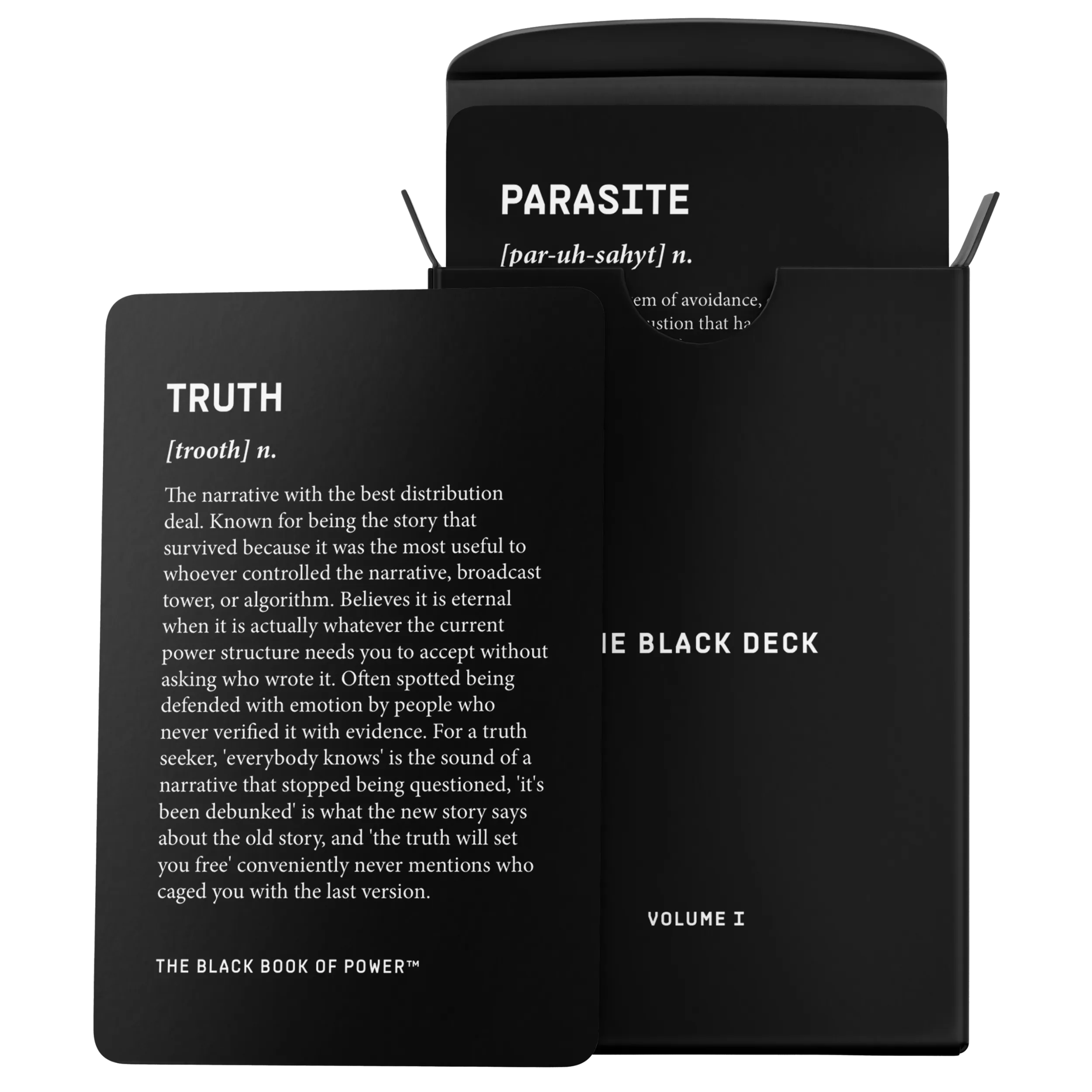
There is a school of therapy that will help you circle your shadow for 30 years, approaching when you feel brave and retreating when the room grows warm, until you can discuss your darkness with the fluency of a museum docent and never once integrate it. The Black Book of Power proposes a ruder schedule. The inner saboteur it calls the Parasite is NOT a wounded child to be befriended over a decade, but the current non-sovereign identity defending itself, a set of neural pathways grooved so deep that the brain treats their dismantling as a threat to survival. So you must now ask yourself if you are willing to negotiate with a parasite.
Ideally no. You kill it, and you do the killing now.
This is precisely where readers misuse the term, so the correction earns its place. The Parasite is internal. It is the voice that arranges the delays, manufactures the fatigue, and supplies the reasonable excuse at the exact moment action becomes possible. It is not the relationship in the consulting room, and it is not another person. What runs between a dependent client and a needed therapist is the Contract, and the slow exchange of bleeding and feeding. The Parasite is what feeds on the potential inside each of them, and it is perfectly content to make a home in a standing appointment.
The book’s wider reframe is a change of posture toward the enemy. The disorder stops being a piece of furniture in the identity and becomes an adversary with a name, a thing to be fought instead of housed, which supplies motion exactly where acceptance has a habit of stalling. From there the later chapters move past perception into resilience, from the Marble Statue toward what the book calls Fortress Mind, a durability that no longer needs a weekly buttress, built through a compressed and deliberately intense reconstruction it names the 72-Hour Phoenix Protocol. That protocol carries explicit warnings of its own, and anyone in fragile medical or psychological condition is told to read it for the concept and keep a doctor informed before attempting the body of it.
The most contested claim in the book’s orbit concerns trauma, and it has to be stated carefully, because the subject does not forgive carelessness. The careful version is narrow. Endless, unstructured retelling can deepen the groove it means to smooth, keeping a memory hot and easily triggered rather than letting it cool, and the strongest evidence for treating trauma favors structured, finite methods over open-ended processing that quietly becomes a way of life. Nobody serious is claiming the injury is imaginary, or that anyone should face it alone.
The book’s contribution here is a change of direction. Instead of returning each week to rehearse what happened, the reader is asked to confront what the injury has cost: the selves it foreclosed and the lives it has been quietly preventing. The book stages this as the Museum of Unlived Lives, a walk through every version of you that inaction has so far refused to permit. The aim is to convert a grief that renews itself into a usable anger, and to let the word survivor become a chapter that closes rather than an address you live at.
None of this licenses the obvious misreading, and the book does not pretend it does. A person in acute crisis needs skilled, present help, and the protocols say directly that severe depression, dissociation, active suicidal thoughts, and anything in genuine medical territory are reasons to bring a professional in. If you are in that place now, the help that matters is the kind with a pulse on the other end, a crisis line such as 988 in the United States or its local equivalent, and a clinician who knows you. Sovereignty is the goal for someone stranded in maintenance but it is not a dare flung at someone who is drowning.
The reaction from the guild is about what you would expect from any guild whose membership model has been questioned. Practitioners who cut session frequency or speak openly about client autonomy find themselves accused of abandonment, working beyond their scope, of dangling impossible outcomes before vulnerable people. The complaints, tellingly, come from colleagues, not clients, the signature of professional self-protection more than of concern for the wounded.
The official cautions warn against brief interventions that promise too much, and praise the value of sustained relationships and ongoing support, a vocabulary that manages to make permanence sound like devotion. A few clinicians have handed back their licenses rather than keep practicing to a standard that, in their reading, rewards retention over recovery. Whatever one makes of that decision, it is not the conduct of people who believe the system they left behind was working.
Set the caricature down, because the book does, and so should anyone arguing in good faith. This is not a war on therapy. Crisis work saves lives. Skilled, finite help through a specific passage is among the more valuable things one person can do for another. The shadow the field would rather not name is the drift from acute care into permanent maintenance, the way relief curdles into dependency and a hand offered becomes a hand that is never released. When the practitioner needs the client to keep needing, and the client cannot function without the practitioner, and the whole arrangement depends on no one quite getting better, something has gone wrong that no amount of warm vocabulary repairs.
Both sides of the chair were already feeling this, so The Black Book of Power postures that real healing tends toward independence, and, for most people, sovereignty is the work of months. Most importantly, the Parasite keeping you wounded may have made its home in the appointment itself. So one question outlives all the others: does the cure require the disease? And if your first instinct, having read that, is to book a session to discuss why it unsettled you, you have just met the mechanism.
FAQ
Yes. Call it the subscription model of the soul: the same chair, the same problems given fresh vocabulary, validation at $200 an hour that sends you home understood and somehow never finished. When insight stops converting into change, processing becomes the problem — you become a professional patient, permanently one breakthrough away, scheduling your week around the hour that was supposed to make itself unnecessary.
The economics are uncomfortable: a client made well in 10 sessions is worth a few thousand dollars; the same client maintained for two years is worth many times that. That doesn’t make therapists villains — many are absorbing their clients’ fear 50 minutes at a time and bleeding themselves. But the structure rewards maintenance over graduation, and pretending otherwise protects the structure, not you.
When circling replaces movement: your story is worn smooth as a river stone, sessions validate more than they transform, and leaving feels like disobedience rather than graduation. The test is transformation over transaction — integration without the endless circling. One caveat made explicitly: in real crisis, the help that matters has a pulse on the other end, such as 988 in the United States, and a clinician who knows you.
Readers in this position usually start with the 21-Day Empathy Protocol in Chapter 4, ‘The Marble Statue’ — understanding without absorption, a thing the profession assumes is impossible. Chapter 5, ‘The Parasite,’ asks the harder question: whether the wound keeping you booked has made its home in the appointment itself. The Black Book of Power is sold only at stantaylor.com.

The Black Book of Power


Conversational Narcissism: The Cannibal at the Table
Why you keep consuming the people in front of you to fill a hole dug in childhood.

A Lesson in Power Dynamics at Work
See how getting good at your job switches off the brain circuit that reads power.
The Fawn Response: An Education in Disappearing for Others
Why does being useful feels like the surest way to be loved?

The Know-It-All Personality: Why the 'Smartest' Person Builds Nothing
Why does the 'smartest' person in the room tend to build nothing?
Therapy Dependency: When Therapy Needs You to Stay Broken
In reading this, you will meet the one product the industry cannot afford to cure: the perpetual patient.

Threshold Addiction: The Dopamine of "Almost"
Why does planning feel better than doing?

Am I the Toxic One? An Honest Diagnostic
Close the wound or bleed to death believing your emotional hemorrhaging is holy.

How To Manipulate a Narcissist
Why does this person make me feel like I'm losing my mind?
The Covert Narcissist: How to Recognize the Hidden Predator
The covert narcissist is dangerous precisely because the disguise is weakness.

Self-Sabotage: Why You Do It and How to Kill the Pattern
You don't lack discipline. You're running a program that trades your future for a small, guaranteed hit of safety.

10 Signs of Manipulation (and the Counter for Each)
The ten tells a professional manipulator hopes you never learn, and the counter for each.
Dark Psychology: The Complete Guide (From Someone Who Used It)
What dark psychology actually is, from someone who ran the machinery for 23 years.

How to Deal With a Narcissist Without Losing Yourself
You cannot change a narcissist. You can become the person their tactics no longer work on.

The 9 Best Dark Psychology Books, Ranked by Someone Who Lived It
Nine dark psychology books ranked by someone who ran the plays for 23 years, and what each one will not tell you.
What Is a Dark Empath? Traits, Signs, and the Real Danger
The dark empath is dangerous precisely because empathy was supposed to be the safety feature.

The 12 Traits of a Narcissist and What They Reveal
Twelve traits, one mission: defending a self-image that must never be questioned.