



Quick answer: Threshold addiction is your brain’s love affair with anticipating change rather than achieving it. You consume preparatory activities—researching, planning, organizing—that deliver dopamine without the risk of real action. Studies show the ventral striatum activates more strongly anticipating rewards than achieving them; evolution wired you to get higher on the hunt than the feast.
You've been "about to" start your business for three years. Your browser bookmarks overflow with workout programs you'll begin Monday. That online course you purchased six months ago sits at 3% completion, but you've already bought two more because this time you've found the perfect system. You spend Sunday evenings crafting color-coded schedules you'll abandon by Tuesday lunch. You know more about productivity methods than anyone in your office, yet your actual output remains mysteriously average. The stack of self-help books by your bed has grown so tall it's become furniture, each spine cracked at chapter two.
This is the threshold addiction: your brain's love affair with the anticipation of change rather than change itself.
The term "threshold addiction" captures a phenomenon neuroscientists are beginning to understand with disturbing clarity. It describes the compulsive consumption of preparatory activities—researching, planning, learning, organizing—that deliver neurochemical rewards without requiring the risk of actual action. The word "threshold" derives from the Old English þrescold, the piece of timber at the bottom of a doorway, the boundary between inside and outside. But for millions of people, the threshold has become a place to live, and not a place to cross, a comfortable liminal space where the dopamine flows freely and failure remains impossible because you haven't actually tried yet.
It goes beyond simple procrastination, though researchers have found the two share neural pathways. Threshold addiction is procrastination's more sophisticated cousin, dressed in the clothing of productivity and self-improvement. While the procrastinator avoids work entirely, the threshold addict performs elaborate rituals of almost working, maintaining a constant state of preparation that feels like progress but never quite arrives at the destination.
Meta-analyses of 45 fMRI studies reveal that your ventral striatum—the brain's reward center—shows stronger activation during anticipation of rewards (effect size 0.42) than during actual achievement (0.37). Evolution wired you to get higher on the hunt than the feast. This made sense when resources were scarce and constant seeking meant survival. But in our modern landscape of infinite online courses and endless self-optimization content, this same wiring has created a $48 billion self-help industry that grows by feeding your addiction to almost. The numbers tell the story: 80% of self-help consumers are repeat customers, returning regardless of whether previous programs worked. They're seeking the next hit of possibility.
The mechanism operates through what Kent Berridge's research identified as the dissociation between "wanting" and "liking" in the brain. The popular belief is that dopamine mediates pleasure, but it's actually wanting, craving, and seeking. The experience of satisfaction involves entirely different neural circuits, the opioid systems in tiny "hedonic hotspots" in the nucleus accumbens shell. This is why scrolling through productivity videos feels better than being productive. Your brain literally rewards you more for wanting to change than for changing. It's what I describe in The Black Book of Power as being trapped in your own "factory settings"—those deep patterns of behavior programmed so early you mistake them for identity.
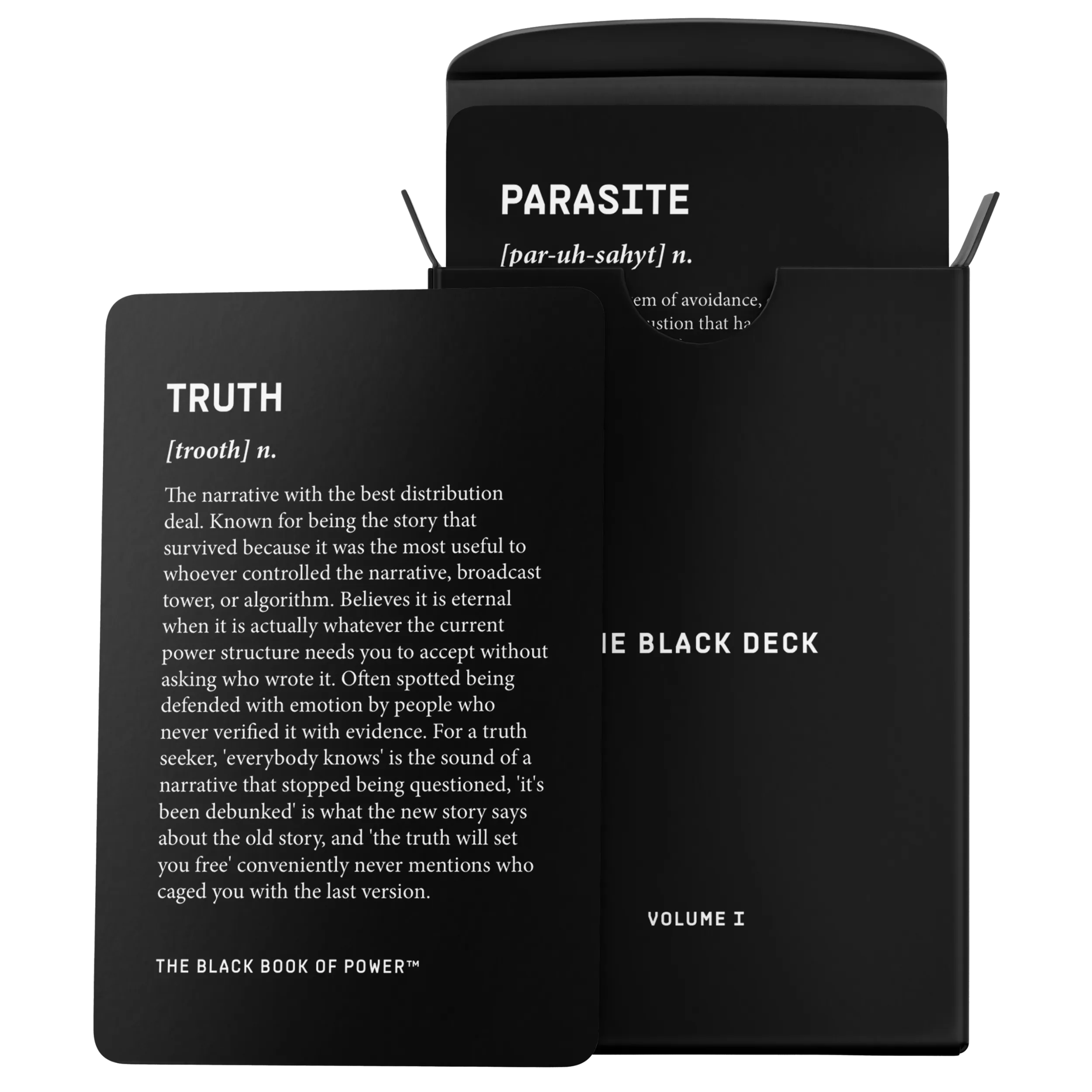
Although threshold addiction may look like individual psychology gone haywire, it's actually a cultural phenomenon rooted in the collision between Protestant work ethic and digital capitalism. Researchers have documented how choice overload—the paralysis that occurs when options exceed our cognitive processing capacity—has exploded in the digital age. The average adult now makes 35,000 decisions daily, each one a small drain on the prefrontal cortex until even simple choices become overwhelming. The threshold addict's solution? Perpetual research. Endless preparation. The Parasite, as I call it—that inner voice of self-doubt that "feeds on your potential" by keeping you safely stuck in planning mode.
The neuroscience is unambiguous. Studies using fast-scan cyclic voltammetry in rats show a sustained dopamine "ramp" throughout the anticipatory period before action—your brain essentially mainlines motivation chemicals while you're preparing. Meanwhile, actual achievement shows reduced nucleus accumbens activation as activity shifts to the medial prefrontal cortex. You're neurologically programmed to prefer the menu to the meal. PET and fMRI studies confirm this with disturbing precision: the correlation between substantia nigra activation during anticipation and ventral striatum dopamine release reaches r=0.748. Your brain is having a party while you plan, and a business meeting when you perform.
This anticipatory preference interacts catastrophically with another cognitive quirk: the planning fallacy. Roger Buehler's research tracked honors students predicting thesis completion. Average prediction: 34 days. Average reality: 56 days. Only 30% finished within their predicted timeframe. Even their "worst-case scenario" predictions of 49 days proved optimistic. The mechanism is revealing: when predicting, 74% of thoughts concerned future scenarios while only 7% referenced past experiences. We're so intoxicated by imagined futures that we become amnesiacs about actual history.
But why does this addiction persist even when we consciously recognize it? The answer lies in the amygdala, the brain's threat-detection system that treats change like a predator. fMRI research shows the amygdala activates within 300 milliseconds when facing uncertainty—faster than conscious thought. The prefrontal cortex, your rational override system, takes several seconds to come online. In that gap, your ancient survival instincts have already voted for the safety of preparation over the risk of action. This is the neurobiological root of what I call "The Contract"—our unconscious agreement to trade sovereignty for safety, authenticity for approval.
The basal ganglia compounds the problem. This region automates repeated behaviors into energy-efficient routines. Studies by Wood and Rünger demonstrate that after 21 to 66 days of repetition, behaviors transfer from conscious prefrontal control to automatic basal ganglia execution. Every morning you spend browsing productivity Reddit instead of working strengthens the neural pathway of preparation. Every evening you spend watching "study with me" videos instead of studying deepens the groove. Your brain literally rewires itself to make threshold addiction your default mode.
Perhaps most insidiously, perfectionism research reveals a cruel twist. Meta-analyses encompassing 10,454 participants show perfectionism correlates with procrastination at r=.23. The gap between standards and performance (what researchers call the APSR Discrepancy) shows even stronger effects at r=.40. Perfectionists don't procrastinate despite high standards—they procrastinate because of them. When your standards are impossible, preparation becomes the only space where you can maintain the illusion of potential greatness. Action would shatter it.
So how do you break free when your own neurology conspires against you? The research points to several evidence-based interventions, though none are as satisfying as buying another self-improvement book.
First, recognize that identity-based change beats goal-based change. Every morning you spend "preparing to write" reinforces your identity as "someone who prepares." Every morning you write one sentence—just one—votes for "someone who writes." The difference seems trivial but compounds neurologically. After enough repetitions, the basal ganglia begins automating the new pattern. You're literally rewiring your default mode, a process I describe as killing the Parasite through "sacred violence"—taking immediate, irreversible action that burns the bridge back to preparation.
Second, commitment devices work, but only when they actually commit you. Dan Ariely's research shows self-imposed deadlines improve performance, but externally imposed evenly-spaced deadlines work even better. The hierarchy is clear: removing your ability to delay beats trusting yourself not to delay. This might mean paying for a coworking space you can only use for actual work. Or using website blockers that can't be disabled, if you can manage the irony of researching the perfect blocker for three days before installing it.
Third, leverage what Peter Gollwitzer calls "implementation intentions"—if-then planning that automates action. "If it's 9am, then I open my document and type one word." Compare that with "I'll write when I feel ready." You need a specific trigger paired with a specific action. Meta-analyses show effect sizes of d=.65, moving you from the 50th to the 74th percentile in follow-through. The mechanism bypasses conscious decision-making, transferring control from your overthinking prefrontal cortex to automatic processes.
Fourth, embrace what productivity experts call the two-minute rule, though not in the way you think. The rule is about making the first step so small that your amygdala doesn't recognize it as a threat. Writing a book is terrifying. Opening a document isn't. Your threat-detection system, evolved to spot lions in tall grass, can't distinguish between social risks and physical danger. By starting below its threshold of concern, you can begin building momentum before your anxiety realizes what's happening.
Fifth, recognize that accountability structures work through social commitment more than willpower. Public declaration of specific, measurable actions (not goals) creates reputational stakes that your social brain takes seriously. But beware the threshold addict's favorite accountability dodge: being accountable for preparation. "I'll research five articles" maintains the addiction. "I'll write 200 words" begins breaking it. This is what I call moving from "The Walking Dead" state of unconscious patterns to conscious sovereignty over your actions.
Finally, understand that modern procrastination research increasingly recognizes emotion regulation (not time management) as the core issue. Threshold addiction is fundamentally about avoiding the negative emotions of potential failure, judgment, or discovering you're ordinary. Every moment of preparation is a moment of preserved possibility, where you could still be great, still be special, still be the person who would write an amazing novel if only you had the time. Action threatens this comfortable fiction.
One last point worth considering: threshold addiction might be the most socially acceptable addiction in modern culture. Unlike other dependencies that disrupt life, this one looks like ambition. Your shelves of unread books signal intellectual curiosity. Your knowledge of productivity systems suggests professional development. Your endless research appears as thoroughness. Society rewards the performance of potential improvement even—perhaps especially—when it never materializes into improvement itself.
This is the final trap, the one that makes threshold addiction so pernicious. It doesn't destroy your life in obvious ways. You remain functional, employed, even successful by external measures. But internally, you're haunted by the gap between who you could be and who you are, a gap that widens with every year you spend preparing to cross it. As I warn in The Black Book of Power, the most effective prisons are the ones we build for ourselves, where the bars are made of our own untested potential and the lock is our addiction to the feeling that we're about to escape. The threshold is where dreams go to feel good about dying.
FAQ
Threshold addiction is your brain’s love affair with the anticipation of change rather than change itself. It’s three years of being ‘about to’ start the business, courses abandoned at 3% completion, color-coded schedules dead by Tuesday. Meta-analyses of 45 fMRI studies show the ventral striatum fires harder during anticipation of rewards (effect size 0.42) than during actual achievement (0.37). Almost literally feels better than done.
Because dopamine pays out at the threshold. Anticipation activates your reward center more strongly than achievement does, so buying the course, drafting the schedule, and researching the method deliver real chemical payoffs with zero risk of failure. Doing, by contrast, burns scarce executive resources — the average adult already makes 35,000 decisions a day. Your brain isn’t lazy; it’s arbitraging the cheaper high.
Because the industry monetizes the threshold. The $48 billion self-help business grows by feeding your addiction to almost: 80% of its consumers are repeat customers who return regardless of whether previous programs worked. Each new system delivers the anticipation high, then joins the stack of books cracked at chapter two. The product isn’t transformation — it’s the renewable feeling that transformation is imminent.
It opens Part I with the threshold addict — the person who mistakes preparing to change for changing. Chapter 5, ‘The Parasite,’ then targets the inner voice that keeps you researching instead of acting, prescribing Guillotines: irreversible actions that cut off retreat. As the book warns, the most effective prisons are the ones we build for ourselves. The Black Book of Power — only at stantaylor.com.

The Black Book of Power



Conversational Narcissism: The Cannibal at the Table
Why you keep consuming the people in front of you to fill a hole dug in childhood.

A Lesson in Power Dynamics at Work
See how getting good at your job switches off the brain circuit that reads power.

The Fawn Response: An Education in Disappearing for Others
Why does being useful feels like the surest way to be loved?

The Know-It-All Personality: Why the 'Smartest' Person Builds Nothing
Why does the 'smartest' person in the room tend to build nothing?

Therapy Dependency: When Therapy Needs You to Stay Broken
In reading this, you will meet the one product the industry cannot afford to cure: the perpetual patient.
Threshold Addiction: The Dopamine of "Almost"
Why does planning feel better than doing?

Am I the Toxic One? An Honest Diagnostic
Close the wound or bleed to death believing your emotional hemorrhaging is holy.

How To Manipulate a Narcissist
Why does this person make me feel like I'm losing my mind?
The Covert Narcissist: How to Recognize the Hidden Predator
The covert narcissist is dangerous precisely because the disguise is weakness.

Self-Sabotage: Why You Do It and How to Kill the Pattern
You don't lack discipline. You're running a program that trades your future for a small, guaranteed hit of safety.

10 Signs of Manipulation (and the Counter for Each)
The ten tells a professional manipulator hopes you never learn, and the counter for each.

Dark Psychology: The Complete Guide (From Someone Who Used It)
What dark psychology actually is, from someone who ran the machinery for 23 years.

How to Deal With a Narcissist Without Losing Yourself
You cannot change a narcissist. You can become the person their tactics no longer work on.

The 9 Best Dark Psychology Books, Ranked by Someone Who Lived It
Nine dark psychology books ranked by someone who ran the plays for 23 years, and what each one will not tell you.

What Is a Dark Empath? Traits, Signs, and the Real Danger
The dark empath is dangerous precisely because empathy was supposed to be the safety feature.

The 12 Traits of a Narcissist and What They Reveal
Twelve traits, one mission: defending a self-image that must never be questioned.