


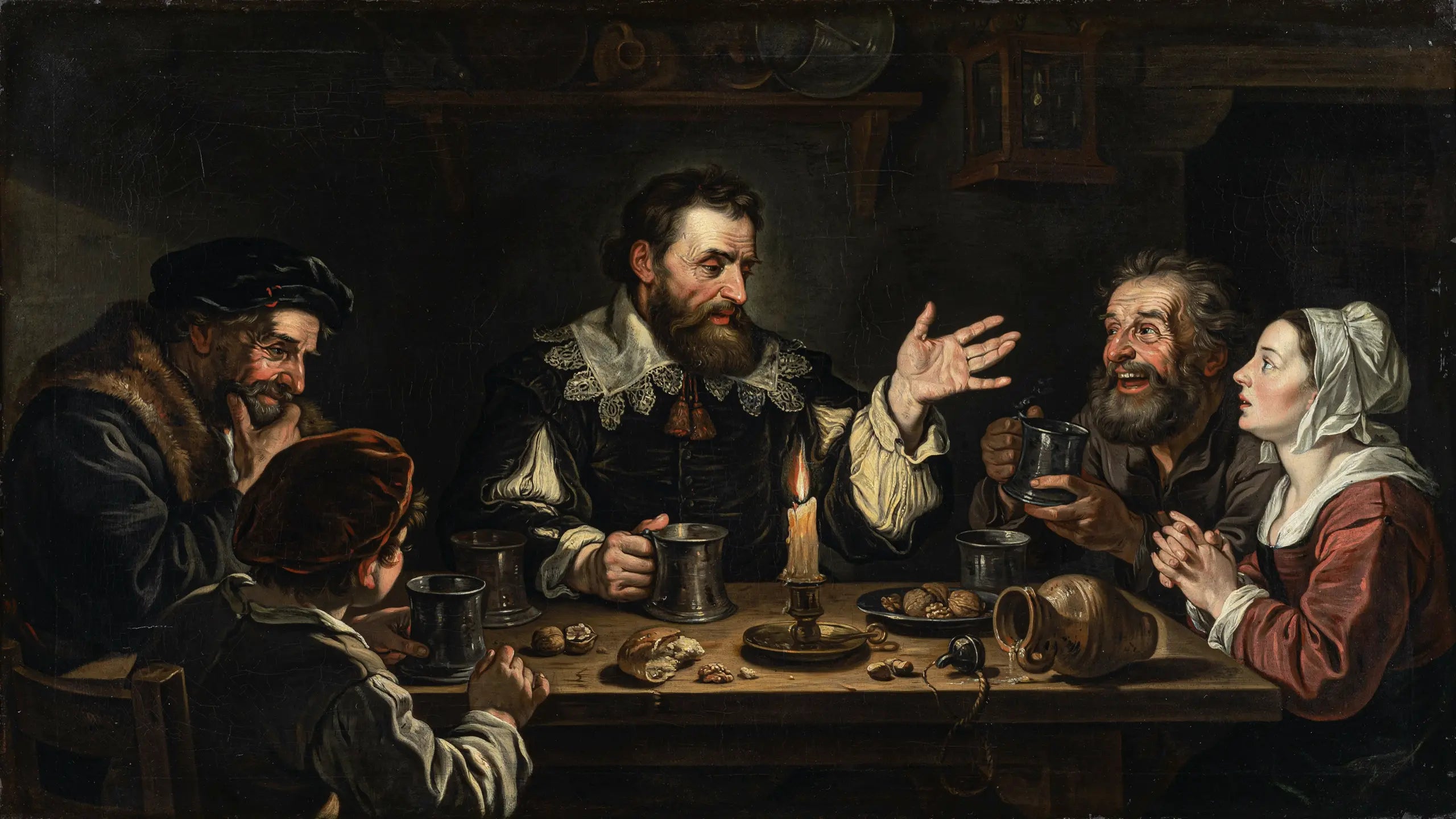
Quick answer: Dark psychology is the study and applied use of manipulation, coercion, and covert influence tactics that bypass a target's conscious judgment to steer behavior. It draws on real research into the dark triad, cognitive bias, and conditioning. Learned defensively, it lets you see manipulation coming, and refuse it.
Why am I the one apologizing? You are staring at your phone, thumb hovering, composing a message to smooth over a situation you did not create. An hour ago you were certain. You had a boundary, a plan, a clean no. Now the certainty has drained out of you like water from a cracked glass, and in its place is a low hum of guilt you cannot source. You reread their last text. Nothing in it is technically cruel. And yet you feel small, wrong, and strangely eager to make it right.
Notice what just happened. Nobody raised a voice. Nobody made a threat you could screenshot and show a friend. The pressure arrived without a body, and by the time you felt it, it was already inside your decision-making, wearing your own reasoning like a borrowed coat. You think you are choosing. You are complying.
You have just met dark psychology in the wild, which is the only place it ever operates. Forget the lab or a villain's monologue, but in the ordinary machinery of a Tuesday: a text, a sigh, a favor that somehow became a debt. I ran that machinery professionally for twenty-three years, then walked away from it. What follows is how the machine works, and how you switch it off.
Dark psychology is an umbrella term for the deliberate use of influence to move a person toward an outcome that serves the manipulator, using methods the target would reject if they saw them clearly. The defining feature is concealment. Ordinary persuasion argues with your conscious mind. Dark psychology routes around it, targeting the older systems underneath, the ones that decide how you feel before you decide what you think.
The word itself is a hybrid. Psychology comes from the Greek psukhe, breath or soul, joined to logia, the study of. Dark is the newer graft, borrowed from an academic construct that gave the whole field its spine. As a popular label, dark psychology is a folk category collecting very real, well-studied behaviors under one memorable name. That is the dark psychology definition to carry: a toolkit, most of it with a peer-reviewed paper behind it.
You may think of dark psychology as a secret art practiced by a shadowy few, but it actually the industrial default of modern life: advertising, political campaigning, algorithmic feeds, and a surprising amount of ordinary parenting run on the same levers. A century ago Edward Bernays, the father of public relations, called it the engineering of consent, in a 1947 essay treating your agreement as a product to be manufactured. Call it what it is: the compliance assembly line. Your yes, mass-produced, packaged as your own idea. Obedience is closer to the human default than flattering self-image admits: a 2017 restaging of Milgram's experiment in Poland found 90 percent of participants willing to deliver the maximum shock.
The serious study of dark psychology starts with three personality traits that keep showing up together in people who manipulate as a default strategy. In 2002, two personality researchers measured them across 245 undergraduates and named the cluster the dark triad: narcissism, Machiavellianism, and psychopathy. They found the three overlap but stay distinct, sharing one common floor: low agreeableness. In plain terms, the ways of being callous are related, but they are not the same disease. Psychologists later compressed the cluster into a rapid twelve-item screen, the Dirty Dozen, validated across 1,085 people in 2010, so the traits could be measured in a minute.
Narcissism is the hunger for status and admiration, and the rage when it is withheld. Machiavellianism is cold strategy, the willingness to treat other people as terrain. Psychopathy is the low-anxiety, low-empathy end, impulsive and unbothered by your pain. Most manipulators you will meet are sub-clinical, the everyday dial-turned-up-two-notches version: the coworker who takes credit, the partner who rewrites last night's argument, the friend whose generosity always arrives with an invoice attached. Narcissism also ships in a hidden model: the covert narcissist, who runs the same extraction through victimhood and false modesty. The full profile is catalogued in the 12 traits of a narcissist.
They are common enough to matter: a 2021 systematic review pooling 15 studies and 11,497 people put psychopathy's prevalence around 4.5 percent in the general adult population, and notably higher, close to 13 percent, in some organizational and corporate samples. The office rewards exactly the traits that hurt you: a 2026 meta-analysis found the dark triad a robust predictor of workplace bullying, with psychopathy the strongest driver at a correlation of .53. A 2020 study of 991 people even isolated a "dark empath" subtype, roughly one in five, that pairs these dark traits with high empathy. If you want the full anatomy of the personality that weaponizes warmth, start with the signs of a dark empath, the most dangerous type precisely because empathy was supposed to be the safety feature.
Skip the urge to treat the tactics below as stage-magic tricks. Each maps to a documented mechanism, and I am describing them so you can recognize the shape of one while it is happening. Read each as a fingerprint.
Give warmth on an unpredictable schedule, withhold it just as unpredictably, and you build an attachment stronger than steady kindness ever could. It is the same reward mechanism that keeps a person at a slot machine: a study of the near-miss effect found that dopamine activity at D2 receptors amplifies the pull of an almost-win, making a loss feel like progress. In a relationship, the intermittent warmth is the almost-win. You stop chasing the person and start chasing the next hit of their approval. It is the mechanism under love bombing, and a 2017 study of 484 young adults found the tactic tracks with narcissism and insecure attachment. The unpredictability is the point.
Your mind runs on shortcuts, and shortcuts can be pre-loaded. In 1974, Amos Tversky and Daniel Kahneman showed that a single arbitrary number silently anchors your later judgment: people who multiplied a descending sequence guessed a median of 2,250, while those who saw it ascending guessed 512, for a problem whose real answer was 40,320. A manipulator anchors deliberately: the absurd opening demand that makes the real one sound reasonable, the first price, the framing sentence that colors everything after it.
Words do work below the level you are auditing them at. In a classic experiment, giving people a reason, any reason, to let you cut in line raised compliance sharply: adding a hollow "because" pushed agreement from 60 percent to over 90 percent, even when the reason was pure filler. The word triggers an automatic script. Manipulators exploit the same grammar. "We need to talk" is a threat with no content, engineered to make you supply the dread yourself. Presuppositions smuggle claims in as assumptions. The question that begins "why do you always" has already convicted you before you answer.
Nothing bonds a group or motivates a target like a shared enemy. Point at a common threat and you deactivate the empathy that would otherwise slow people down. The manipulator who isolates you does it by supplying villains: your friends are jealous, your family does not understand, everyone who warns you about them has an agenda. Each manufactured enemy is a wall, and the walls are always built toward the same center, which is them. Every villain, as the argument goes, is a personal trainer.
People run on stories, and a good story installs beliefs that arrive feeling like your own conclusions. The manipulator offers a narrative in three layers: a surface tale as decoy, a mirror that reflects your own life back so you feel seen, and underneath, the belief they want you to hold. Once you are inside the story, contradicting evidence gets rewritten to fit. Algorithmic feeds do this at industrial scale.
Every person carries standing appetites: fear, status, belonging, control, validation, comfort. Manipulation rarely creates a new desire. It finds an existing one, salts the wound to make it ache, paints a promised land where the ache disappears, and positions itself as the only bridge across. This is the engine under most advertising and every cult. The tactic is finding the bleeding first.
The most corrosive technique attacks your instrument for making them: your grip on what is real. Gaslighting is the sustained effort to make you doubt your own memory and perception. Researchers documenting it in 2023 found that across 315 adults, dark-tetrad traits predicted greater acceptance of gaslighting tactics in intimate relationships. Gaslighting is also structural: a 2019 sociological study built on 43 survivor interviews showed it works by mobilizing wider stereotypes. Its close cousin is DARVO, short for deny, attack, and reverse victim and offender: confront the manipulator and they flip the board, becoming the wounded party while you apologize. In a 2022 study of 89 women assaulted in college, nearly half reported DARVO from the person who harmed them.
Recognition is faster with a reference you can scan. The table pairs each technique with what it looks like on an ordinary day and the most useful counter. The counters are not spells; they are habits, and habits take reps.
| Technique | What it looks like on a Tuesday | The counter |
|---|---|---|
| Intermittent reinforcement | Hot then cold, affection you can never predict or earn reliably | Track the pattern in writing; consistency, not intensity, is the real signal of safety |
| Anchoring and framing | An extreme first demand or price that makes the next one feel fair | Name the anchor out loud, then decide from your own reference point, not theirs |
| Loaded language | "We need to talk," "why do you always," a hollow "because" | Ask for the specific, literal request; refuse to fill in the blank with dread |
| Manufactured villains | Everyone who warns you about them is jealous or has an agenda | Notice who is being cut off; isolation is the tell, not the reasons given |
| Narrative control | A story that explains away every contradiction in their favor | Hold the raw facts separate from the interpretation offered |
| Desire installation | An offer aimed exactly at your loneliness, ambition, or fear | Ask what wound this is pressing on, and whether the ache is yours or manufactured |
| Gaslighting and DARVO | Your memory is wrong; confronting them makes you the villain | Keep an external record; reality does not need their permission |
Becoming suspicious of everyone is just paranoia, its own kind of prison. Defense is a small number of reliable instruments you reach for when the low hum starts. The first is a single question, the most portable tool here.
Ask yourself, in the middle of any interaction that leaves you feeling off: what am I being made to feel, and why now? It moves you from inside the emotion to a seat just outside it, where the emotion becomes data instead of command. Most manipulation depends on you staying fused with the feeling it induced. Name the feeling and its timing, and the spell loses its anonymity: a manipulation you can see is already failing.
The second instrument is the pre-commitment, sometimes called a Ulysses pact after the sailor who had himself tied to the mast so the sirens could sing all they liked. You cannot reliably resist pressure in the moment, because the moment is when your judgment is already compromised. So you decide in advance and remove your ability to cave. You tell a friend the boundary before the conversation. You set the rule that you never agree to anything financial the same day it is proposed. You build the fortress when the weather is calm.
The third is knowing the specific shapes. General wariness is weak; pattern recognition is strong. When you can name the difference between love bombing and affection, or a fair ask and an anchored one, the tactic loses its cover. This is why cataloguing the signs of manipulation matters more than vague vigilance, and why understanding your own cognitive biases is armor rather than trivia. You cannot defend a door whose hinges you have never looked at.
There is a harder truth underneath all three. The most reliable entry point a manipulator has is a person who cannot tolerate someone else's disappointment. If saying no makes you physically anxious, if approval works on you like a drug, you are pre-manipulated, and every tactic above finds a shorter path in. That vulnerability installs early. The chronic habit of people pleasing is a survival program written in childhood, and it can be rewritten. The same installed fears can turn inward, running as self-sabotage, so no external hand has to pull the levers at all. Repairing that removes the lever instead of dodging the hand. For the full architecture, from the master question to the pre-commitment drills, the complete defense manual against these techniques lays out the training in sequence.
Both, and the distinction matters. The individual mechanisms are unimpeachable science: anchoring, intermittent reinforcement, the dark triad, gaslighting, each with decades of peer-reviewed work behind it. What is not scientific is the packaging. There is no unified academic field called dark psychology, no journal, no diagnostic criteria. The term is a marketing wrapper that popular writers put around a real toolbox.
This matters, because a great deal of online dark psychology content sells mythology: the idea that a few sinister tricks turn anyone into a puppet-master. That is fantasy, and believing it makes you easier to manipulate because it points your suspicion at cartoon villains while the real influence walks past in ordinary clothes. Even the gaslighting literature is messy: a 2025 interdisciplinary review concluded that after years of study, the definition and measurement of gaslighting remain inconsistent across fields. The science is real. The certainty the internet sells about it is not.
Here is the complicating factor, the honest however. Not everyone who uses these tactics is a predator. You anchor a salary negotiation. You frame a hard conversation gently. Persuasion and manipulation run on overlapping machinery, and the line between them is consent and interest, which is exactly what the ethics turn on.
The most common objection is that studying manipulation makes you a manipulator, the way handling poison makes you a poisoner. But the same knowledge that lets a predator hunt is what lets a target see the hunt coming. Refusing to learn how influence works makes you unarmed in a room where everyone else, from the advertiser to the algorithm to the charming stranger, is already fluent.
There is a workable ethics here. Before you use any influence, run it through three gates. Is it true, working with real information rather than a lie? Is it respectful, treating the other person as an agent rather than a lever? Is it genuinely beneficial to them, not only to you? A nudge that passes all three, a doctor framing a treatment so a frightened patient can actually hear it, is influence in service of the person. A tactic that fails any is predation, whatever warm name it hides behind.
The deeper argument runs through everything above. Human behavior is more programmable than you would like to believe, which means your reactions, your fears, and half your desires were installed by someone, at some point, for some purpose that may not have been yours. Seeing the code is the first act of reclaiming it. The whole project is to become an unmanipulable person, the only kind who can be trusted with these tools. If you want the rules of the power game named out loud, without the mechanism or the defense, few catalogues are as blunt as Robert Greene's, which I break down in an honest summary of the 48 Laws of Power. To read more widely, the field's own literature, studies and books alike, is ranked in a guide to the best dark psychology books.
A guide like this carries a risk I would rather name than pretend away. Learn to see manipulation everywhere and you start seeing it where it is not, turning every clumsy request or ordinary bad mood into evidence of a plot. That is not sovereignty. It is a new cage with the same walls, built by your own hand this time. The goal is clarity, which includes the clarity to know when nothing sinister is happening at all.
So hold two things at once. The manipulation described here is real, common, and often aimed at you by people who mean you no particular harm and simply want their way. And your best defense was never a counter-tactic. It is the slow work of becoming someone whose yes is genuinely their own, who can tolerate another person's disappointment without dissolving, who has looked at their own installed code closely enough to tell which lines they wrote and which were written for them. The predator's whole advantage is that most people never look. Comfort, as the argument goes, is complicity when you are living inside someone else's design. The oldest and darkest technique in the book is simply counting on you not to notice. Notice.
FAQ
Dark psychology is the study and applied use of manipulation, coercion, and covert influence tactics designed to move a person toward an outcome they would reject if they saw it clearly. It is an umbrella term rather than a clinical diagnosis, collecting well-researched mechanisms like the dark triad, cognitive bias, gaslighting, and intermittent reinforcement under one name. Learned defensively, it is protection, not predation.
The recurring ones are intermittent reinforcement, the unpredictable hot-and-cold that builds compulsive attachment; anchoring and framing, which pre-set your judgment; loaded language such as "we need to talk"; manufactured villains that isolate you; narrative control that rewrites contradictory facts; desire installation aimed at an existing hunger; and gaslighting with its cousin DARVO, which attack your grip on reality itself.
The mechanisms are real and peer-reviewed; the packaging is not. Anchoring, the dark triad, gaslighting, and intermittent reinforcement each have serious research behind them. But there is no unified academic field, journal, or diagnosis called dark psychology. The term is a popular wrapper around genuine science. Trust the individual studies; distrust anyone selling it as a secret system that turns people into puppets.
The dark triad is a cluster of three overlapping but distinct personality traits named by researchers in 2002: narcissism, the hunger for status and admiration; Machiavellianism, cold strategic manipulation; and psychopathy, low-empathy, low-anxiety callousness. They share low agreeableness. Most manipulators are sub-clinical, the everyday elevated version rather than a clinical case, which is exactly what makes them hard to spot.
Use three instruments. Ask "what am I being made to feel, and why now" to step outside an induced emotion and turn it into data. Set pre-commitments, deciding boundaries and rules in advance so you cannot cave under live pressure. And learn the specific patterns, since named tactics lose their cover. Underneath all three, reduce your own need for approval, the lever most manipulation depends on.
Yes, when the goal is recognition and defense. Refusing to understand influence does not make you innocent; it makes you unarmed among fluent people. The ethical test for using any tactic is three gates: is it true, is it respectful of the other person's agency, and is it genuinely beneficial to them, not only to you. Pass all three and it is influence; fail any and it is manipulation.

The Black Book of Power



Conversational Narcissism: The Cannibal at the Table
Why you keep consuming the people in front of you to fill a hole dug in childhood.
A Lesson in Power Dynamics at Work
See how getting good at your job switches off the brain circuit that reads power.

The Fawn Response: An Education in Disappearing for Others
Why does being useful feels like the surest way to be loved?

The Know-It-All Personality: Why the 'Smartest' Person Builds Nothing
Why does the 'smartest' person in the room tend to build nothing?
Therapy Dependency: When Therapy Needs You to Stay Broken
In reading this, you will meet the one product the industry cannot afford to cure: the perpetual patient.

Threshold Addiction: The Dopamine of "Almost"
Why does planning feel better than doing?

Am I the Toxic One? An Honest Diagnostic
Close the wound or bleed to death believing your emotional hemorrhaging is holy.
How To Manipulate a Narcissist
Why does this person make me feel like I'm losing my mind?
The Covert Narcissist: How to Recognize the Hidden Predator
The covert narcissist is dangerous precisely because the disguise is weakness.

Self-Sabotage: Why You Do It and How to Kill the Pattern
You don't lack discipline. You're running a program that trades your future for a small, guaranteed hit of safety.

10 Signs of Manipulation (and the Counter for Each)
The ten tells a professional manipulator hopes you never learn, and the counter for each.
Dark Psychology: The Complete Guide (From Someone Who Used It)
What dark psychology actually is, from someone who ran the machinery for 23 years.

How to Deal With a Narcissist Without Losing Yourself
You cannot change a narcissist. You can become the person their tactics no longer work on.

The 9 Best Dark Psychology Books, Ranked by Someone Who Lived It
Nine dark psychology books ranked by someone who ran the plays for 23 years, and what each one will not tell you.
What Is a Dark Empath? Traits, Signs, and the Real Danger
The dark empath is dangerous precisely because empathy was supposed to be the safety feature.

The 12 Traits of a Narcissist and What They Reveal
Twelve traits, one mission: defending a self-image that must never be questioned.