


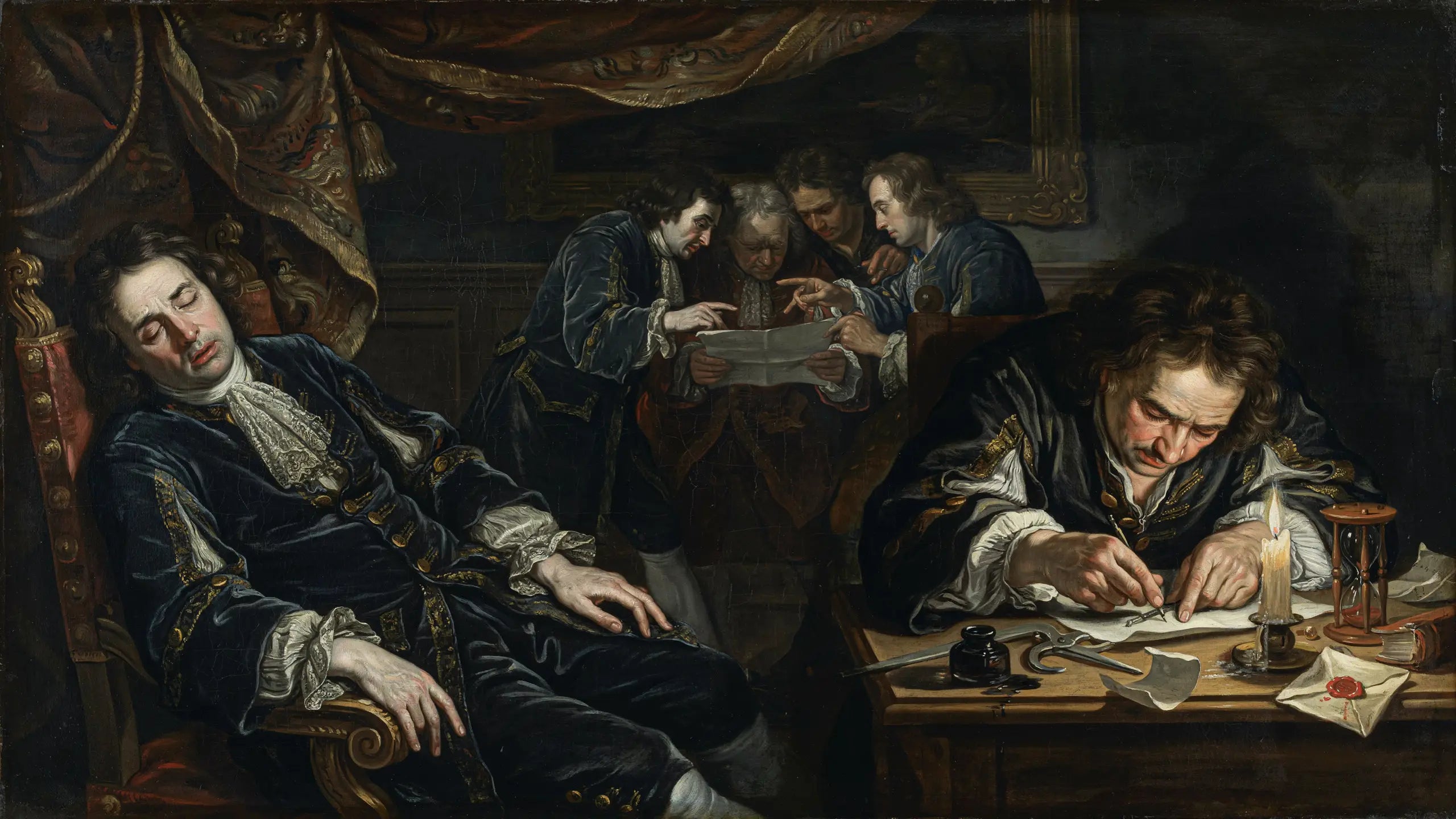
Quick answer: The room stops seeing you because excellence puts you in a ‘competence trance.’ You run two brains—the Maker that builds and the Courtier that tracks status—and deep focus silences the status circuit. Your brain registers rank shifts as powerfully as money, yet you were raised to ignore that wing. Audit your attention to wake it.
"The work will speak for itself" is the lie you tell yourself while you repair something that ships tomorrow under a name that is not yours.
The repair is clean with the unshowy symmetry of a problem solved by someone who actually understands it. It's also the reason no one will ever see it. You close the laptop with that warm hum of having been useful, and you file the hum under progress. By Thursday the promotion has gone to a man whose chief gift is narrating thin work in an unhurried baritone, a man who has never once stayed past six. You send your congratulations. You mean them, more or less, and the small swallow that goes down with them is the part you have stopped examining.
Every mentor and motivational graphic has told you that the room skips you because the room is corrupt, or political, or blind to merit. The story flatters you and happens to be wrong. Something stranger is loose inside your own skull, and you installed it yourself by becoming excellent.
This is the competence trance.
You run two brains at work, and they cannot both stand at full height. The first one builds. It codes, drafts, models, fixes the thing, closes the ticket, and loses all track of the clock while it does so. The second one watches the room. It registers who deferred to whom, the half-beat of silence before the boss agreed, the name that keeps surfacing in the warm part of the meeting and the name being edited out of next quarter without anyone saying so.
Give them names worth keeping. The Maker and The Courtier.
The Courtier has an address in the tissue. Put a person in a scanner and let them watch their own rank climb and fall inside a live social game, and the brain convenes a specific committee to do the watching: the medial prefrontal cortex, the amygdala, the dorsolateral prefrontal cortex, the working parts of how the brain registers social rank. The same experiment turned up a fact your nervous system has always known and your professional creed has always denied. A shift in standing lit up with a force comparable to a shift in money. Your brain runs the alarm in a wing of the building you were raised never to enter.
Two animals, one cage, one food supply. That is the layout, and the rest of your career has been an argument about who gets fed.
Deep focus runs on a temporary down-shift of the prefrontal cortex. Neuroscience gave the effect a graceless name, transient hypofrontality, and the plain version is that when you drop into flow, the brain dials down its own front office: the seat of self-monitoring, social calculation, and the internal clerk who keeps a ledger of how you are landing. Jazz pianists improvising inside a scanner showed broad deactivation across exactly this ground. The inner critic falls silent. The inner courtier falls silent in the same instant. They share a wall.
Hold that against the previous paragraph and the cruelty resolves into focus. The prefrontal and amygdala ground that tracks your rank sits next door to the prefrontal ground that flow sedates. Every hour inside the trance, the good hours, the ones that make you indispensable, is an hour the Courtier spends under anesthetic. You trained one animal to the condition of an Olympian and let the other go slack in the corner, then stood there genuinely puzzled at the fights you keep losing without noticing they began. A hand reaches for the wrong glass before thought arrives. A decision about your future gets made four feet from your chair while you are gorgeously, profitably, elsewhere.
No induction packet mentions this on the first morning. Competence and power-perception compete for the same square inch of skull, and on any given afternoon only one of them is awake.
Consider the brain as the most parsimonious accountant ever to draw breath. It declines to spend a farthing of attention on anything it can already foresee. Every skull in your meeting is forever guessing the next instant and laying out its scarce funds only on the gap between the guess and the event: the surprise, error, and thing it failed to see coming. This is the reigning account of what the cortex is mainly up to, which is the minimizing of surprise and the treatment of prediction error as the only news fit to print. Whatever the brain can foresee, it stops watching. Expectation, the lab confirms, flattens the response to anything predicted and beside the point. Reliability, it turns out, is a sedative you administer to other people's attention.
Follow that to its address in your career. Every flawless delivery teaches the building to forecast you. You become low-surprise, high-confidence, fully modeled, and a known quantity, which is the courteous term for a quantity nobody needs to look at twice. The reward for being dependable is to be depended on and then, in the eyes of the room, to disappear. Picture the difference between a wallet left on a table and a fact everyone already knows. The wallet gets overlooked. The known fact gets predicted, filed, and skipped, and you have spent a decade becoming the known fact. Meanwhile the loud man with the thin work keeps emitting small surprises, errors, and uncertainties about what he might do next, and attention slides toward him for the same reason your eye snags on a flickering bulb and glides past a steady one. You optimized yourself into a solved equation and nobody re-reads a solved equation.
You flatter yourself that the cure is simply to notice all this and adjust. Mastery has already removed the noticing. As you sink deeper into a craft, the mental models that run it set fast, stable, and almost impossible to interrogate from the inside. The field calls it cognitive entrenchment, and the finding is unsentimental. The more expert you grow, the more efficiently you read the world through the schema you already hold, and the less able you become to see the assumptions holding it up. Inside your discipline the hardening is a gift, the very source of your speed. Pointed at the rules of advancement, it becomes a sealed door. The schema you set somewhere around your second promotion reads "good work earns its reward," and you have run that program to such acclaim in the technical layer that you cannot imagine it failing in the political one, even as the proof files past your desk each quarter wearing somebody else's lanyard.
A voice keeps watch at that door, and you have been tipping it for years. It assures you that visibility is for the insecure, asking to be seen is a species of begging, and that the dignified move is to let the work stand mute. Distrust it on contact, because it does not work for you. It is the Parasite, a lodger assembled out of other people's fear that moved in early, slipped into the factory settings of a certain kind of childhood, the home that taught you to mistake self-erasure for virtue, and it now pays its rent in compliments while starving the one circuit that could rescue your career. "I don't play politics," it says, in your own voice, and you nod, and the Courtier sleeps through another meeting.
The exhaustion arrives first in the body, a grey weight behind the eyes that no amount of sleep will lift. "I'm just tired," you say, and the wellness market materializes on cue to sell you a candle and a breathing app for what is, underneath, a wiring fault. You have been manufacturing enormous value in a state that erases you from view, which means the work and the credit have come unbundled, and the gap between what you pour in and what comes back as standing refuses to close. It compounds instead, year over year, into the slow rusting of your belief that any of it registers. No candle was ever equal to that. It is the running cost of letting the Maker devour the whole brain. Treat the depletion as a readout, as it reports that you have been performing without a flaw inside the wrong machine.
Set the consolations aside and the count is colder and kinder than any encouragement. The largest synthesis of the question gathered one hundred and forty-one studies across more than fifty-seven thousand people and found that political skill reliably predicts who advances. Its firmest grip is on the sense of rising, mattering, and being valued. A second meta-analysis supplies the line that should make you set the cup down. Political skill forecasts who gets ahead after you have subtracted raw intelligence and personality from the sum. In the economy of who rises, reading the room is the main course; competence only sets the table, and you have been laying cutlery for years. Worst of all, you've been calling it integrity.
Your own description of your work completes the sabotage. Across experiments running into the thousands, capable people handed their exact scores still rated their performance below equally capable peers. Honesty about your output earns you a room that takes you at your modest word, a room already primed to forecast you into the wallpaper.
Then the loophole, which is the entire reason this essay declines the usual sermon on your helplessness. The forecasting machine carries an exception in its source code. It will still drag its attention toward a signal it cannot afford to ignore, a high-cost, high-stakes input that breaks the model, even when that signal comes from someone it had otherwise filed and forgotten. Volume will not buy it, and impersonating the loud man will not either. The move is to turn un-forecastable in a handful of chosen moments, in a way the room has no spare capacity to resolve, and to wake the animal you put under.
Start with an autopsy of your own attention, since no one retrains a circuit they refuse to look at. For one ordinary week, log the hours you vanished into the trance, head down, time gone, the good work flowing, and set beside each one the moments a decision about your standing was being taken somewhere within earshot while you were gone. Run the audit without the resentment, which only corrodes the hand holding the scalpel. Run it for the cold vertigo of seeing, possibly for the first time, the exact hours you have been absent from your own career. This is the instrument the book calls the Master Question, "what am I being made to feel, and why now?", turned at last on the one room you never thought to search: the one behind your eyes.
Then ration the trance. The Maker is a magnificent creature and has earned its hours, yet it cannot be allowed to swallow all of them, because the minutes either side of a meeting belong to the Courtier and you have been feeding them to the wrong mouth. Walk in already awake, if you can manage it; not performing, not amplified, present and reading, which costs nothing beyond the decision to remain visible. The aim is to stand inside the weather of a room while staying uncolonized by it, warm and clear and unhurried, sovereign instead of absorbed. The book calls that bearing the marble statue, and it is the opposite number of the bleeding, over-available helpfulness that has kept you useful and unseen.
Now spend the loophole on purpose, where the stakes justify it. Take one contribution you would by reflex have fixed in the dark, and make it impossible to forecast away. Name the problem out loud before you solve it, fasten your reasoning to your name where the deciders can see the join, and let a single piece of your real thinking arrive as a legible surprise rather than a silent rescue. The Parasite will hiss that this is grubby self-promotion; the Parasite is lying. What you are doing is converting work that merely happens to the organization into work the organization is forced to attribute. The first kind builds kingdoms you will never rule. The second is the opening move of power literacy, the trained capacity to read how influence actually travels and to set yourself inside the current on purpose instead of by accident.
Expect the body to fight you, because a sleeping circuit does not wake in a grateful mood. The first time you let your thinking be seen, the old conditioning will flood you with a heat it labels shame and you should label withdrawal, the death-throes of a habit that once kept you safe and now keeps you hungry. Entrenchment, mercifully, carries no life sentence; the people who named it also found that it loosens when you work deliberately outside your settled domain and force your attention onto the patterns you were trained to skip. The Courtier comes back into condition the way any neglected muscle does. You built one half of this brain on purpose, across ten thousand silent hours. The other half answers to the same method.
You probably own the standard shelf already. The great catalogues of historical ruthlessness gleam like a museum and assist about as much when the exhibit on the wall is your own performance review. They assume a reader whose Courtier is already awake and merely short of equipment, and they hand that reader a rack of honed tactics. Pass a honed tactic to a brain whose status circuit has spent a decade sedated by its own brilliance, and the tactic dissolves on contact with the conditioning. You will read it, admire it, and decide it is beneath you, which is the Parasite filing your escape under bad manners.
The shortage in the workplace of 2026 is a route that begins where you actually stand, inside the wiring, trance, and conviction that asking to be seen is shameful, before it hands you a single lever. The Black Book of Power was built for that passage, a five-phase descent that opens by diagnosing the patterns keeping you usable and closes with you operating as someone the room can neither resolve nor mine. Diagnosis first, because a louder ghost remains a ghost. Identity before tactics, because the tools only fire in a brain that has woken the circuit meant to hold them.
The blade swings toward you as readily as toward anyone. A woken Courtier is a knife, and a knife has no loyalty to the hand. The same fluency that ends your invisibility will murmur that you might simply do upward what was done to you. Seize every room, harvest every credit, and run the forecasting loophole on people who never see the wire. The road is real and well lit, and it arrives, without one exception in the literature or in life, at the figure the book calls the lonely dictator, surrounded, feared, and known by no one.
The harder and more interesting life asks you to see power plainly and carry it with restraint. You must make yourself impossible to overlook while refusing to make anyone else disappear. Watch yourself, from here on, with the cold attention you are about to learn to aim at the room. You become whoever you practice being until the practice becomes you, and power is identity as choice.
The most dangerous person in any building is the one who has finally grasped the game and has not yet settled what kind of player to be. For the first time in your competent, overlooked, gorgeously absent career, that person could be you.
What does "power dynamics at work" actually mean? Power dynamics at work are the informal currents of influence, credit, visibility, and decision-making that run beneath the official org chart: who gets heard, who gets attributed, who rises. Perception shapes them at least as heavily as output, which is why political skill predicts advancement even after you remove raw ability. Reading those currents is what this essay calls power literacy, and it depends on a brain circuit most high performers have switched off without meaning to.
Why do competent people get passed over for promotion? A neurological trade-off does much of the work. The deep-focus state behind excellent output runs on a temporary down-shift of the prefrontal cortex, the same ground that tracks social rank. The better you focus, the less you clock the status game moving around you. Reliability deepens the hole, because a brain that can forecast you stops attending to you.
Is being overlooked at work the same as being undervalued? They feel identical and run on different mechanisms. Undervaluing is a judgment somebody passes on your worth. Being overlooked is closer to a failure of perception: the room has forecast you into a settled assumption it no longer loads into live attention. The repair differs too. You move the needle by turning harder to predict in chosen moments, rather than by grinding out more hours.
What is the "competence trance"? It is the term this essay uses for the state in which your best work and your social invisibility issue from the same brain activity. Flow hushes the prefrontal self-monitoring and status-tracking circuits, so the hours that make you indispensable are the hours you can least read the politics of the room. The phrase names a trade-off in how the brain spends itself, and a trade-off can be renegotiated.
Is workplace manipulation always intentional? Often it is structural and perceptual before it is personal. No conspiracy is required for a room to route attention toward higher-surprise colleagues; the brain does that unprompted by spending its energy on prediction error. Deliberate professional exploitation also happens, and the defense against both is the same: wake the circuit that reads power and stop subsidizing people who mistook your silence for consent.
Is power literacy the same as office politics? No. Office politics usually means self-serving maneuver at another person's expense. Power literacy is the trained ability to perceive how influence moves and to place yourself inside it on purpose, defensive and strategic, fully compatible with declining to do to anyone else what was done to you. One is a maneuver. The other is a restored faculty.
Where do I start if I recognize myself in this? Begin with the attention audit: across one week, set the hours lost to the trance against the moments your standing was being decided within earshot. Then study the whole framework rather than hoarding more tactics, since tactics dissolve in a brain whose status circuit is still asleep. The Black Book of Power lays out a five-phase, identity-first program built for people at exactly this point, where seeing the wiring clearly is the first real move toward rewiring it.
FAQ
Because rooms don’t reward solved equations — they reward narration. The promotion goes to the man describing thin work in an unhurried baritone while your clean repair ships under someone else’s name. And this isn’t merely corruption or blindness, however much that story flatters you: ‘the work will speak for itself’ is a lie you tell yourself, and the room was never listening to work.
Work has no voice; people do. Expertise builds the wall and then paints it shut — the better you get, the more invisible the difficulty becomes, and the room stops looking at what appears effortless. Meanwhile flow anesthetizes the status circuit that should be objecting. The warm hum of having been useful gets filed under progress while the actual ledger of visibility records nothing.
Because tactics dissolve in a brain whose status circuit is still asleep. Reading laws of power while carrying the conviction that asking to be seen is shameful just hands a courtier’s script to someone whose body refuses the role. The route has to begin where you actually stand — inside the wiring, the trance, the conviction — before a single lever is worth holding.
Chapter 14, ‘Power Webs,’ maps the invisible architecture — the favor bank, the shadow chart of who actually influences whom — so you stop navigating by an org chart that governs nothing. And the book’s five-phase, identity-first program wakes the status circuit before handing you tactics, which is why the tactics finally hold. The Black Book of Power is sold only at stantaylor.com.

The Black Book of Power


Conversational Narcissism: The Cannibal at the Table
Why you keep consuming the people in front of you to fill a hole dug in childhood.
A Lesson in Power Dynamics at Work
See how getting good at your job switches off the brain circuit that reads power.
The Fawn Response: An Education in Disappearing for Others
Why does being useful feels like the surest way to be loved?

The Know-It-All Personality: Why the 'Smartest' Person Builds Nothing
Why does the 'smartest' person in the room tend to build nothing?
Therapy Dependency: When Therapy Needs You to Stay Broken
In reading this, you will meet the one product the industry cannot afford to cure: the perpetual patient.

Threshold Addiction: The Dopamine of "Almost"
Why does planning feel better than doing?

Am I the Toxic One? An Honest Diagnostic
Close the wound or bleed to death believing your emotional hemorrhaging is holy.

How To Manipulate a Narcissist
Why does this person make me feel like I'm losing my mind?
The Covert Narcissist: How to Recognize the Hidden Predator
The covert narcissist is dangerous precisely because the disguise is weakness.

Self-Sabotage: Why You Do It and How to Kill the Pattern
You don't lack discipline. You're running a program that trades your future for a small, guaranteed hit of safety.

10 Signs of Manipulation (and the Counter for Each)
The ten tells a professional manipulator hopes you never learn, and the counter for each.
Dark Psychology: The Complete Guide (From Someone Who Used It)
What dark psychology actually is, from someone who ran the machinery for 23 years.

How to Deal With a Narcissist Without Losing Yourself
You cannot change a narcissist. You can become the person their tactics no longer work on.

The 9 Best Dark Psychology Books, Ranked by Someone Who Lived It
Nine dark psychology books ranked by someone who ran the plays for 23 years, and what each one will not tell you.

What Is a Dark Empath? Traits, Signs, and the Real Danger
The dark empath is dangerous precisely because empathy was supposed to be the safety feature.
The 12 Traits of a Narcissist and What They Reveal
Twelve traits, one mission: defending a self-image that must never be questioned.