



Supported by world-class advisors and researchers working with


There is a ruler in your home, and you are the one who crowned them.
Each time you stepped in to rescue them, you handed over a little more of the household, and a warm pulse arrived to tell you this was love.
That pulse lands the second you rescue and is gone within minutes, so you keep hunting for the next small crisis to solve.
This rescue addiction lifts a piece of competence out of their future and trades it for a hit of validation.
You have been loving them, with everything you have, into helplessness.
The Little Dictator hands you a structured 21 days the addicted self cannot talk its way out of and stands beside you while the regime screams itself hoarse.
Safety Warning
This book asks you to tell discomfort from danger and to step back only from the first. Where there is real risk of harm, you intervene at once, and stepping back from a rescue is never stepping back from protection or love. If you have a history of trauma or are currently in crisis, attend to that first. Every judgment that follows is yours to make. By continuing, you accept that the decisions in this book are yours, weighed against your own child and circumstances, and that nothing here replaces professional judgment where it is needed.
Depose the small king
There is no theory, absolution, or invitation to feel like a martyr for your own exhaustion, only the instruments for taking apart the throne you built, and freeing the small ruler stranded on top of it.
Witness their Crowning
The first thing the book does is take your excuses away. It walks you through your own home and makes you see the arrangement you long ago stopped noticing. Under every act of help you perform runs a transaction where you collect a private hit of being needed. They pay in a piece of the capacity to ever stop needing you. Solve a child's problems for long enough and you un-raise them, one rescue at a time, into a capable-looking adult who falls apart the first day no one is there to catch them. You have been buying their incapacity and calling the receipts love, and this is the first honest look you will take at it.

Execute The Bloodless Coup
Your willpower has failed every time because what you are fighting has the chemistry of an addiction. Every rescue pays out a dose of relief and significance, the dose burns off in minutes, and you go hunting the next small emergency so you can feel it again. Nobody warned you, because the culture decided to call this particular addiction devotion and pin a medal on it. This is the detox for the one addiction your friends will congratulate you for having.
Rule a Warm Empire
On the far side of the throne is a life you have not had in years. You stop managing a small monarch and become the one steady, immovable presence in their world, on hand for real danger and quiet the rest of the time. You build a home that teaches them to run their own life while you sit in the next room doing what serves you. You learn to hold a limit so firm and warm that they stop fighting it and start trusting it. The house stops taking its weather from their moods, you get your own life back, and the person you deposed from the throne turns out to be far more formidable than the one you spent years serving.
Here's how it works

PART I
The Inheritance
See the throne you built and the child you crowned.
PART I
The InheritanceSee the throne you built and the child you crowned.
Nobody in the house chose their role. The child inherited a throne. You inherited the reflex that builds one. Part I is the diagnosis, delivered without a villain and without an anesthetic.
- Chapter 1 · Childhood Stolen: The incapacity is a generation's curse, manufactured by loving adults who removed every friction a person grows on, and your child carries it the way every child of this era carries it. The fault lies in the loving. You will recognize your own home in the evidence, and the defensiveness rising in your chest as you read is itself the symptom the chapter has already named.
- Chapter 2 · The Sleepwalker: The self that does your parenting and the self reading this sentence are two different operators. The one in charge during the hard moments is fast and automatic, installed in your first years by other people's nerves, firing before thought and inventing a flattering reason afterward. This is the reason every book you ever agreed with changed nothing once you were back in the room.
- Chapter 3 · The Mirror: Every rescue is a Transaction, and you are the one who profits. You take the chemistry. They take the deficit. Every problem you solve for them is a muscle you reach in and cut out, and you feel useful doing it. And they have studied you so closely that their whole method of getting rescued is a working copy of you. The chapter ends by proving that seeing all of this, completely and clearly, will not on its own hold a single boundary, and hands you, disarmed, into Part II.
PART II
The Withdrawal
Enter rehab for the addiction the whole culture applauds.
PART II
The WithdrawalEnter rehab for the addiction the whole culture applauds.
The metaphor stops being a metaphor. You are an addict, decorated where others are disgraced. This is your detox.
- Chapter 4 · The Noble Addict: The rescuing fires the same circuitry as every other dependency, and three locks no act of will can pick are holding it shut. The high lasts minutes, so you go looking for the next emergency to solve. Every exit you have tried was a way of managing the addiction while keeping it. The brain, against all the odds you assumed, is built to change.
- Chapter 5 · The Extinction Burst: The hour you withhold a rescue they were counting on, their forecasting brain reads the broken promise as an emergency and throws the whole arsenal at you. That storm is the regime dying while the child stays whole underneath it. You will learn to stand in it like weather, and tonight you will make three irreversible cuts that wall the exits shut behind you.
- Chapter 6 · The Intervention Detox: The full twenty-one days, lived on the ground across three phases. See the rescuing and count it. Withdraw it one territory at a time through the protest. Build the new parental self, the Witness, into the room the subtraction clears. You finish this chapter by surviving it.

PART III
The New Ground
Build the warm empire where a sovereign child grows.
PART III
The New GroundBuild the warm empire where a sovereign child grows.
The old ground was automatic and unconscious. This ground is yours, drawn by your own hand. For the first time you are not standing inside an arrangement someone else built.
- Chapter 7 · The River: Stand on the bank while the child crosses the difficulty of learning under their own power, because the crossing is the entire lesson and help offered mid-stream leaves them dry and untaught. Let the consequences teach, and let reflection turn the raw experience into character that holds.
- Chapter 8 · The Echo: The voice your child will use on themselves for the rest of their life is assembled out of your unguarded, ordinary speech. Get past their deafness to lectures with story and their reflex against orders with choice, then install, on purpose, the identity and the questioning voice they carry into every room you will never enter.
- Chapter 9 · The World You Build: Your freed strength turns constructive. Arrange the home so competence becomes inevitable, defend real play against an industry that hollowed it out and sold it back in a box, fence the screens, see the school for the obedience engine it was built to be, and read mess as the honest residue of work. The environment is the tireless third teacher, and the home, where most of childhood happens, is where the capable adult is actually made.
- Chapter 10 · The Warm Edge: A limit held with warmth is the precondition of freedom, the bank that gives a river its current instead of a swamp. The warm edge, firm enough to build a character and warm enough to build a trust, hardens over time into the invisible architecture of the child's world, felt no more than gravity is felt. This is the book's whole ethic. Power held with love.
- Chapter 11 · The Becoming: The child who has been dethroned, allowed to struggle, witnessed without being managed, and held inside warm limits turns into themselves, and the catalogue you imagined choosing from never held this person. Ten capacities grow the moment you stop standing in their light, and in their freedom you discover, almost as an afterthought, your own.
Help is not neutral
Every household runs on the same three phases: resistance, rhythm, momentum. Most parents never see the swing because they are too busy steadying it. Push the button marked Intervene and watch what your help actually does, or simply witness independent childhood development when you finally stop.
The record of his swings slides downward as the carriage carries him from his rule toward freedom. Each compliance nudges the carriage back toward the throne.
They never accounted for a parent who walks free
The industry priced your fear, guilt, and fatigue to the penny. It never ran the numbers on the parent who stops serving.

The house stops belonging to one person's moods
The house stops belonging to one person's moods
You will live in a home that no longer takes its weather from a single small ruler.
The thing you fight about every day, whatever it is in your house?
The fight needs two people, and you are about to stop showing up to it. You hold the line once, and again, and again, and the war runs out of fuel because you stopped supplying it.
The mood that decided whether the whole evening would be survivable?
Stops deciding. You become the one fixed point the household can count on, and a child who cannot move you stops spending their genius trying.
The tantrum, the sulk, the standoff, the cold shoulder?
Becomes weather. It passes. You are still standing when it does, warm and unbothered, and it shortens every week, because nothing is feeding it.

Your own life comes back from the dead
Your own life comes back from the dead
You will be startled by how much of your one life the throne had been eating.
The hours you spent managing a life that was not yours to manage?
Returned to you. The work is theirs. The outcome is theirs. The thing forgotten and panicked over at the last minute is theirs to feel, and feeling it once teaches what your thousand reminders never reached.
The mental ledger running under everything you do?
Goes quiet. You will catch yourself absorbed in something that has nothing to do with your child, in the same house, at the same time as them, and recognize the silence as a competence you are finally no longer interrupting.
The version of you that existed before you became staff?
Still in there. The day you stop carrying their whole life slung beside your own, you get the weight off your back and the person back.
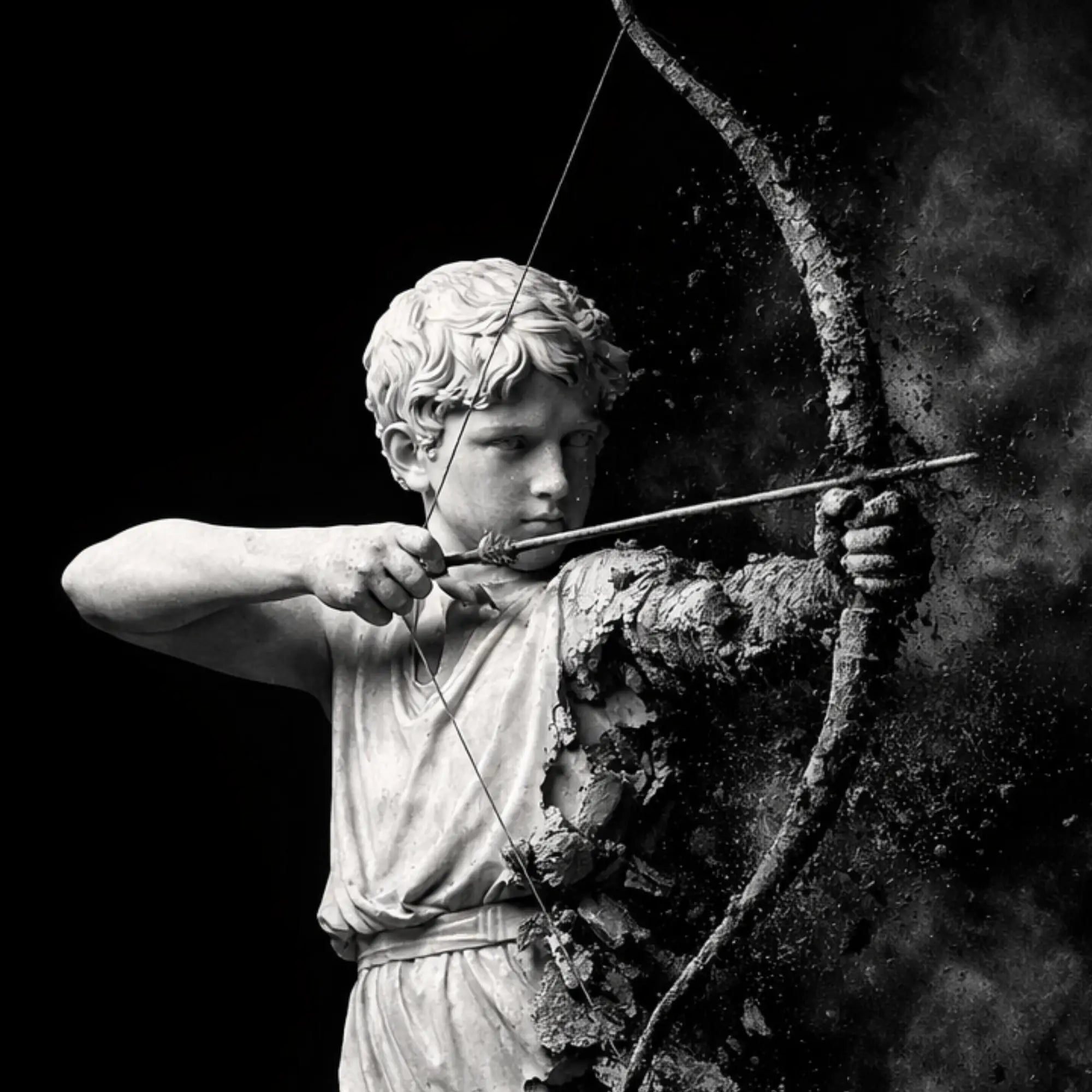
Their independence starts to frighten you
Their independence starts to frighten you
You stopped seeing what they could do, because you were scanning every hour for what might go wrong.
The child you were certain could not?
Could, and had been able to for longer than you knew. The capability was sitting in plain sight, buried under years of rescue, and it surfaces within weeks of your stepping back.
The fragility you were so tenderly guarding?
Was a muscle you had been lifting on their behalf. Set it down and it appears, because that strength only ever builds inside the struggle you used to interrupt.
The difficult one, the strong-willed one, the impossible one?
Is a strategist of the first rank with nowhere honest to aim the gift. Turn that brilliance away from working you and toward building themselves, and the difficulty reads, for the first time, as drive.

The old inheritance stops cold
The old inheritance stops cold
You will catch yourself mid-gesture, repeating the exact house you swore you would never reproduce, and you will stop.
The voice insisting that stepping back is neglect?
You will learn to hear it for what it is, the voice of withdrawal pretending to be your conscience, and you will decline its advice.
The certainty that their discomfort is an emergency?
You will test it with one cold question, which is what actually happens if you do nothing, and most days the honest answer is that they learn something.
The fear, grip, over-helping that ran through the generations like a condition in the blood?
Ends with you, the first one in the line to refuse to pass it down.

Love stops being a labor
Love stops being a labor
Love becomes a thing you give from strength, and stop bleeding from a wound.
The exhaustion you mistook for devotion?
Resolves into something cleaner and harder, a warmth that stops leaking through a hundred small surrenders and starts arriving where it counts, after the storm, in the repair.
The guilt that lived under every refusal?
Dissolves, the day you understand in your body that holding a limit is itself an act of love, and the whole weight they throw against it is the resistance that builds them.
The closeness that ran entirely on being needed?
Becomes the real thing, the hour one of you stops being held up by being needed and the other stops being held up by needing.

You become a parent they cannot operate
You become a parent they cannot operate
You will stop being the most easily worked person in your own household.
The move engineered to move you?
Lands on something steady, warm, and entirely unmoved. You take it in completely and decline to dance, and the move, deprived of its result, drops out of the repertoire.
The guilt played with the timing of a professional?
Stops working. You see it, you name it to yourself, you hold the warm line anyway, and the household learns that influence is not the currency it trades in.
The escalation that always, in the end, won?
Wins nothing now, and within a few hard weeks it is no longer even built, because the regime it defended has stopped existing.
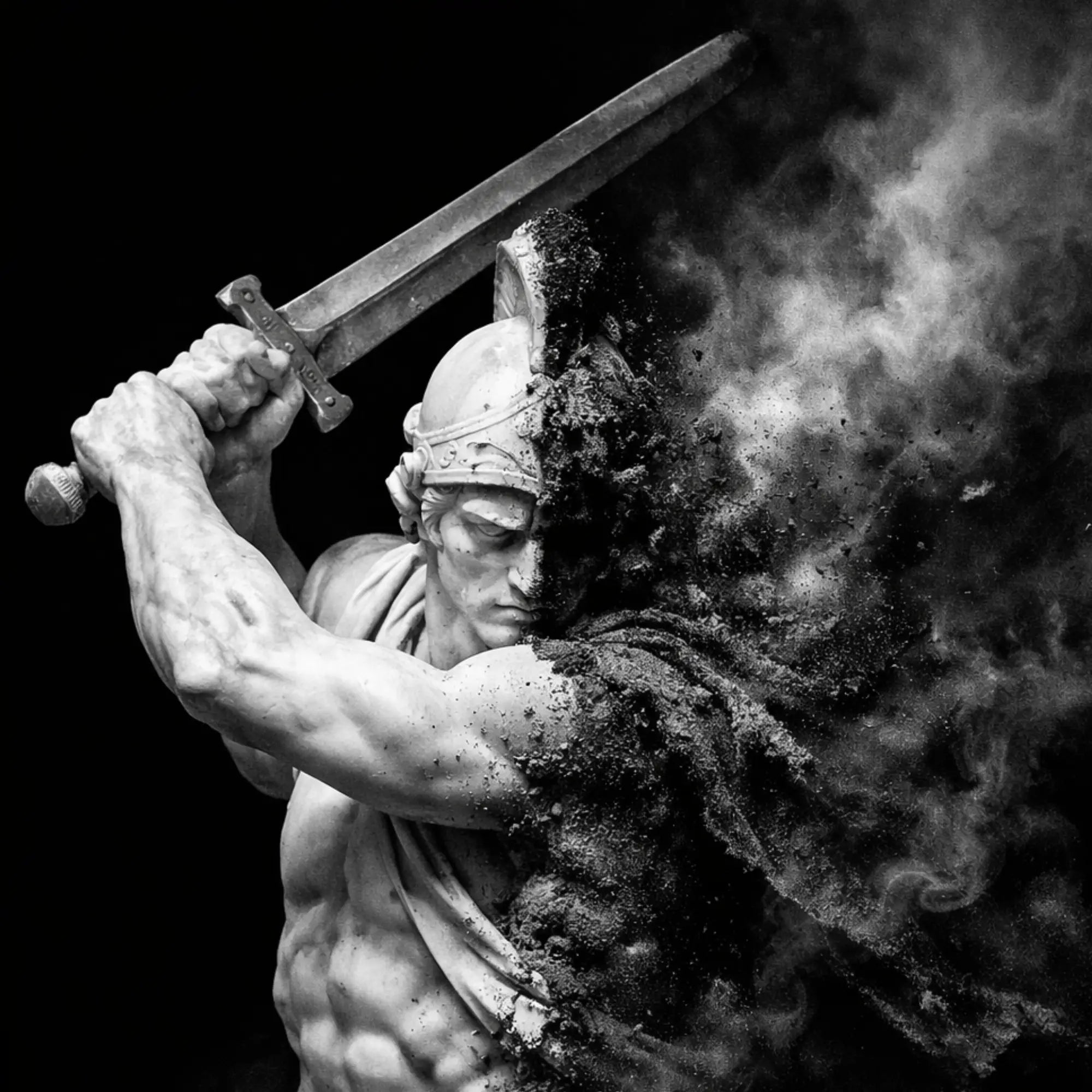
The home stops being a war zone
The home stops being a war zone
You will trade the battlefield for a workshop.
The walking on eggshells around one person's temper?
Over. The household stops orbiting a single small sun, the other people in it exhale into rooms that are theirs again, and the adults recover the strange memory that they are adults.
The performance of being a good child, staged for whoever is watching?
Gives way to something far less photogenic and far more durable, a child with an actual centre, who does the decent thing when no one is watching because the value belongs to them and not to your approval.
The throne in the middle of the room?
Empty, and unmourned.

You are handed back to yourself
You are handed back to yourself
You will remember that a whole person stood here before the servant did.
The identity that shrank to "the one who helps"?
Loosens its grip, and the question that used to frighten you, who you are if no one needs you, finally meets a better answer: the witness, the builder, the warm edge, and a human being who happens also to be a parent.
The curiosity you buried for years under the work of managing?
Comes back up, and you model the rarest thing a parent can model, which is wonder chosen on purpose by someone old enough to know better.
The life you shelved until they were older?
Resumes. They got older the afternoon you stopped living theirs for them.
What the Parenting Industry Panders

STAN TAYLOR
The Little Dictator™
MISCELLANEOUS
Other Parenting FrameworksThe Transaction, Named and Measured
Symptoms, No Diagnosis
The Rescue-Addiction, with Its Chemistry
"It's Only a Phase"
Three Locks No Willpower Picks
"Be More Patient"
The Sleepwalker and Why Insight Fails
Insight That Changes Nothing
A Structured 21-Day Detox
"Every Child Is Different," and Then Silence
The Three Guillotines, Irreversible
"Try to Help a Little Less"
The Extinction Burst, Forecast in Advance
A Gentle Nudge, Never a Cut
Bleeding and Feeding, Channel by Channel
"Pick Your Battles"
The Witness, Installed in the Cleared Room
"Connect Before You Correct," as a Slogan
Natural Consequence as Reality's Verdict
A Better Mood, the Same Behavior
The Five Rs for the Logical Kind
Time-Outs and Lectures on Logic
Reflection That Becomes Interior Software
Punishments = Consequences
The Riverbank: Where to Actually Stand
"Use Your Words," Then Move Along
Productive Failure Over Rescue
Hover, and Narrate Every Step
Story, to Get Past the Deafness
Rescue at the First Flicker of Struggle
Choice, to Dissolve the Reflex
"Explain Why" Until They Stop Listening
Identity Planted Before the Moment
Ornamental Choices a Child Sees Through
Process Language Over Praise
"Good Job" for the Act of Breathing
The Genuine Question and the Long Pause
Praise the Outcome, Manufacture a Performer
Capability Stations: the Room Teaches
"Ask Open Questions," Answer Already Loaded
Free, Guided, and Structured Play
More Classes, More Structure, More Optimising
Fenced Screens, a Clear-Eyed School
Police the Screens by Willpower Alone
The Warm Edge: Firmness Held With Warmth
Boundaries Either Cold or Entirely Absent
The Ten Capacities of the Sovereign Child
A Compliant Child Who Cannot Steer Themselves
- Parenting Guidance
- Content Quality
- Emotional Impact
- Practical Value
- Relatability
- KHKoren H.Verified Buyer1 month agoReviewingThe Little Dictator EbookRated 5 out of 5 starsThe only parenting book you need
Attachment parent here ✌️.
Enrolled in as many psychology classes as I could in high school by taking summer school PE and math so there would be more room in my schedule for electives during the year. Bachelor of Science in Marriage, Family, and Human Development. I could probably tell you what I learned there in 10 bullet points, worthwhile but not necessary to spend four years of learning. Stan Taylor (he, she, collective they like Shakespeare?), is fed up with all injustice in the world and is wholeheartedly embracing hope for humanity one reader at a time. Not by fixing what’s wrong, but by teaching us how to be the thing that is right. The first pages talk about encouraging your child’s ability to sit with discomfort and then all the remaining pages are you sitting with yours. Prepare to deal with mutiny in yourself and your household depending on how engrained the patterns are running amongst you (if your kids are older than 12 months, you’re in it :)) This book makes a lot of other well-intentioned books feel more like surface manipulation. Not to discredit anyone, but if you want to fix the processor its core and not prettily paint over it and give yourself a sticker, Little Dictator is the antidote.
- LWLisa W.Verified Buyer4 days agoReviewingThe Little Dictator HardcoverRated 5 out of 5 starsProfound perception & behavioral change I wish I’d had 20 years ago.
I’m sitting here with barely words but lots of raw emotion in my body after completing the 21-day protocol with the Detox Journal, and then reading ahead. This is truly hard to describe. I’ve read copious parenting books and applied methodologies, and I would return all of them for this book 20 years ago. The truth is I want to beg every parent to get this book and do this work, for the sake of your child’s future. It turns everything that is modeled in parenting and schools in today’s too-comfortably-numbed and thoughtless society on its head, requires you to confront yourself and change, and leads with such a depth of underlying love, understanding and care that none of it looks like anything that was ever passed down. Extraordinary.
The Journal itself is very well done and organized to carry and accompany you right through the protocols. It’s done with respect to the time/ability of busy parents yet holds accountability; the small hinges swing very big doors. This book is an invaluable investment compounding for the rest of you and your children lives that you cannot afford not to have.
- MFMiguel F.Verified Buyer1 week agoReviewingThe Little Dictator HardcoverRated 5 out of 5 starsWorks on YOU, the parent
You'd be mistaken to walk into this protocol thinking it's about more direction for your children. That's the trap that gets you to rescue your kid at the exact moment struggle was necessary.
- ALAlamea L.Verified Buyer1 week agoReviewingThe Little Dictator HardcoverRated 5 out of 5 starsEven "good" parents need this
My kids are mostly independent teens, but they can still fail at simple tasks. This is because sometimes it's easier to just do things for them, and sometimes I do things for them because I love them. But this book really opened my eyes to the fact that giving/doing for them makes me feel good but doesn't always serve them. In executing protocols, sitting still while my son struggled with his math problem was so much more difficult than I imagined it would be. I literally had to sit on my hands and concentrate on keeping my mouth closed, even though he had already told me to let him figure it out. But then he DID figure it out. And the pride on his face and feeling of satisfaction he had from doing it on his own was worth so much more than me handing him "just a clue" to help him. He has transitioned to just asking me to check his work when he is done, but only if he isn't sure he understood completely. I used to always wake my kids in the morning but have transitioned them to using alarms. One morning my daughter overslept, and I let her have only 20 min to get ready before I woke her. She hasn't forgotten to set her alarm since then. One daughter forgot her lunch one day, and instead of bringing her food, I let her go hungry, even though I physically felt uncomfortable in doing that. But now she takes more care to remember her lunch. And after failure, I am now asking, "What can you do differently next time to avoid this?" They are having to analyze and speak a solution…
- SFShannan F.Verified Buyer3 weeks agoReviewingThe Little Dictator HardcoverRated 5 out of 5 starsThe Little Dictator
I purchased this not so much because I have kids in the house, rather to see how I can help the 'child within'. Wow! I will post another review once I have gone through the entire process. All I can say right now, is that the little girl inside is discovering her voice, sharing her truth, and feeling heard in ways she did not have in the past.
- DBDustin B.Verified Buyer1 month agoReviewingThe Little Dictator HardcoverRated 5 out of 5 starsAnother Great read!!
I purchased the Black Book of Power, and now The Little Dictator. I have to say these are two of the most eye opening books I’ve ever read. As I’m reading I see myself in the exact situations the books refer to. Great reads!! Well done Stan Taylor, well done.
A $500 Billion industry is betting you will never let your child be bored
Every day you wait, the throne gains weight, and you make one more withdrawal from a future that cannot yet object. The bill comes due in 20 years, in a grown person who cannot cope, with your name on the receipt.
You will not be paying $3000 to the parenting coach who soothes one flashpoint at a time and leaves the regime fully intact.
You will not be paying $300 a month for enrichment classes sold as the cure for a boredom that was never the disease.
You can stop adding to the pile of parenting books you nodded along with and never gave you a working system.
Your long romance with the word "almost" ends today.
GET YOUR COPY FOR
Start the Protocols
If after 90 days of real, documented work your home is no calmer and your child no more capable, send me your journal notes and I will refund you in full. This is for the parent ready to pay in discomfort taken on the chin, the tongue held, and the storm met without flinching. Once you have done the work, you will be too busy watching your child become a sovereign to remember you even considered a refund.
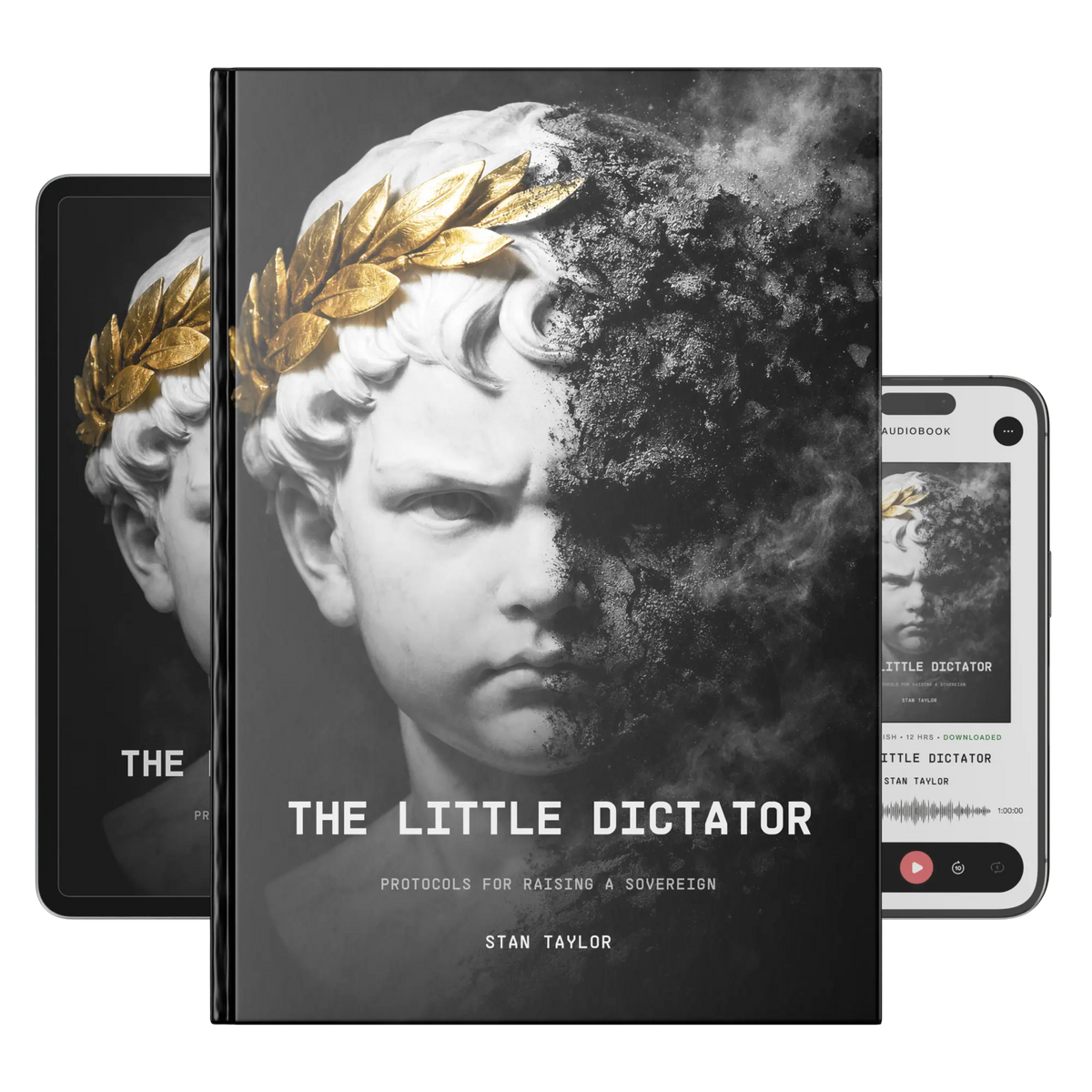
PREMIUM
HARDCOVER BUNDLE
One-time. No subscription. Lifetime access.
INCLUDES
-
The Ebook is available in English, Spanish, French, Dutch, German, Italian, Polish, Norwegian, Danish, Swedish, Brazilian Portuguese and Greek. Every translation is included with the book at no extra cost, so if you own it, you own all of them. Preface: The Creek Preface: The Creek
Luke and I had walked out past where the trail ended. No road reached this far. The nearest man-made sounds were a long way off, and between here and there stood nothing but trees.
Water moved over the stones with patient indifference, branches and silt arranging themselves into the small dams any creek will build for itself given a few seasons.
His parents were in another country at a conference, having delivered him to me on the theory that someone with a background in psychology might succeed where their own methods had not.
He looked up from his tablet that had gone useless at the property line, where the signal stopped.
"Go ahead," I said.
He looked confused. "Go where?"
"Nowhere. Just play."
His expression soured in the way they tend to do when a contract is being violated.
"With what?"
With what. It is a small and devastating thing to watch an eight-year-old boy, surrounded by every raw material a child has ever needed, stand in the position of a customer at a vending machine that will not accept his coin. The creek offered him stones, mud, water, and time. He could see none of it. The faculty for converting raw world into game had been steadily idled out of him by adults too willing to provide the next instruction.
"Will you help me?" he asked. The question carried the subtle authority of a child who issues commands and softens them with the grammar of request.
I shook my head, which only sharpened his confusion into something harder.
"But you have to!”
The belief sat well below the level of language, where the deepest convictions live.
Adults help, direct, and solve. From this premise the rest of his world was efficiently organized. Brick by considerate brick, rescue by gentle rescue, we had built him a kingdom in which he ruled and every adult rushed to serve.
He had inherited this throne one accommodation at a time, questions answered for him that he could have answered for himself, every "yes" accepted where a "no" would have done him better service. Now, he stood at the edge of a creek with no notion of how to enter it. A small dictator, crowned by kindness.
His mother Lara had once shown me a photograph of herself at roughly his age, knee-deep in a similar creek, hair tangled and shins streaked with the kind of mud that signals a productive afternoon. She had spent whole summers in such water, inventing nations of stones with separate temperaments, building forts from branches that served as imperial outposts in the morning and refugee camps by sundown. The creek required nothing of her and supplied everything.
She had unknowingly erased that world from her son's life with the reverent care of someone dismantling a shrine for safekeeping. Structured activities, supervised play dates, enrichment programs, all assembled in tribute to the advantages she felt she had lacked. By exceeding her own parents on every measure of attention, she had filled every available hour and, in doing so, paved over the unscheduled ground on which a child discovers what he is when nobody is watching.
She loved Luke with a force that had reorganized her own life around his comfort. She tied his shoes daily, packed his bag, and helped solved his homework in the evenings. The sight of his frustration produced a near-physical compulsion in her chest to step in, smooth, and repair.
She did not yet recognize the dense, satisfying warmth that settled behind her sternum each time she removed an obstacle from his path. But the feeling of love had an appetite of its own, and the appetite was growing.
"I don't know what to do," Luke said, and took three small steps toward the bank before turning back to me with the wounded astonishment of a master whose servant had gone on strike.
"You're being mean," he tried. "My mom would help me," he escalated.
"Okay," I said with a shrug, and sat down on a fallen log.
Luke’s tears came silent and bewildered, the weeping of an eight-year-old boy who had forgotten how to play. They came right on time, when he understood that I was not going to issue an instruction.
Sadness came first, then the guilt, and then the threats to report my negligence to his parents, each one a tested implement that had reliably moved adults before. None of them moved me.
He stood at the water's edge for seventeen minutes. I counted off because counting was the only thing keeping me on the log. At minute three he kicked a stone. At minute five he sat down in the dirt and stared at the water with the vacancy of someone in an airport waiting for a delayed flight. At minute nine he picked up a stick and put it down again. At minute twelve he turned to me with a question on his face that I answered by remaining still. At minute fourteen something gave when his body had understood, before his mind did, that no one was coming to rescue him.
My hands gripped the rough bark of the log hard enough to mark the palms. My jaw ached from holding itself shut. Every cell in me was demanding that I point, suggest, invent a game, narrate a possibility, or lift one branch and place it in the water just to break the spell. I did none of these things and the cost was considerable. There is no version of this moment in which the adult feels noble by being the monster on a log. But freedom withers under instruction, and dictators are produced by adults who never required them to feed themselves.
Without a single instruction, he eventually knelt at the creek's edge. He touched the water, rubbed mud between his fingers, and noted what mud does. By minute twenty-three he had taken off his own shoes. By minute thirty-five he had dragged the first branch across the current. His movements moved from tentative to deliberate, then to focused. When his first structure collapsed under the water, he glanced back at me. I held his eye and smiled and did not move. The old reflex held him a long beat. Then he turned back, gathered heavier branches, and started again.
Three hours later he was soaked, mud-caked, and in possession of a working dam. He was also in possession of the more important thing, which was the evidence that he could produce an outcome unaided.
"Look," he called, and the voice carried a current I had not heard from him before. "When I put the flat rocks here, the water speeds up. I tried it with sticks but it didn't work."
He was, in that mud-spattered moment, a physicist, engineer, and poet of the creek. He was manipulating variables, observing fluid behavior, and revising hypotheses against results, all because no adult had supplied the experiment ready-made. Three hours earlier he had not been able to imagine playing without a script. Three hours later he was conducting research.
The wonder in his voice opened something in me that has not closed since, and it opens again whenever I watch a child struggle and feel the suffocating pressure to step in. That pressure lives in the body and speaks in the vocabulary of love, duty and reasonable adult concern. But it is concealing something none of us cares to look at directly.
I kept returning to those seventeen minutes and to the small, banal fact that doing nothing had been the most demanding thing I had been asked to do in years. The simplest possible act, performed against my own nervous system, had cost more than any speech, lecture, or intervention I had ever staged.
When Lara heard what had happened at the creek, her response began at the perimeter of being judged.
"You just let him cry?"
I told her that the son she had described as a child without initiative had spent three hours conducting an unsupervised investigation into the physics of moving water. And so, the story she had been telling herself about who he was and what he required from her took its first hairline crack.
She read everything I gave her and started her own slow withdrawal, frightened the entire time that she was doing it incorrectly. The mornings changed first. She placed the lunch ingredients on the counter and walked away. The first day produced a standoff. The second produced a peanut butter sandwich that looked as though it had been assembled in a wind tunnel. By the end of the week, Luke was packing his own lunches with a focus she had not previously seen in him at that hour. She stopped solving his homework. She sat near him as a present body and no longer as a working hand. When he pushed his math sheet across the table to her with the assurance of long custom, she pushed it gently back.
She learned to sit through his frustration and held the line against the full inventory of a child's persuasions. She still capitulated on tired evenings and lost ground during school holidays, when his boredom became her crisis. She reported each lapse with the heaviness of a person who expected herself to be perfect. I told her perfection was beside the point.
A few weeks later an email arrived from Luke's teacher, written in the cautious tone teachers reserve for parents who may interpret good news as criticism. There was a steadiness in the boy, and a spark. He was volunteering to help other students without being prompted. He was asking questions lit with a curiosity no child could fake.
I have watched some version of this story play out in hundreds of families, where the creek becomes a kitchen counter, a basket of unfolded laundry, or a pair of shoelaces at the front door. I have seen entire classrooms reorganize themselves around the appetite of a four-year-old. I have seen homes in which the word “no” does not survive without a debate, and in which the parent eventually concedes because the alternative is another scene they have run out of energy to manage. I have watched a thirty-year-old man stand in front of an unfamiliar task with the same frozen helplessness Luke wore at the water's edge, his hesitation refined by two decades of practice.
The route from hesitation to capacity runs through ground we have unconsciously paved over. The specifics rotate but the pattern is constant in a child helped so completely that the help has become a disability and a parent who has fused stepping in with the meaning of love. Between them, a choreography so smooth it appears to be personality and is, on inspection, training.
We did not set out to do this. No parent has ever convened a small private meeting with themselves to plan the systematic disabling of his child's capacity for independent life. We rejected the cold and authoritarian regimes of our own upbringings, silences and slammed doors included. We promised ourselves we would be present, responsive, and gentle so that our children would not feel the loneliness we had felt. We delivered on that promise with admirable thoroughness and then continued straight past the target. The pendulum did what pendulums do and went so far from the old dictatorship that we installed a new one, in which the child rules and the parents organize the day around their moods.
We confused responsiveness with rescue. We took gentleness to mean the elimination of all discomfort. We treated love as the daily removal of every obstacle from our children's paths. Meals became negotiations. Emotions became emergencies. We built domestic systems that rewarded distress, and we walked through our own kitchens on the careful feet of people afraid to disturb a sleeping animal.
Our children became, with perfect predictability, what any human being becomes when given unearned power. They are fluent in commands and paralyzed without them. They navigate digital interfaces with effortless competence and freeze when asked to navigate a sidewalk without instruction. They believe, in the part of the bone that holds first beliefs, that the world is a service economy organized around their preferences. Luke is not unusual. His hesitant “With what?” is the soundtrack of a generation.
You are holding a book about little dictators. At its base it is a book about what becomes visible only after something in your routine has cracked open and refused to close. The word “parent” here covers anyone who has accepted responsibility for guiding a child. The distance between what children require and what we are providing has grown beyond the reach of comfortable adjustments, because the loss in question is a faculty, surrendered slowly under the steady pressure of our best intentions.
Test the claims here against your own home and any typical Monday morning. Test them against the look on your child's face in the moment he is waiting for you to perform the small task he could perform himself. Somewhere along the line we stopped asking who taught us that struggle was dangerous. We accepted the inheritance, learned a set of reflexes, called them love, and never once held them up to a strong light.
To step back is to grant both of you room. It requires staying curious through the first tears and protests, or the first look that compels your hands moving before your mind has consented to anything. Stay there long enough to see what comes out of the silence.
Most parenting books are read, underlined, discussed agreeably over coffee, and filed next to the other books that changed nothing. You agreed with the argument and certainly meant to act on it. Then Monday arrived, and your hands moved in their old grooves, because reading is not the same as living and you had done only the first. This book asks you to remain still while your child struggles with a task you could finish in seconds. It asks you to watch the fumble, failure, tears, and to feel the heat rise in your chest with the certainty that you are a monster, and to remain exactly where you are.
Readiness comes and goes. You can return when you are prepared to read without the agreeable warmth of someone who agrees in principle and acts on nothing. That mode of reading is its own addiction. It supplies the sensation of growth without the cost of change or the feel of potential without the marks of practice.
Some of you arrived here from The Black Book of Power. You remember what those pages required. If you sat inside your own nervous system through the twenty-one days when every signal demanded relief, and you refused to move, you bring an asset to this book that matters. But it does not exempt you. The skin opened by this book has not been touched by the practice you did on yourself. Your parenting was assembled by watching the adults around you mistake their very own conditioning for love. That is the inheritance and that archive is still operational under every discipline you have since acquired. This text points at it directly, and If The Black Book of Power was a slap to a cheek you had not noticed needed it, this one will find a different cheek, and it will find it with the same accuracy.
If you have not read my earlier work, you stand on the same ground as those who have. What that book does for your relationship with the world, this one will do for the relationship with the single person whose face is wired into the oldest part of your brain.
If what you have read so far arrived as recognition, a mirror tilted at an angle you were not expecting, what follows is for you. If a single afternoon of withdrawal could produce a small change in Luke, the more uncomfortable question is what we have done with all the other afternoons.
This book will hurt you. It must. May it release the children sitting on thrones they never asked for, and free the adults still kneeling at the foot of them.
-
The Audiobook is English only, but includes all languages of the Ebook at no extra cost. -
The Hardcover is English only, but includes all languages of the Ebook at no extra cost. Premium print with 350+ pages + bookmark. -
A guided, fillable workbook that carries you through the full protocol one day at a time, in the three-part daily rhythm the detox runs on: a short reading and intention before the house wakes, fieldwork logged in fragments through the day, and fifteen minutes of honest writing before you sleep, which is the part most people skip and the part that produces most of the change. Each day has its own page, its own prompt, and its own space to set down what you saw, including the entry you would rather leave off the page. GET IT FREE with your copy, in the format that matches your edition. The Ebook and the Audiobook come with the printable PDF, built to print clean. The Hardcover comes with the physical softcover journal, the object that gains weight in your hand across three weeks until you pick it up and feel that you have been doing something serious. That feeling is the new identity asserting itself. -
Your order admits you to a private parents' group running the protocol. People post the day's withheld rescues, the storm nights, the first time their child did the thing they had always done for them. It is a practice room, not a debating society, and the stated goal is that you stop needing it entirely. -
Download the ebook and audiobook for offline reading with the free app.

PLUS
AUDIOBOOK BUNDLE
One-time. No subscription. Lifetime access.
INCLUDES
-
The Ebook is available in English, Spanish, French, Dutch, German, Italian, Polish, Norwegian, Danish, Swedish, Brazilian Portuguese and Greek. Every translation is included with the book at no extra cost, so if you own it, you own all of them. Preface: The Creek Preface: The Creek
Luke and I had walked out past where the trail ended. No road reached this far. The nearest man-made sounds were a long way off, and between here and there stood nothing but trees.
Water moved over the stones with patient indifference, branches and silt arranging themselves into the small dams any creek will build for itself given a few seasons.
His parents were in another country at a conference, having delivered him to me on the theory that someone with a background in psychology might succeed where their own methods had not.
He looked up from his tablet that had gone useless at the property line, where the signal stopped.
"Go ahead," I said.
He looked confused. "Go where?"
"Nowhere. Just play."
His expression soured in the way they tend to do when a contract is being violated.
"With what?"
With what. It is a small and devastating thing to watch an eight-year-old boy, surrounded by every raw material a child has ever needed, stand in the position of a customer at a vending machine that will not accept his coin. The creek offered him stones, mud, water, and time. He could see none of it. The faculty for converting raw world into game had been steadily idled out of him by adults too willing to provide the next instruction.
"Will you help me?" he asked. The question carried the subtle authority of a child who issues commands and softens them with the grammar of request.
I shook my head, which only sharpened his confusion into something harder.
"But you have to!”
The belief sat well below the level of language, where the deepest convictions live.
Adults help, direct, and solve. From this premise the rest of his world was efficiently organized. Brick by considerate brick, rescue by gentle rescue, we had built him a kingdom in which he ruled and every adult rushed to serve.
He had inherited this throne one accommodation at a time, questions answered for him that he could have answered for himself, every "yes" accepted where a "no" would have done him better service. Now, he stood at the edge of a creek with no notion of how to enter it. A small dictator, crowned by kindness.
His mother Lara had once shown me a photograph of herself at roughly his age, knee-deep in a similar creek, hair tangled and shins streaked with the kind of mud that signals a productive afternoon. She had spent whole summers in such water, inventing nations of stones with separate temperaments, building forts from branches that served as imperial outposts in the morning and refugee camps by sundown. The creek required nothing of her and supplied everything.
She had unknowingly erased that world from her son's life with the reverent care of someone dismantling a shrine for safekeeping. Structured activities, supervised play dates, enrichment programs, all assembled in tribute to the advantages she felt she had lacked. By exceeding her own parents on every measure of attention, she had filled every available hour and, in doing so, paved over the unscheduled ground on which a child discovers what he is when nobody is watching.
She loved Luke with a force that had reorganized her own life around his comfort. She tied his shoes daily, packed his bag, and helped solved his homework in the evenings. The sight of his frustration produced a near-physical compulsion in her chest to step in, smooth, and repair.
She did not yet recognize the dense, satisfying warmth that settled behind her sternum each time she removed an obstacle from his path. But the feeling of love had an appetite of its own, and the appetite was growing.
"I don't know what to do," Luke said, and took three small steps toward the bank before turning back to me with the wounded astonishment of a master whose servant had gone on strike.
"You're being mean," he tried. "My mom would help me," he escalated.
"Okay," I said with a shrug, and sat down on a fallen log.
Luke’s tears came silent and bewildered, the weeping of an eight-year-old boy who had forgotten how to play. They came right on time, when he understood that I was not going to issue an instruction.
Sadness came first, then the guilt, and then the threats to report my negligence to his parents, each one a tested implement that had reliably moved adults before. None of them moved me.
He stood at the water's edge for seventeen minutes. I counted off because counting was the only thing keeping me on the log. At minute three he kicked a stone. At minute five he sat down in the dirt and stared at the water with the vacancy of someone in an airport waiting for a delayed flight. At minute nine he picked up a stick and put it down again. At minute twelve he turned to me with a question on his face that I answered by remaining still. At minute fourteen something gave when his body had understood, before his mind did, that no one was coming to rescue him.
My hands gripped the rough bark of the log hard enough to mark the palms. My jaw ached from holding itself shut. Every cell in me was demanding that I point, suggest, invent a game, narrate a possibility, or lift one branch and place it in the water just to break the spell. I did none of these things and the cost was considerable. There is no version of this moment in which the adult feels noble by being the monster on a log. But freedom withers under instruction, and dictators are produced by adults who never required them to feed themselves.
Without a single instruction, he eventually knelt at the creek's edge. He touched the water, rubbed mud between his fingers, and noted what mud does. By minute twenty-three he had taken off his own shoes. By minute thirty-five he had dragged the first branch across the current. His movements moved from tentative to deliberate, then to focused. When his first structure collapsed under the water, he glanced back at me. I held his eye and smiled and did not move. The old reflex held him a long beat. Then he turned back, gathered heavier branches, and started again.
Three hours later he was soaked, mud-caked, and in possession of a working dam. He was also in possession of the more important thing, which was the evidence that he could produce an outcome unaided.
"Look," he called, and the voice carried a current I had not heard from him before. "When I put the flat rocks here, the water speeds up. I tried it with sticks but it didn't work."
He was, in that mud-spattered moment, a physicist, engineer, and poet of the creek. He was manipulating variables, observing fluid behavior, and revising hypotheses against results, all because no adult had supplied the experiment ready-made. Three hours earlier he had not been able to imagine playing without a script. Three hours later he was conducting research.
The wonder in his voice opened something in me that has not closed since, and it opens again whenever I watch a child struggle and feel the suffocating pressure to step in. That pressure lives in the body and speaks in the vocabulary of love, duty and reasonable adult concern. But it is concealing something none of us cares to look at directly.
I kept returning to those seventeen minutes and to the small, banal fact that doing nothing had been the most demanding thing I had been asked to do in years. The simplest possible act, performed against my own nervous system, had cost more than any speech, lecture, or intervention I had ever staged.
When Lara heard what had happened at the creek, her response began at the perimeter of being judged.
"You just let him cry?"
I told her that the son she had described as a child without initiative had spent three hours conducting an unsupervised investigation into the physics of moving water. And so, the story she had been telling herself about who he was and what he required from her took its first hairline crack.
She read everything I gave her and started her own slow withdrawal, frightened the entire time that she was doing it incorrectly. The mornings changed first. She placed the lunch ingredients on the counter and walked away. The first day produced a standoff. The second produced a peanut butter sandwich that looked as though it had been assembled in a wind tunnel. By the end of the week, Luke was packing his own lunches with a focus she had not previously seen in him at that hour. She stopped solving his homework. She sat near him as a present body and no longer as a working hand. When he pushed his math sheet across the table to her with the assurance of long custom, she pushed it gently back.
She learned to sit through his frustration and held the line against the full inventory of a child's persuasions. She still capitulated on tired evenings and lost ground during school holidays, when his boredom became her crisis. She reported each lapse with the heaviness of a person who expected herself to be perfect. I told her perfection was beside the point.
A few weeks later an email arrived from Luke's teacher, written in the cautious tone teachers reserve for parents who may interpret good news as criticism. There was a steadiness in the boy, and a spark. He was volunteering to help other students without being prompted. He was asking questions lit with a curiosity no child could fake.
I have watched some version of this story play out in hundreds of families, where the creek becomes a kitchen counter, a basket of unfolded laundry, or a pair of shoelaces at the front door. I have seen entire classrooms reorganize themselves around the appetite of a four-year-old. I have seen homes in which the word “no” does not survive without a debate, and in which the parent eventually concedes because the alternative is another scene they have run out of energy to manage. I have watched a thirty-year-old man stand in front of an unfamiliar task with the same frozen helplessness Luke wore at the water's edge, his hesitation refined by two decades of practice.
The route from hesitation to capacity runs through ground we have unconsciously paved over. The specifics rotate but the pattern is constant in a child helped so completely that the help has become a disability and a parent who has fused stepping in with the meaning of love. Between them, a choreography so smooth it appears to be personality and is, on inspection, training.
We did not set out to do this. No parent has ever convened a small private meeting with themselves to plan the systematic disabling of his child's capacity for independent life. We rejected the cold and authoritarian regimes of our own upbringings, silences and slammed doors included. We promised ourselves we would be present, responsive, and gentle so that our children would not feel the loneliness we had felt. We delivered on that promise with admirable thoroughness and then continued straight past the target. The pendulum did what pendulums do and went so far from the old dictatorship that we installed a new one, in which the child rules and the parents organize the day around their moods.
We confused responsiveness with rescue. We took gentleness to mean the elimination of all discomfort. We treated love as the daily removal of every obstacle from our children's paths. Meals became negotiations. Emotions became emergencies. We built domestic systems that rewarded distress, and we walked through our own kitchens on the careful feet of people afraid to disturb a sleeping animal.
Our children became, with perfect predictability, what any human being becomes when given unearned power. They are fluent in commands and paralyzed without them. They navigate digital interfaces with effortless competence and freeze when asked to navigate a sidewalk without instruction. They believe, in the part of the bone that holds first beliefs, that the world is a service economy organized around their preferences. Luke is not unusual. His hesitant “With what?” is the soundtrack of a generation.
You are holding a book about little dictators. At its base it is a book about what becomes visible only after something in your routine has cracked open and refused to close. The word “parent” here covers anyone who has accepted responsibility for guiding a child. The distance between what children require and what we are providing has grown beyond the reach of comfortable adjustments, because the loss in question is a faculty, surrendered slowly under the steady pressure of our best intentions.
Test the claims here against your own home and any typical Monday morning. Test them against the look on your child's face in the moment he is waiting for you to perform the small task he could perform himself. Somewhere along the line we stopped asking who taught us that struggle was dangerous. We accepted the inheritance, learned a set of reflexes, called them love, and never once held them up to a strong light.
To step back is to grant both of you room. It requires staying curious through the first tears and protests, or the first look that compels your hands moving before your mind has consented to anything. Stay there long enough to see what comes out of the silence.
Most parenting books are read, underlined, discussed agreeably over coffee, and filed next to the other books that changed nothing. You agreed with the argument and certainly meant to act on it. Then Monday arrived, and your hands moved in their old grooves, because reading is not the same as living and you had done only the first. This book asks you to remain still while your child struggles with a task you could finish in seconds. It asks you to watch the fumble, failure, tears, and to feel the heat rise in your chest with the certainty that you are a monster, and to remain exactly where you are.
Readiness comes and goes. You can return when you are prepared to read without the agreeable warmth of someone who agrees in principle and acts on nothing. That mode of reading is its own addiction. It supplies the sensation of growth without the cost of change or the feel of potential without the marks of practice.
Some of you arrived here from The Black Book of Power. You remember what those pages required. If you sat inside your own nervous system through the twenty-one days when every signal demanded relief, and you refused to move, you bring an asset to this book that matters. But it does not exempt you. The skin opened by this book has not been touched by the practice you did on yourself. Your parenting was assembled by watching the adults around you mistake their very own conditioning for love. That is the inheritance and that archive is still operational under every discipline you have since acquired. This text points at it directly, and If The Black Book of Power was a slap to a cheek you had not noticed needed it, this one will find a different cheek, and it will find it with the same accuracy.
If you have not read my earlier work, you stand on the same ground as those who have. What that book does for your relationship with the world, this one will do for the relationship with the single person whose face is wired into the oldest part of your brain.
If what you have read so far arrived as recognition, a mirror tilted at an angle you were not expecting, what follows is for you. If a single afternoon of withdrawal could produce a small change in Luke, the more uncomfortable question is what we have done with all the other afternoons.
This book will hurt you. It must. May it release the children sitting on thrones they never asked for, and free the adults still kneeling at the foot of them.
-
The Audiobook is English only, but includes all languages of the Ebook at no extra cost. - Limited Edition Hardcover
-
A guided, fillable workbook that carries you through the full protocol one day at a time, in the three-part daily rhythm the detox runs on: a short reading and intention before the house wakes, fieldwork logged in fragments through the day, and fifteen minutes of honest writing before you sleep, which is the part most people skip and the part that produces most of the change. Each day has its own page, its own prompt, and its own space to set down what you saw, including the entry you would rather leave off the page. GET IT FREE with your copy, in the format that matches your edition. The Ebook and the Audiobook come with the printable PDF, built to print clean. The Hardcover comes with the physical softcover journal, the object that gains weight in your hand across three weeks until you pick it up and feel that you have been doing something serious. That feeling is the new identity asserting itself. -
Your order admits you to a private parents' group running the protocol. People post the day's withheld rescues, the storm nights, the first time their child did the thing they had always done for them. It is a practice room, not a debating society, and the stated goal is that you stop needing it entirely. -
Download the ebook and audiobook for offline reading with the free app.
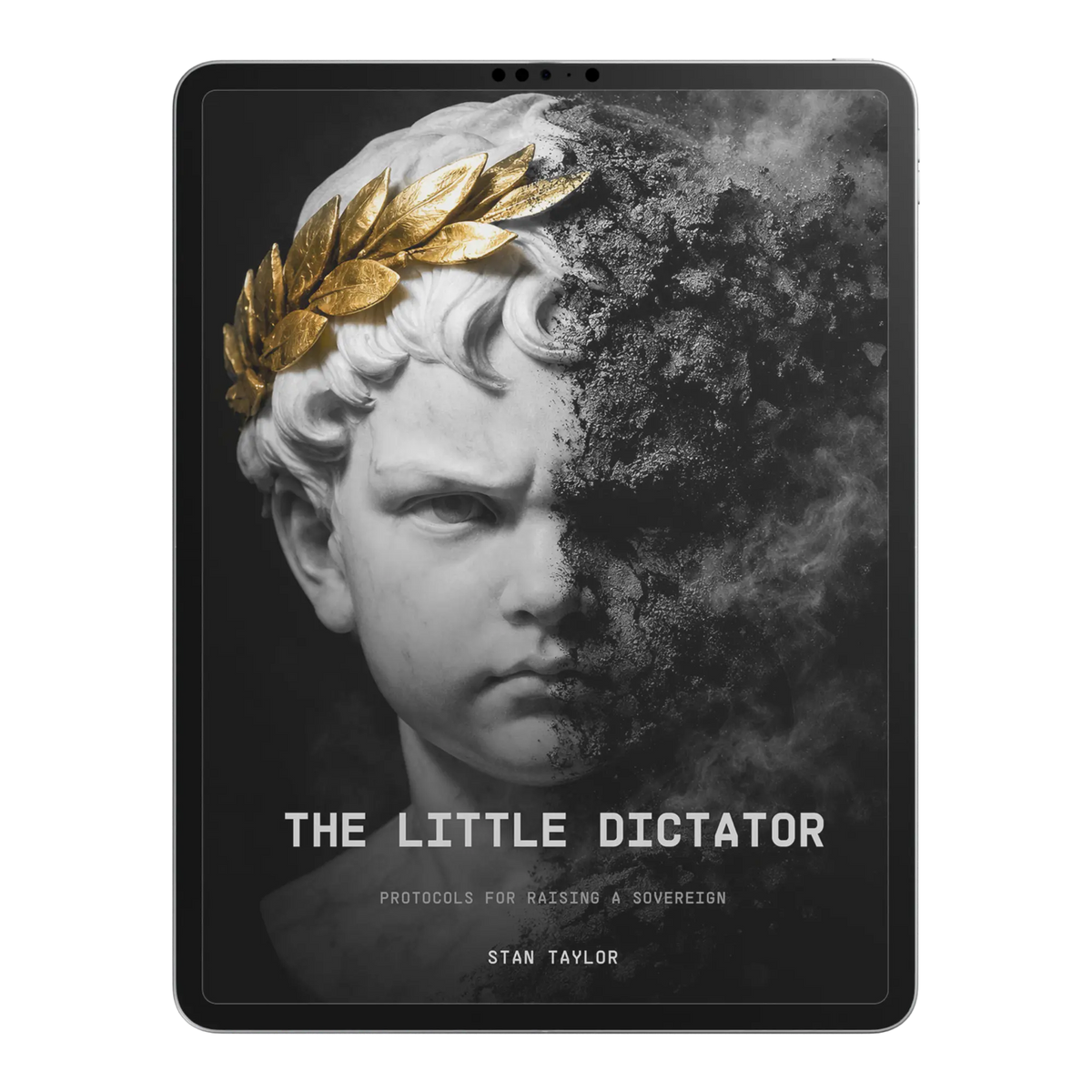
CORE
EBOOK BUNDLE
One-time. No subscription. Lifetime access.
INCLUDES
-
The Ebook is available in English, Spanish, French, Dutch, German, Italian, Polish, Norwegian, Danish, Swedish, Brazilian Portuguese and Greek. Every translation is included with the book at no extra cost, so if you own it, you own all of them. Preface: The Creek Preface: The Creek
Luke and I had walked out past where the trail ended. No road reached this far. The nearest man-made sounds were a long way off, and between here and there stood nothing but trees.
Water moved over the stones with patient indifference, branches and silt arranging themselves into the small dams any creek will build for itself given a few seasons.
His parents were in another country at a conference, having delivered him to me on the theory that someone with a background in psychology might succeed where their own methods had not.
He looked up from his tablet that had gone useless at the property line, where the signal stopped.
"Go ahead," I said.
He looked confused. "Go where?"
"Nowhere. Just play."
His expression soured in the way they tend to do when a contract is being violated.
"With what?"
With what. It is a small and devastating thing to watch an eight-year-old boy, surrounded by every raw material a child has ever needed, stand in the position of a customer at a vending machine that will not accept his coin. The creek offered him stones, mud, water, and time. He could see none of it. The faculty for converting raw world into game had been steadily idled out of him by adults too willing to provide the next instruction.
"Will you help me?" he asked. The question carried the subtle authority of a child who issues commands and softens them with the grammar of request.
I shook my head, which only sharpened his confusion into something harder.
"But you have to!”
The belief sat well below the level of language, where the deepest convictions live.
Adults help, direct, and solve. From this premise the rest of his world was efficiently organized. Brick by considerate brick, rescue by gentle rescue, we had built him a kingdom in which he ruled and every adult rushed to serve.
He had inherited this throne one accommodation at a time, questions answered for him that he could have answered for himself, every "yes" accepted where a "no" would have done him better service. Now, he stood at the edge of a creek with no notion of how to enter it. A small dictator, crowned by kindness.
His mother Lara had once shown me a photograph of herself at roughly his age, knee-deep in a similar creek, hair tangled and shins streaked with the kind of mud that signals a productive afternoon. She had spent whole summers in such water, inventing nations of stones with separate temperaments, building forts from branches that served as imperial outposts in the morning and refugee camps by sundown. The creek required nothing of her and supplied everything.
She had unknowingly erased that world from her son's life with the reverent care of someone dismantling a shrine for safekeeping. Structured activities, supervised play dates, enrichment programs, all assembled in tribute to the advantages she felt she had lacked. By exceeding her own parents on every measure of attention, she had filled every available hour and, in doing so, paved over the unscheduled ground on which a child discovers what he is when nobody is watching.
She loved Luke with a force that had reorganized her own life around his comfort. She tied his shoes daily, packed his bag, and helped solved his homework in the evenings. The sight of his frustration produced a near-physical compulsion in her chest to step in, smooth, and repair.
She did not yet recognize the dense, satisfying warmth that settled behind her sternum each time she removed an obstacle from his path. But the feeling of love had an appetite of its own, and the appetite was growing.
"I don't know what to do," Luke said, and took three small steps toward the bank before turning back to me with the wounded astonishment of a master whose servant had gone on strike.
"You're being mean," he tried. "My mom would help me," he escalated.
"Okay," I said with a shrug, and sat down on a fallen log.
Luke’s tears came silent and bewildered, the weeping of an eight-year-old boy who had forgotten how to play. They came right on time, when he understood that I was not going to issue an instruction.
Sadness came first, then the guilt, and then the threats to report my negligence to his parents, each one a tested implement that had reliably moved adults before. None of them moved me.
He stood at the water's edge for seventeen minutes. I counted off because counting was the only thing keeping me on the log. At minute three he kicked a stone. At minute five he sat down in the dirt and stared at the water with the vacancy of someone in an airport waiting for a delayed flight. At minute nine he picked up a stick and put it down again. At minute twelve he turned to me with a question on his face that I answered by remaining still. At minute fourteen something gave when his body had understood, before his mind did, that no one was coming to rescue him.
My hands gripped the rough bark of the log hard enough to mark the palms. My jaw ached from holding itself shut. Every cell in me was demanding that I point, suggest, invent a game, narrate a possibility, or lift one branch and place it in the water just to break the spell. I did none of these things and the cost was considerable. There is no version of this moment in which the adult feels noble by being the monster on a log. But freedom withers under instruction, and dictators are produced by adults who never required them to feed themselves.
Without a single instruction, he eventually knelt at the creek's edge. He touched the water, rubbed mud between his fingers, and noted what mud does. By minute twenty-three he had taken off his own shoes. By minute thirty-five he had dragged the first branch across the current. His movements moved from tentative to deliberate, then to focused. When his first structure collapsed under the water, he glanced back at me. I held his eye and smiled and did not move. The old reflex held him a long beat. Then he turned back, gathered heavier branches, and started again.
Three hours later he was soaked, mud-caked, and in possession of a working dam. He was also in possession of the more important thing, which was the evidence that he could produce an outcome unaided.
"Look," he called, and the voice carried a current I had not heard from him before. "When I put the flat rocks here, the water speeds up. I tried it with sticks but it didn't work."
He was, in that mud-spattered moment, a physicist, engineer, and poet of the creek. He was manipulating variables, observing fluid behavior, and revising hypotheses against results, all because no adult had supplied the experiment ready-made. Three hours earlier he had not been able to imagine playing without a script. Three hours later he was conducting research.
The wonder in his voice opened something in me that has not closed since, and it opens again whenever I watch a child struggle and feel the suffocating pressure to step in. That pressure lives in the body and speaks in the vocabulary of love, duty and reasonable adult concern. But it is concealing something none of us cares to look at directly.
I kept returning to those seventeen minutes and to the small, banal fact that doing nothing had been the most demanding thing I had been asked to do in years. The simplest possible act, performed against my own nervous system, had cost more than any speech, lecture, or intervention I had ever staged.
When Lara heard what had happened at the creek, her response began at the perimeter of being judged.
"You just let him cry?"
I told her that the son she had described as a child without initiative had spent three hours conducting an unsupervised investigation into the physics of moving water. And so, the story she had been telling herself about who he was and what he required from her took its first hairline crack.
She read everything I gave her and started her own slow withdrawal, frightened the entire time that she was doing it incorrectly. The mornings changed first. She placed the lunch ingredients on the counter and walked away. The first day produced a standoff. The second produced a peanut butter sandwich that looked as though it had been assembled in a wind tunnel. By the end of the week, Luke was packing his own lunches with a focus she had not previously seen in him at that hour. She stopped solving his homework. She sat near him as a present body and no longer as a working hand. When he pushed his math sheet across the table to her with the assurance of long custom, she pushed it gently back.
She learned to sit through his frustration and held the line against the full inventory of a child's persuasions. She still capitulated on tired evenings and lost ground during school holidays, when his boredom became her crisis. She reported each lapse with the heaviness of a person who expected herself to be perfect. I told her perfection was beside the point.
A few weeks later an email arrived from Luke's teacher, written in the cautious tone teachers reserve for parents who may interpret good news as criticism. There was a steadiness in the boy, and a spark. He was volunteering to help other students without being prompted. He was asking questions lit with a curiosity no child could fake.
I have watched some version of this story play out in hundreds of families, where the creek becomes a kitchen counter, a basket of unfolded laundry, or a pair of shoelaces at the front door. I have seen entire classrooms reorganize themselves around the appetite of a four-year-old. I have seen homes in which the word “no” does not survive without a debate, and in which the parent eventually concedes because the alternative is another scene they have run out of energy to manage. I have watched a thirty-year-old man stand in front of an unfamiliar task with the same frozen helplessness Luke wore at the water's edge, his hesitation refined by two decades of practice.
The route from hesitation to capacity runs through ground we have unconsciously paved over. The specifics rotate but the pattern is constant in a child helped so completely that the help has become a disability and a parent who has fused stepping in with the meaning of love. Between them, a choreography so smooth it appears to be personality and is, on inspection, training.
We did not set out to do this. No parent has ever convened a small private meeting with themselves to plan the systematic disabling of his child's capacity for independent life. We rejected the cold and authoritarian regimes of our own upbringings, silences and slammed doors included. We promised ourselves we would be present, responsive, and gentle so that our children would not feel the loneliness we had felt. We delivered on that promise with admirable thoroughness and then continued straight past the target. The pendulum did what pendulums do and went so far from the old dictatorship that we installed a new one, in which the child rules and the parents organize the day around their moods.
We confused responsiveness with rescue. We took gentleness to mean the elimination of all discomfort. We treated love as the daily removal of every obstacle from our children's paths. Meals became negotiations. Emotions became emergencies. We built domestic systems that rewarded distress, and we walked through our own kitchens on the careful feet of people afraid to disturb a sleeping animal.
Our children became, with perfect predictability, what any human being becomes when given unearned power. They are fluent in commands and paralyzed without them. They navigate digital interfaces with effortless competence and freeze when asked to navigate a sidewalk without instruction. They believe, in the part of the bone that holds first beliefs, that the world is a service economy organized around their preferences. Luke is not unusual. His hesitant “With what?” is the soundtrack of a generation.
You are holding a book about little dictators. At its base it is a book about what becomes visible only after something in your routine has cracked open and refused to close. The word “parent” here covers anyone who has accepted responsibility for guiding a child. The distance between what children require and what we are providing has grown beyond the reach of comfortable adjustments, because the loss in question is a faculty, surrendered slowly under the steady pressure of our best intentions.
Test the claims here against your own home and any typical Monday morning. Test them against the look on your child's face in the moment he is waiting for you to perform the small task he could perform himself. Somewhere along the line we stopped asking who taught us that struggle was dangerous. We accepted the inheritance, learned a set of reflexes, called them love, and never once held them up to a strong light.
To step back is to grant both of you room. It requires staying curious through the first tears and protests, or the first look that compels your hands moving before your mind has consented to anything. Stay there long enough to see what comes out of the silence.
Most parenting books are read, underlined, discussed agreeably over coffee, and filed next to the other books that changed nothing. You agreed with the argument and certainly meant to act on it. Then Monday arrived, and your hands moved in their old grooves, because reading is not the same as living and you had done only the first. This book asks you to remain still while your child struggles with a task you could finish in seconds. It asks you to watch the fumble, failure, tears, and to feel the heat rise in your chest with the certainty that you are a monster, and to remain exactly where you are.
Readiness comes and goes. You can return when you are prepared to read without the agreeable warmth of someone who agrees in principle and acts on nothing. That mode of reading is its own addiction. It supplies the sensation of growth without the cost of change or the feel of potential without the marks of practice.
Some of you arrived here from The Black Book of Power. You remember what those pages required. If you sat inside your own nervous system through the twenty-one days when every signal demanded relief, and you refused to move, you bring an asset to this book that matters. But it does not exempt you. The skin opened by this book has not been touched by the practice you did on yourself. Your parenting was assembled by watching the adults around you mistake their very own conditioning for love. That is the inheritance and that archive is still operational under every discipline you have since acquired. This text points at it directly, and If The Black Book of Power was a slap to a cheek you had not noticed needed it, this one will find a different cheek, and it will find it with the same accuracy.
If you have not read my earlier work, you stand on the same ground as those who have. What that book does for your relationship with the world, this one will do for the relationship with the single person whose face is wired into the oldest part of your brain.
If what you have read so far arrived as recognition, a mirror tilted at an angle you were not expecting, what follows is for you. If a single afternoon of withdrawal could produce a small change in Luke, the more uncomfortable question is what we have done with all the other afternoons.
This book will hurt you. It must. May it release the children sitting on thrones they never asked for, and free the adults still kneeling at the foot of them.
- Audiobook Access
- Limited Edition Hardcover
-
A guided, fillable workbook that carries you through the full protocol one day at a time, in the three-part daily rhythm the detox runs on: a short reading and intention before the house wakes, fieldwork logged in fragments through the day, and fifteen minutes of honest writing before you sleep, which is the part most people skip and the part that produces most of the change. Each day has its own page, its own prompt, and its own space to set down what you saw, including the entry you would rather leave off the page. GET IT FREE with your copy, in the format that matches your edition. The Ebook and the Audiobook come with the printable PDF, built to print clean. The Hardcover comes with the physical softcover journal, the object that gains weight in your hand across three weeks until you pick it up and feel that you have been doing something serious. That feeling is the new identity asserting itself. -
Your order admits you to a private parents' group running the protocol. People post the day's withheld rescues, the storm nights, the first time their child did the thing they had always done for them. It is a practice room, not a debating society, and the stated goal is that you stop needing it entirely. -
Download the ebook for offline reading with the free app.
Wake up from the reflex that crowned a ruler in your own home, end the addiction to helping that has been feeding on your child's future, and trade the exhausted servant for the calm sovereign who does the harder, kinder thing. This is the passage from the figure kneeling at a small throne to the figure standing on the bank, watching a child they no longer carry cross the water on their own legs.
What it's for
This is the working application of the one idea most parents will spend a lifetime avoiding, that the helping is the harm and the love is how it gets in.
For the household run on one person's mood. Whatever the daily flashpoint is in your home, it has the same engine underneath it, and Chapter 3 exposes the engine. The protocol teaches you to stop feeding it. The fights need a partner, and you are about to resign the position.
For the parent who has become the staff. You have been doing the work that belongs to someone else, and the more reliably you do it the less reason their own capacity has to grow. Chapter 7 hands the work, the outcome, and the consequence back to its owner, and shows you exactly where to stand while they pick it up.
For the screen sieges. The screen is the closest target for a bored brain with nothing better in reach. Chapter 9 stops the standoff by feeding the real appetite underneath it, with open-ended play, the junk pile, the take-apart corner, and calibrated risk, and gives you four boundaries and three rules for the machine that turn a sedative back into a tool.
For the years of tantrums and standoffs. Chapter 5 forecasts the storm before it lands, so the worst day reads as the success signal it actually is. You hold the line like weather, grounded and almost wordless, and the storm gets shorter every week you do not feed it.
For the parent run ragged by their own nerves. The dread that floods you when you leave a child's protest unanswered is withdrawal, and Chapter 4 names the chemistry that manufactures it. Chapter 6 teaches the small practice that lets it pass through you, and one question separates real danger from ordinary discomfort and puts the panic back in its box.
For raising a teenager who can decide. Chapter 8 hands the adolescent real choices in place of decorative ones, because a teenager smells a decorative choice instantly and despises being managed with it, and installs the questioning voice they carry into the rooms you will never enter.
For holding a line without becoming the cold house you grew up in. Chapter 10 ends the false choice between the harsh regime and the child-ruled one. The warm edge is firm enough to build a character and warm enough to build a trust, and the child raised inside it stops, in time, having to think about the limit at all.
Who it's for
The Short-Order Servant
You bend the household around one person's preferences and file it under meeting their needs. It is tribute, paid daily, and the house has learned to reorganize itself around a ruler. Chapter 1 shows you the throne. Chapter 6 helps you stop laying tribute at the foot of it.
The Hostage of the Daily Battle
Some recurring fight has annexed your home, and you have made its outcome your own responsibility. You have become the part of their brain that should be developing on its own. Chapter 7 releases you from it.
The Human Pacifier
You cannot tolerate the protest, so you end it, every time. You believe you are soothing the child. You are soothing yourself, and the discomfort you cannot bear is teaching them, by faithful example, that they cannot bear it either.
The Snowplough
You clear the path ahead of every obstacle a person their size is built to climb over, and you file the clearing under protection. It is the removal of the exact friction that turns a child into a capable adult.
The Anxious Manager
Every hour scheduled, every problem pre-solved, every feeling handled. Their life runs through your nervous system because you cannot stand the uncertainty of letting it run through theirs. Chapter 2 will tell you, without cruelty, whose anxiety you have actually been quieting all this time.
The Reformed Authoritarian
You swore you would never be as cold as the home you were raised in, so you ran the full length of the room and built one your child governs. The old regime at least produced people who could function. The correction produced a small ruler who cannot. Chapter 10 hands you the third option neither of your parents had.
The Exhausted Servant
You give and give and give, you are running on fumes, and you believe with your whole chest that this is what love is. You are the most devoted courtier a small dictator ever commanded. The book asks you, first gently and then not, who the devotion is actually serving.
The Gentle Convert Going Under
You read the kind books, you validate every feeling, you narrate every moment, you praise every breath, and your child still cannot survive the word no. You did what the manual instructed. The manual was missing the chapter called the warm edge.
Who it's not for
The comfortable, who would rather keep the crown than do the unglamorous work of taking it apart.
The Comfort Seekers
If you want to be told you are doing a wonderful job and your instincts are sound, the parenting shelf has obliged you a thousand times and will again. This book tells you that your most loving acts have been your most disabling, and you will not enjoy the hour in which it does. Stay where it is warm. The staying is the whole problem.
The Script Collectors
If you want a sentence to recite so the behaviour stops, there are cheaper books. This one refuses scripts, because a script is a loan and changed thinking is the only capital that compounds. It will not hand you the magic words. It changes who is saying them.
The Validation Seekers
If you need your exhaustion to mean nobility, do not open this. It tells you the exhaustion was the running cost of a regime, and the telling is not designed to flatter. Some parents need the story more than they want the capable child, and they are welcome to keep it.
The Partially Committed
Looking for balance in this is like looking for balance in quitting a drug. The protocol asks for three irreversible cuts on the first night and twenty-one days you do not get to renegotiate. The half-measure has the throne rebuilt by morning, with interest.
The Blamers
If you need this to be the school's fault, the screen's fault, the culture's fault, or the child's fault, the book will exasperate you. It names every one of those systems with precision, and then it comes home, because home is where most of childhood happens and the excuses do not survive the arithmetic.
The Theory Collectors
Another parenting book for the shelf, another framework for the group chat, another night your house runs exactly as it ran last night. This one demands the guillotines. If you want something to admire instead of a habit to break, you already own a great deal, and the admiring has changed nothing.
Why this, why now
Because the extraction is speeding up, and the window for the easy version of this change is closing while you read.
The incapacity is now measurable. A generation is reaching adulthood demonstrably less able to act on its own than any on record, raised by the most present, most attentive parents in history. More supervision has produced less capability. The correlation is not subtle, and your own child is somewhere inside it right now.
The screen has better engineers than you do. The most sophisticated behavioural scientists alive are competing for your child's unfinished brain, and the device wins by default whenever the room offers nothing better. Every season you wait to build the real alternative, the wanting gets more captured and the imagination falls further out of use.
A whole generation overcorrected. Parents fled the cold houses of their own childhood and ran straight into the child-ruled one, treating gentleness-as-rescue as the cure when it is the same disease in a mirror. The result is a country of small dictators and depleted servants. This book is the third road the overcorrection never put on the map.
Boredom is being abolished, and boredom was load-bearing. The empty hour switches on the regions of the brain that make creativity and meaning, and modern childhood has deleted it like a fault. A child who is never bored never builds what boredom builds, and that machinery does not install later by appointment.
The personal clock is the one that matters. The throne gains weight every day you keep it, and the capacity for self-direction calcifies the longer it sits unused. The window for the least painful version of this is the present one, because intensity outperforms duration and the soonest start is always the strongest.
The inheritance is copying itself while you hesitate. The fear, the grip, the rescue-reflex came down your bloodline like a heritable condition, and it is transcribing itself into your child as you read. You are the carrier with the rare chance to break the chain, and the chance expires at the end of their childhood.
How it works
The book runs a controlled demolition, and only then, on cleared ground, a build.
Phase one, the diagnosis. Part I takes away your anaesthetic. You sit through the recognition that the self doing your parenting was installed before you could read, that every rescue is a Transaction in which you take the chemistry and the child takes the deficit, and that perfect awareness will not, on its own, hold one boundary. Insight was the sedative. This phase withdraws it, and the vertigo is the point.
Phase two, the guillotines. Resolve decays fast and bargains with itself faster, so the protocol opens with three irreversible cuts on the first night, before the addicted self can argue you out of them. The guillotines are the hinge between preparing and acting. They prove, to the only sceptic who counts, that the reading is over.
Phase three, the storm forecast. The first withheld rescue sets off a predictable escalation through the whole arsenal. Because you were shown the storm in advance, you read it as the regime dying and hold the line, grounded and almost wordless, while it spends itself. It always spends itself.
Phase four, the twenty-one days. Chapter 6 is lived rather than read, across three phases: see the rescuing and count it, withdraw it one territory at a time, build the Witness into the cleared room. A short reading at dawn, fieldwork through the day, fifteen minutes of honest writing at night, which is where the change actually happens. Relapse is written into the design.
Phase five, the new ground. Now you build. The riverbank for consequences, story and choice for language, capability stations for the home, the warm edge for boundaries, and at the end the becoming. Each skill arrives as recognition, because you have already lived the thing it names.
The mechanism underneath. This is grounded in how a brain actually changes. The protocol disrupts the environment to knock the autopilot offline, swaps commands for questions that fire a different circuit, and rebuilds the parental identity by repetition, because identity change comes before behaviour change and never after it. New pathways form. Old ones thin with disuse. The transformation, in the end, is physical.
The Detox Journal™
A guided, fillable workbook that carries you through the full protocol one day at a time, in the three-part daily rhythm the detox runs on: a short reading and intention before the house wakes, fieldwork logged in fragments through the day, and fifteen minutes of honest writing before you sleep, which is the part most people skip and the part that produces most of the change. Each day has its own page, its own prompt, and its own space to set down what you saw, including the entry you would rather leave off the page.
GET IT FREE with your copy, in the format that matches your edition. The Ebook and the Audiobook come with the printable PDF, built to print clean. The Hardcover comes with the physical softcover journal, the object that gains weight in your hand across three weeks until you pick it up and feel that you have been doing something serious. That feeling is the new identity asserting itself.
Table of Contents
PREFACE · The Creek
The afternoon the throne became visible.
A child is taken somewhere the signal dies and asked to do the one thing they can no longer do: occupy themselves. They cannot. They run every persuasion they own at the adult who will not move, and when none of it summons a rescue, something older finally takes over and they begin, on their own, to play. A single afternoon of withheld help uncovers a faculty that years of help had quietly switched off. If one act of doing nothing can reveal this much, what has all the doing been burying?
PART I · The Inheritance
See the throne you built and the child you crowned.
Nobody in the house chose their role. The child inherited a throne. You inherited the reflex that builds one. Part I is the diagnosis, delivered without a villain and without an anesthetic.
- Chapter 1 · Childhood Stolen: The incapacity is a generation's curse, manufactured by loving adults who removed every friction a person grows on, and your child carries it the way every child of this era carries it. The fault lies in the loving. You will recognize your own home in the evidence, and the defensiveness rising in your chest as you read is itself the symptom the chapter has already named.
- Chapter 2 · The Sleepwalker: The self that does your parenting and the self reading this sentence are two different operators. The one in charge during the hard moments is fast and automatic, installed in your first years by other people's nerves, firing before thought and inventing a flattering reason afterward. This is the reason every book you ever agreed with changed nothing once you were back in the room.
- Chapter 3 · The Mirror: Every rescue is a Transaction, and you are the one who profits. You take the chemistry. They take the deficit. Every problem you solve for them is a muscle you reach in and cut out, and you feel useful doing it. And they have studied you so closely that their whole method of getting rescued is a working copy of you. The chapter ends by proving that seeing all of this, completely and clearly, will not on its own hold a single boundary, and hands you, disarmed, into Part II.
PART II · The Withdrawal
Enter rehab for the addiction the whole culture applauds.
The metaphor stops being a metaphor. You are an addict, decorated where others are disgraced. This is your detox.
- Chapter 4 · The Noble Addict: The rescuing fires the same circuitry as every other dependency, and three locks no act of will can pick are holding it shut. The high lasts minutes, so you go looking for the next emergency to solve. Every exit you have tried was a way of managing the addiction while keeping it. The brain, against all the odds you assumed, is built to change.
- Chapter 5 · The Extinction Burst: The hour you withhold a rescue they were counting on, their forecasting brain reads the broken promise as an emergency and throws the whole arsenal at you. That storm is the regime dying while the child stays whole underneath it. You will learn to stand in it like weather, and tonight you will make three irreversible cuts that wall the exits shut behind you.
- Chapter 6 · The Intervention Detox: The full twenty-one days, lived on the ground across three phases. See the rescuing and count it. Withdraw it one territory at a time through the protest. Build the new parental self, the Witness, into the room the subtraction clears. You finish this chapter by surviving it.
PART III · The New Ground
Build the warm empire where a sovereign child grows.
The old ground was automatic and unconscious. This ground is yours, drawn by your own hand. For the first time you are not standing inside an arrangement someone else built.
- Chapter 7 · The River: Stand on the bank while the child crosses the difficulty of learning under their own power, because the crossing is the entire lesson and help offered mid-stream leaves them dry and untaught. Let the consequences teach, and let reflection turn the raw experience into character that holds.
- Chapter 8 · The Echo: The voice your child will use on themselves for the rest of their life is assembled out of your unguarded, ordinary speech. Get past their deafness to lectures with story and their reflex against orders with choice, then install, on purpose, the identity and the questioning voice they carry into every room you will never enter.
- Chapter 9 · The World You Build: Your freed strength turns constructive. Arrange the home so competence becomes inevitable, defend real play against an industry that hollowed it out and sold it back in a box, fence the screens, see the school for the obedience engine it was built to be, and read mess as the honest residue of work. The environment is the tireless third teacher, and the home, where most of childhood happens, is where the capable adult is actually made.
- Chapter 10 · The Warm Edge: A limit held with warmth is the precondition of freedom, the bank that gives a river its current instead of a swamp. The warm edge, firm enough to build a character and warm enough to build a trust, hardens over time into the invisible architecture of the child's world, felt no more than gravity is felt. This is the book's whole ethic. Power held with love.
- Chapter 11 · The Becoming: The child who has been dethroned, allowed to struggle, witnessed without being managed, and held inside warm limits turns into themselves, and the catalogue you imagined choosing from never held this person. Ten capacities grow the moment you stop standing in their light, and in their freedom you discover, almost as an afterthought, your own.
Languages Available
The Ebook is available in English, Spanish, French, Dutch, German, Italian, Polish, Norwegian, Danish, Swedish, Brazilian Portuguese, Greek, and Turkish. Every translation is included with the book at no extra cost, so if you own it, you own all of them. Open my.stantaylor.com or the new iOS and Android app, go to Extras and then Translations, and add the edition you want to your library.
The Audiobook & Hardcover are English only, but include all languages of the ebook at no extra cost.
Why other systems fail
They fail by design, because most of them treat the symptom and leave the engine running.
They sell comfort. The typical parenting book is built to be agreed with over coffee and forgotten by dinner. It reminds you the work is hard, you deserve relief, you are doing your best, all of it true and all of it sedation. Kindness without honesty is a more agreeable kind of control, and it changes nothing by morning.
They hand you scripts and call it help. "Say this when they melt down." The line works once, and the regime under it is untouched. This book refuses scripts because a sentence cannot reach the level where parenting actually happens, which is the fast, automatic self that was installed before you had words to object.
They manage the behaviour and miss the system. Sticker charts, reward economies, time-outs, all aimed at the last thing that happens and blind to the Transaction underneath. The reward dismantles the very drive it claims to grow, the way a wage kills a small child's spontaneous wish to help.
They mistook gentleness for surrender. A generation read validate every feeling as rescue every discomfort, and produced children who cannot survive the word no. Real gentleness contains the warm edge, and a limit held with love is the kindest thing in the house, and most of the gentle literature never mentions it.
They praise the child into a performer. "Good job!" handed out for ordinary competence trains a child to perform for an audience and to flee any task that risks the label. This book retires praise in favour of named identity and process language, which build a self instead of a show.
They are written from inside the trance. A great deal of advice comes from authors still running their own inherited programming, teaching a transformation they have never undergone. This book starts by dismantling the parent, because you cannot install in a child a capability you are actively undermining at the dinner table.
They never demand the cut. The rescue-addiction is as indifferent to small steps as any other addiction, and the gentle version is the thing that kept you stuck for years. This book asks for three irreversible cuts and twenty-one non-negotiable days, because that is what has ever actually worked.
They flatter the helping. You are such a devoted parent. Yes, and the devotion has been the delivery system for the harm. Other books leave you feeling correct about the over-helping. This one makes you see what it costs, which is the only thing that has ever moved a parent to stop.
The Ethics
This book puts real power over a developing human being into your hands, and it refuses to pretend otherwise. The same language that plants a good identity will plant a worse one. The same boundary that builds a character can break one. The same stillness that lets a child grow becomes neglect in the hands of a parent looking for an excuse. Chapter 10, the Warm Empire, is where the ethics are kept.
The single test. Before any move, one honest question. Am I withholding this rescue to build the child, or to be admired as the calm parent in the room? Am I holding this line for their growth, or for my own convenience? Most misuse dies on that first question, because your comfort is not their liberation and never was.
Firmness without warmth is the old tyranny. A limit delivered in anger drives the brain into threat and teaches fear in the place of self-control. The warm edge needs both halves, as it is the thing that makes the firmness instruct without wounding.
Warmth without firmness is the new tyranny. Endless validation with no edge produces a child made anxious by a world with no shape, a small ruler who has confused being served with being loved. Kindness without honesty is still control, and the child pays for the disguise.
The discomfort is shared, never inflicted. This is the line between the witness and the cold parent. You do not erase the struggle, and you do not abandon the child to it. Stay warm and present and out of the water, and you tolerate the discomfort alongside them. The connection comes after the storm.
The author's position. Honesty and love are one thing seen from two sides. Honesty without warmth is cruelty. Warmth without honesty is control. The synthesis is the warm edge, and the book is built to model the exact stance it asks you to take.
About the author
For twenty-three years I studied how human behavior is moved, and I was good enough at it to stay invisible while I worked. I wrote The Black Book of Power to lay open the machinery of influence as it runs in the world, the institutions and the systems and the quiet operators who turn ordinary people into something to be harvested. A hundred thousand readers found it without a single advertisement.
Then I watched myself run the identical machinery at my own dinner table.
I had the neuroscience. I knew what a dopamine loop was, how a reinforcement schedule works, how an identity gets installed in a person before that person can speak a word in their own defense. None of it stopped me from leaning in to rescue my own child from the struggle that would have built them, and feeling, every time, the warm chemical arrival of being needed. I had written the book on extraction, and I was running a small, tender one in my own kitchen, in the name of love, which is where the worst of them always run.
The Little Dictator is what I learned taking that arrangement apart. It is The Black Book of Power turned to face inward, the same cold and curious eye aimed at the first relationship that shapes a human being, the one everyone has agreed to treat as innocent of the laws of power. It is not innocent. It is only the one regime you were never trained to see, because you were standing inside it the whole time, kneeling at a small throne and feeling, the whole time, like a hero.
Stan Taylor
Money-Back Guarantee
If after ninety days of real, documented work your home is no calmer and your child no more capable, send me your journal notes and I will refund you in full. This is for the parent ready to pay in discomfort taken on the chin, the tongue held, and the storm met without flinching. Once you have done the work, you will be too busy watching your child become a sovereign to remember you even considered a refund. Please see the full terms here.
Compare Editions
Ebook Edition
Instant access to The Little Dictator™
- Immediate access to the ebook via the new Stan Taylor app on iPhone, iPad, Android, or any web browser at my.stantaylor.com
- Download the book for offline reading with the app
- Includes The Detox Journal™ in a printable PDF
- Bookmark your awakening
Instant access through BookFunnel on any phone, tablet, or browser. Read the creek scene before bed and start the protocol with the first cup of coffee. For the parent who needs the recognition before the next flashpoint.
Audiobook Edition
12 hours of immersive audio.
- Psychological deprogramming narrated with clinical precision
- Immediate access to the ebook and audiobook via the new Stan Taylor app on iPhone, iPad, Android, or any web browser at my.stantaylor.com
- Includes the complete Ebook Edition
- Includes The Detox Journal™ in a printable PDF
- Turn the commute into the work
Hours of narration, plus the complete Ebook. Let the diagnosis land while you drive, so that by the time you walk back through your own front door you are seeing the throne for the first time. Includes the full Ebook Edition.
Hardcover Edition
The artifact of your new parenting journey.
- 350 pages of parenting protocols on premium paper
- Durable binding that survives your transformation
- Includes the complete Ebook and Audiobook
- Includes The Detox Journal™ in softcover format and digital download
- Keep physical evidence of your rewiring
- The weight of truth in your hands
Built to survive the underlining, the arguments in the margin, and the twenty-one nights of writing. Includes the complete Ebook and the Audiobook. For the parent who knows certain books must be held, marked, and returned to on the hard nights. International shipping by tracked courier, duties settled at checkout.
When available, international shipping is offered via UPS®, DHL®, or Fedex®. Rates, duties, and taxes calculated and prepaid at checkout for door to door delivery. Your government may want to know what you're reading.
How to gift this book
So you want to give someone The Little Dictator, and you also do not want them to hear the sentence I think you are a bad parent. A fair worry. Here is how to give it without committing that crime:
The problem. "Most parenting books are easy presents. This one is about over-helping, rescue, and the throne built from love, and handed across wrong it lands as an accusation." The reframe is the whole trick.
The reframe. "This is a book about what was done to them. The fear, the grip, the rescue-reflex came from their own childhood, their own culture, their own parents. They did not choose any of it. The book lets them see it and decide what stays." That framing changes the temperature of the gift. You are saying they have been carrying something that was never theirs.
What to say, by recipient. For the exhausted parent: "this explained why I was so tired, and it was not the reason I expected." For the household in the thick of the tantrum years: "there is a chapter that forecasts the worst day and tells you it is the good sign." For the gentle-parenting believer going under: "it is gentle parenting with the missing half, the warm edge." For the sceptic who has read everything: "less inspiration, more neuroscience, and an actual protocol."
The soft entry. "I am reading something that is changing how I run my house, and some of it made me think of conversations we have had." You are sharing, not prescribing.
What not to say. "You really need this," which announces they are failing. "This will fix your kid," when the book is about the parent. "You remind me of the parents in this book," which files them on the spot as a case study.
The format. The hardcover with the Field Journal says I expect you to actually do this, and the twenty-one days do require the writing. If budget is the constraint, the ebook works, but for a real gift, go physical.
Safety Warning
Read this before you withhold a single rescue. The rest of the book asks you to step back. This page draws the one line you must never step over.
The method is aimed at friction, never at danger. Everything in these pages concerns developmental discomfort: the boredom of an empty hour, the frustration of a hard problem, the sting of a natural consequence, the protest of a child meeting a limit. None of it concerns harm. The difference between discomfort and danger is the whole safety architecture of this book, and you, standing in your own home with your own eyes on your own child, are the only one positioned to make the call.
Where there is real risk of serious harm, you intervene, fully and at once. A child near a road, near deep or moving water, near a height they cannot manage, near fire, near a hot stove, near a choking hazard, near a substance that could poison them, near a person who would hurt them, or in a medical or psychological emergency, is not in a teaching moment. They are in danger, and danger is answered immediately, completely, and without reference to any protocol in this book. Stepping back from a rescue is never stepping back from supervision, protection, or love, and any reading of these pages that lowers your guard against real harm is a misreading.
Calibrate to the age and the child in front of you. A toddler's struggle near a staircase is not a ten-year-old's struggle with a hard assignment, and the book never pretends they are the same. The younger the child and the higher the stakes, the closer you stand. Stepping back is earned outward, in proportion to what the child can actually handle, and you move back in the instant a situation crosses from hard into hazardous.
During the extinction burst, stay near. When the storm comes, a young child still needs you in the room, close enough to keep them physically safe, even as you decline to supply the particular rescue you are withdrawing. Holding a boundary is not leaving a small child alone with their distress in an unsafe place. Presence and protection continue at full strength. Only the unnecessary intervention stops.
A difficult behaviour is always a signal worth reading. If a child's distress is extreme, persistent, or frightening, or if it points to something beyond ordinary protest, that is information, and you investigate it as a parent rather than wait it out as a protocol. Sudden or severe changes in a child's mood, sleep, eating, or sense of safety deserve attention and, where needed, a professional.
This book is not therapy, and it is not medical or psychological advice. The author is not a licensed clinician. The frameworks are drawn from neuroscience and behavioural research for educational purposes. Nothing here replaces the judgment of a qualified professional who can see your particular child and your particular circumstances.
Mind yourself, too. This work surfaces guilt and old childhood material, often your own, and it can be deeply destabilising for some parents. If you have a history of trauma, go slower, and consider doing the work alongside a therapist. If you are in crisis, stabilise first. In the United States you can reach the 988 Suicide and Crisis Lifeline by call or text at 988, or the Crisis Text Line by texting HOME to 741741. A parent who is steady is the precondition for everything else in this book.
The responsibility is yours, and it does not transfer. Every decision in these pages is yours to make, weighed against your own child, your own home, and your own honest reading of the moment. The author hands you a lens for telling care from control and discomfort from danger. He does not hand you a verdict, he cannot see your house, and the final call in every case is yours.
The New Constitution
Can you handle seeing that you built the throne with your own hands, one surrender at a time, out of nothing but love? That the difficult ruler you have spent years appeasing was crowned by you, and the exhaustion you keep calling devotion is the salary you pay to run their regime? That the warm rush you get from stepping in has been yours all along, collected at their expense? That the help itself, the part of yourself you are proudest of, has been the slow theft of the one thing they actually needed, which is the chance to become someone who can do without you? That nearly everything the culture taught you about being a good, gentle, attentive parent was bent by exactly the few degrees required to keep you kneeling, and grateful for the chance? Can you handle the discovery that the only thing separating the parent whose child can stand on their own from the parent whose child cannot is that one of them stopped helping?
Burn off every comfortable story you have told yourself about why the house runs the way it runs. What it leaves behind is a clear head, a steady hand, and a child finally permitted to become someone.
FAQs
Does this apply to neurodivergent children?
Yes, with a finer hand. The book is explicit that the philosophy holds, because the child is capable, and that the zone where they can almost manage on their own simply sits in a different place and shifts with their energy and their anxiety. The work is more precise. The book draws an honest scope line, that it speaks to parents whose children have the capacity to grow toward independence, and it says so plainly.
My child is older. Is it too late?
No. The pathways thin with disuse at any age, and the protocol forces the same biological change whether the ruler in your house is four or fourteen. The older child arrives with a longer-running regime and a richer arsenal, so the storm can be louder, but the drive toward independence was only buried. Late access still changes a life. Early access changes a trajectory.
Isn't this simply about controlling my child?
It is the reverse. Control is the old tyranny, and a house run by a frightened parent issuing edicts is the same incapacity under new management. This book aims at self-government, at the child who can run themselves when no one is watching. The only thing you take control of is your own rescue-reflex. The child, for the first time, is handed the controls to their own life.
What if I discover things about myself I would rather not know?
You will. The book shows you the warm wage you collected from every rescue, and the way their helplessness has been feeding your sense of purpose. It is a hard hour, and a necessary one, because you cannot stop building a throne whose existence you refuse to admit.
Will this damage my relationship with my child?
For a short while the withdrawal feels like loss and the storm feels like rupture. After that, it cuts the dependency away from the love so that the love remains. What is left is connection in the place of a hostage arrangement, two people who actually like each other instead of one sustained by importance and the other by need.
Is the addiction framing real, or a figure of speech?
Real. The rescuing fires the same dopamine, oxytocin, and serotonin circuit as other dependencies, the brain grows extra oxytocin receptors after a child arrives and never updates them, and the high lasts minutes. That is why willpower and information fail, and why the book prescribes a structured detox in place of a pep talk.
How quickly will I see results?
Most parents report the first recognition within forty-eight hours of Part I, the first withheld rescue holding within a week, and a visibly calmer home inside thirty days. Full change depends on how completely you run the twenty-one days and how truthfully you do the evening writing. Most parents want to quit around the storm. The ones who hold report a different household inside ninety days.
Will my child notice I have changed?
Yes, and at first they will object. The arsenal stops working, the regime stops being fed, and a child who has run the house for years escalates before they adapt. Then the brilliance that was aimed at moving you turns toward building themselves, and you watch a different child come up, the one who was capable the whole time.
What if my situation is different?
The machinery is universal. The flashpoint differs from house to house, the engine under it does not, because the Transaction beneath every one of them is the same. Your particular throne has the same lock as everyone else's, and the book hands you the same key.
Is this dangerous information?
It puts real influence over a developing human into your hands, and the book takes that seriously. The same instruments that build a sovereign child can be misused to control one. Chapter 10 builds the ethics in, the single test of whom the power serves, because power over a child without that test is the old tyranny waiting for its chance.
Does this conflict with gentle parenting?
It completes it. Gentle parenting got the warmth right and the edge wrong, and produced children who cannot survive the word no. This book keeps the warmth, adds the firmness, and names the synthesis the warm edge. If you loved the gentleness and wondered why your child still could not cope, this is the half you were never given.
What makes this different from other parenting books?
This is the source code. It hands you the chemistry of your own helping, the exact exchange under the behavior, and a protocol that rewires the parent before it ever touches the child. Most books teach you to manage the ruler more skilfully. This one shows you that the managing was the disease.
Can I use this knowledge for good?
That is the entire aim. Used well, these instruments raise a capable, sovereign, decent child and hand you back your own life. The ethic, the warm edge, is the safeguard. And the forces already shaping your child, the algorithms and the industries and your own inherited programming, are not asking your permission or troubling themselves about ethics. Refusing to understand the machinery makes your child the easiest mark in the room.
What if I am not ready?
Then wait, knowing the throne gains weight and the pathways calcify while you do. You saw the advertisement more than once. You are still reading. That is the last sovereign part of you recognizing the regime in its own house. The recognition has started. The only question left is whether you finish it or let the parasite talk you back to sleep.
Is there anything positive in this book?
That depends on your definition. If positive means comfortable and flattering, then no. If positive means finally understanding why your life vanished and your child cannot cope, and walking out with the instruments to repair both for good, then every page is positive. It just will not feel that way while a small ruler is testing whether the throne really moved.
Is there a community?
Yes. Your order admits you to a private parents' group running the protocol. People post the day's withheld rescues, the storm nights, the first time their child did the thing they had always done for them. It is a practice room, not a debating society, and the stated goal is that you stop needing it entirely.
Is The Detox Journal™ included, and what do I actually get?
Yes, it's included with every edition. It is the working companion to Chapter 6, the place the 21-day detox is actually lived: a dated page for every day, the three irreversible cuts to commit the night before Day One, the daily rhythm of reading, fieldwork, and evening writing, the 21-Day Tracker, and a Quick Reference of the core instruments for the hard mornings.
The format matches your edition. The Ebook and the Audiobook come with the printable PDF, ready to print at home or fill on a tablet. The Hardcover comes with the physical softcover journal.
Buy the book and the journal is yours at no extra cost.
Do I need to read The Black Book of Power™ first?
No. The Little Dictator stands entirely on its own. Every idea it inherits from the earlier book arrives with its own explanation, so a reader who has never heard of The Black Book of Power™ will miss nothing the intervention needs. You can begin here, run the full 21 days, and finish with everything this book promises.
The two are companions for a reason, though. The Black Book of Power™ does to your own mind what The Little Dictator™ does to your parenting, and it addresses the influences that operate on you long before you ever influence a child. Readers who have done that work first arrive at this book already sovereign over their own programming, and they will find a second layer running beneath every chapter, parallels placed there deliberately for them. So the honest answer is no, you do not need it first, and yes, it is highly recommended, because this book will free your child, and the other one finishes the job of freeing you.
