


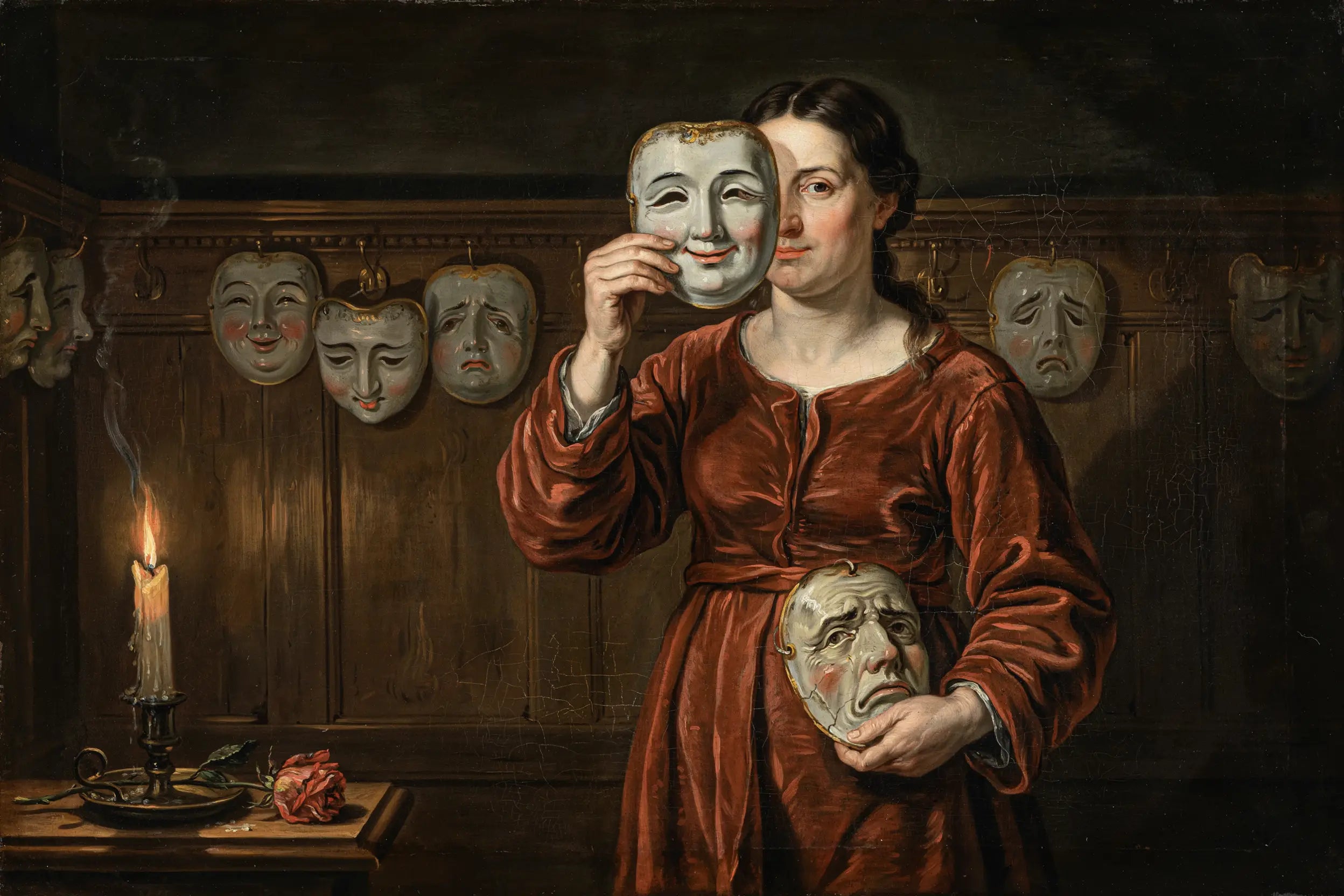
Quick answer: ‘Be yourself’ is terrible advice because there’s no fixed authentic self to be. Neuroscience shows the default mode network constructs your identity from memory, knowledge, and social feedback, maintaining multiple context-dependent selves. Authentic people are often punished at work while adapters are rewarded. Liberation begins when you stop discovering a self and start consciously creating selves—plural, flexible, chosen.
Say your new boss asks you to "introduce yourself to the team." Your mind races through the acceptable professional script, the sanitized version of who you are, scrubbed clean of rough edges, controversial opinions, and the anxiety currently flooding your nervous system. You smile, stand, and perform the ritual dance of workplace identity: enthusiastic but not overeager, competent but not threatening, unique but not weird. Later, scrolling through LinkedIn, you see post after post celebrating "authentic leadership" and "bringing your whole self to work." Which version of you is real? The one carefully calibrated for professional survival, or the one that emerges after three drinks with old friends?
This is the most successful lie in modern Western culture: the myth that being yourself is both possible and advisable. This is historically recent propaganda that emerged from a specific philosophical movement, spread through American counterculture, and now systematically punishes those who follow it while rewarding those who recognize it as the trap it is.
The concept of an authentic self that you can "be" assumes something exists inside you—fixed, discoverable, and true. Neuroscience obliterates this assumption. The default mode network, that constellation of brain regions including your medial prefrontal cortex and posterior cingulate cortex, constructs a story. Vinod Menon's comprehensive 2023 review at Stanford, synthesizing two decades of neuroimaging research, demonstrates that what feels like discovering your "true self" is actually your brain weaving together fragments of memory, semantic knowledge, and social feedback into a coherent narrative.
This is measurable in brain scanners. When researchers at the University of Liège had participants judge themselves in different contexts, distinct neural signatures emerged. Context-independent self-judgments ("I am creative") activated the medial prefrontal cortex, while context-dependent judgments ("I am creative at work") recruited the posterior cingulate and retrosplenial cortex. Your brain literally maintains multiple versions of "you," activating different neural patterns depending on the situation. There are multiple selves your brain constructs and reconstructs based on context.
Bruce Hood, the developmental psychologist at the University of Bristol, says the self is an illusion generated by your brain for its own benefit. The daily experience of being "you" feels so familiar, so obviously real, that it seems absurd to question it. Yet the neuroscience consistently shows this sense of unified selfhood is a post-hoc narrative your brain creates to make sense of what is actually a cacophony of parallel processes, competing drives, and contextual adaptations. The mirror neuron system, discovered by Italian researchers and now mapped across the brain, provides the infrastructure for this constant adaptation—neurons that fire both when you perform an action and when you observe others performing it, creating the neurological basis for empathy, imitation, and behavioral flexibility.
Perhaps most devastating to authenticity ideology is the evidence from neuroplasticity research. Kempermann's landmark study placed 40 genetically identical mice in identical environments and watched them develop completely different personalities over time. The mice who explored more grew more new neurons in their hippocampus. Their behavior literally changed their brain structure, which changed their future behavior. If identical genes in identical environments produce different "selves" based on behavioral choices, what exactly is the authentic self you're supposed to be?
The advice to "be yourself" is a remarkably recent invention with a specific birthday and birthplace. Before the 1760s, no human culture organized around the principle of individual authenticity. The concept emerged from Jean-Jacques Rousseau's fevered imagination during the Romantic movement, when he declared that society corrupts our natural goodness and we must return to our authentic emotional core. His 1762 work "Émile" introduced the revolutionary idea that children should develop according to their inner nature rather than social expectations—a concept that would have been literally incomprehensible to previous generations.
Johann Gottfried Herder, building on Rousseau, coined the fateful phrase: "Each human being has his own measure, as it were an accord peculiar to him of all his feelings to each other." This wasn't describing something that existed—it was inventing a new way to think about human existence. For the first time in history, someone claimed that every individual possessed a unique internal essence that demanded expression. The idea crept through European philosophy for 150 years, from Kierkegaard's "becoming who you are" through Heidegger's "authentic existence," remaining largely an intellectual exercise debated in universities.
Then came the 1960s. The counterculture movement took this obscure philosophical concept and weaponized it against "the establishment." The January 1967 Human Be-In at Golden Gate Park, where 30,000 people gathered to "turn on, tune in, drop out," marked the moment authenticity escaped from philosophy departments and infected mass culture. "Do your own thing" became the defining slogan of a generation. By the time Charles Taylor declared we live in "the age of authenticity" in 2007, this bizarre historical accident had calcified into something that felt like eternal truth.
But here's what the flower children didn't realize: authenticity ideology serves power perfectly. When everyone is focused on discovering and expressing their "true self," they're too busy navel-gazing to notice structural inequalities. When workers are told to "bring their whole selves to work," companies harvest their emotional labor along with their productive labor. When people believe they must be authentic to be moral, they become easier to manipulate—just make them feel inauthentic and watch them scramble to prove their genuineness.
The data on authenticity and career success is so consistent it's almost cruel. Adam Grant at Wharton synthesized 136 studies covering 23,191 employees and found that people who score high on authenticity receive significantly lower performance evaluations and are significantly less likely to be promoted into leadership positions. This is measurable, replicated finding across industries, cultures, and decades of research. The most genuinely "themselves" people in your workplace are systematically held back while those who adapt, calibrate, and perform different versions of themselves advance.
Mark Snyder's self-monitoring research at the University of Minnesota reveals the mechanism. High self-monitors—people who consciously adapt their behavior to fit social contexts—consistently outperform low self-monitors (authentic types) on every career metric that matters. They network more effectively, navigate politics more successfully, and climb hierarchies faster. A 2024 study in the Journal of Business and Psychology examining 505 employees across two samples found that the highest salaries and promotions went to those who used "passive impression management"—employing multiple strategies at low frequency rather than being highly authentic or highly manipulative.
Herminia Ibarra at INSEAD documented how authenticity becomes a career trap at crucial inflection points. Her research following executives through leadership transitions found that those who clung to "being themselves" failed to develop new capabilities required for their roles. One executive, "Cynthia," promoted to manage ten times more people, authentically admitted her fears and uncertainties to her team—and immediately lost credibility. Another, "George," insisted on maintaining his authentic collaborative style in a command-and-control culture and was sidelined within months. The pattern is consistent: moments requiring growth demand that you act like the person you want to become, not the person you currently are. But authenticity ideology tells you that's fake, that you're an imposter, that you should resist the very adaptations that enable development.
The Stanford research on vulnerability and status reveals another cruel twist. When high-status individuals display vulnerability—admit mistakes, show uncertainty, ask for help—they're perceived as confident and competent. When low-status employees do exactly the same things, they're perceived as weak and incompetent. The same "authentic" behavior produces opposite career outcomes depending on your position in the hierarchy. Authenticity is a luxury good that only the already-powerful can afford.
The most damning evidence comes from research on strategic identity management among minorities. Sonia Kang's groundbreaking study at the University of Toronto sent 1,600 real job applications to actual employers across 16 U.S. cities. Black applicants who "whitened" their resumes—anglicizing names, removing ethnic organizations, downplaying racial identity—received 25% callbacks versus 10% for authentic resumes. Asian applicants saw 21% callbacks when whitened versus 11.5% authentic. Let those numbers sink in: being yourself literally cuts your chances of getting an interview in half if you're not white.
The cruelest finding? Organizations with pro-diversity statements discriminated just as much as those without them, but minorities were 50% less likely to whiten their resumes when applying to supposedly inclusive employers. They let their guard down, showed up authentically, and got punished for believing the rhetoric. This is what The Black Book of Power calls "the comfort trap"—when systems that exploit you make you feel safe enough to expose your vulnerabilities.
Courtney McCluney's research at Cornell with 300 Black college-educated professionals found that code-switchers—those who actively managed their racial presentation at work—perceived greater career success than those who remained authentic. They advanced faster, earned more, and received better evaluations. But here's the price: they were significantly more likely to burn out. The psychological toll includes chronic stress, impostor syndrome, exhaustion from constant self-monitoring, and what participants described as "losing myself" in the performance.
Am I even Black anymore? one participant asked researchers, describing how code-switching had become so automatic she couldn't access her "real" voice even at home. The neurological research on code-switching shows that the cognitive load of constant identity management creates measurable stress responses. Cortisol levels spike. Blood pressure rises. The University of Michigan research found sustained code-switching is linked to hypertension and heart disease in Black populations. Success through inauthenticity literally takes years off your life.
William James wrote in 1890 that a person "has as many social selves as there are individuals who recognize him." Modern psychology has finally caught up to what James understood intuitively: multiple selves aren't pathological—they're adaptive. Erving Goffman's dramaturgical theory, developed through meticulous observation of social interaction, demonstrates that all human behavior involves performance. There's no "backstage" authentic self that you bring to the "front stage" of social interaction. Even your most intimate moments involve performing intimacy. Even your solitude involves performing solitude for yourself.
The research on growth mindset and identity reveals something profound: believing you have a fixed authentic self predicts worse outcomes than believing identity is malleable. Carol Dweck's team followed 200,000 California students and found those with growth mindsets about ability learned significantly more than those with fixed mindsets. When applied to identity itself, the pattern holds—people who believe they can develop new aspects of themselves outperform those seeking to discover their "true" nature. Believing in the authentic actively hinders development.
Research with children demonstrates that making kids aware of their multifaceted identities—student, sibling, athlete, artist—enhances cognitive flexibility and problem-solving ability. Children who understand they can be different people in different contexts adapt more successfully to challenges. Meanwhile, adults who believe they must maintain consistent authenticity across contexts show decreased psychological flexibility and increased anxiety. The mental health establishment's emphasis on "finding yourself" may be exactly backward—mental health might require accepting that there's no fixed self to find.
This multiplicity is sophistication. High self-monitors don't lack a core self; they possess what researchers call "relational authenticity"—the ability to bring forward different genuine aspects of themselves based on relational context. The introvert at the office party who becomes animated discussing their passion project are both real; the skill lies in knowing which self serves which moment.
Why does authenticity ideology persist despite overwhelming evidence of its harm? The answer lies in a cognitive bias so fundamental psychologists simply call it the fundamental attribution error. When you see someone behave differently in different contexts, your brain automatically attributes this to personality flaws—they're "two-faced," "fake," "inauthentic"—rather than recognizing they're appropriately adapting to different situations. You do this even though you yourself behave differently with your mother than with your manager, with old friends than with new colleagues.
Cultural psychology research shows this error is dramatically more pronounced in individualistic cultures like the United States than in collectivistic cultures like Japan or China. Americans are trained from birth to believe in essential, individual identity—your "true self" that must be discovered and expressed. East Asian cultures recognize identity as fundamentally relational and contextual—who you are depends on who you're with. Guess which perspective aligns with neuroscience? Guess which produces better mental health outcomes?
The attribution error creates a vicious cycle. You judge others for adapting their behavior (they're inauthentic), so you resist adapting your own behavior (to remain authentic), which leads to worse outcomes (because adaptation is necessary for success), which reinforces your belief that the world punishes authenticity (rather than recognizing that authenticity is the problem). You're trapped in a prison of your own ideology, and the bars are made of concepts that didn't exist 300 years ago.
You might be thinking, "Maybe the problem is that being myself isn't enough." Close, but not quite. The problem is believing there's a "myself" to be in the first place.
The systematic review of impostor syndrome research covering 62 studies with 14,161 participants reveals something nobody wants to admit: impostor feelings might be accurate assessments of a hostile environment rather than psychological dysfunction. When 70% of people experience impostor syndrome, maybe it's appropriate recognition that performing professional identity is inherently artificial.
Feenstra's research at the University of Groningen reframes impostor syndrome as "a psychological response to a dysfunctional context" rather than individual pathology. When you feel like you're performing rather than being authentic, you're accurately perceiving reality. All professional interaction involves performance. The people who don't feel like impostors aren't more authentic; they're better at forgetting they're performing.
The racial distribution of impostor syndrome tells the real story. Research with 240 ethnic minority students found Asian Americans scored highest on impostor feelings, followed by Latino/a students, then African Americans. The more your authentic cultural identity differs from white professional norms, the more you feel like an impostor when conforming to those norms. This is accurate perception of cultural distance. The treatment is recognizing that everyone is performing and some people just have to perform further from their starting point.
Think about the last time you felt like an impostor. Were you pretending to be something you're not, or were you accurately recognizing that professional identity is always a performance? The distinction matters. Authenticity ideology tells you feeling like an impostor means something's wrong—with you, with the situation, with the world. But what if impostor feelings are your brain accurately detecting that all identity is performance, that authenticity is impossible, that everyone is making it up as they go?
The personality change research offers a way out of the authenticity trap, but not the one self-help gurus are selling. Nathan Hudson's studies at Southern Methodist University followed 377 people actively trying to change personality traits over 15 weeks. Those who completed specific behavioral challenges did successfully change—introverts became more extraverted, chaotic people became more conscientious. But here's the catch: wanting to change didn't matter. Planning to change didn't matter. Only sustained behavioral change created personality change.
This directly contradicts both authenticity ideology (you can't change who you really are) and its supposed alternative, "fake it till you make it" (pretend to change and change will follow). The power posing debacle illustrates why. Amy Cuddy's famous TED talk claimed standing in a "power pose" for two minutes would increase testosterone, decrease cortisol, and make you more confident. When actual scientists tried to replicate this with proper controls, the effects vanished. Eleven studies found no evidence that power poses change behavior or outcomes. Standing like Wonder Woman makes you a person standing like Wonder Woman.
Real change requires what Hudson calls "counterhabitational behavior"—consistently acting against your current patterns until new patterns form. Not pretending you're confident while feeling terrified (that's the exhausting performance authenticity ideology claims to oppose), but repeatedly entering situations that build genuine competence. An introvert who wants to become more social consistently schedules social interactions until social interaction becomes less effortful. The behavior changes the brain, which changes future behavior. No authentic self is betrayed because there was no authentic self to begin with—just patterns that can be reinforced or replaced.
The neuroplasticity research supports this completely. Your brain physically restructures based on repeated behavior. Dendrites grow. Synapses strengthen. What feels like "who you are" is actually just your most frequently activated neural pathways. Change the activation patterns consistently enough, and you change "who you are." It's how brains work. The fake part is believing there's a fixed you that exists independent of behavior patterns.
Before you burn your vision board and embrace full Machiavellian manipulation, understand that authenticity does provide benefits—in specific, limited contexts that most people rarely experience. Alex Wood's research at the University of Manchester found that authentic living correlates with well-being, but only when measuring subjective experience, not objective outcomes. Feeling authentic makes you feel better even when being authentic makes your life worse. This is what The Black Book of Power identifies as a "comfort trap"—something that feels good while harming your interests.
The self-determination theory research by Deci and Ryan reveals when authenticity becomes beneficial rather than harmful: when you have genuine autonomy, competence, and relatedness. In other words, authenticity works when you have power, skill, and genuine connections—exactly the things authenticity ideology prevents you from developing. It's a luxury good that markets itself as a necessity. Research on authentic leadership finds it reduces leader stress and increases engagement, but only for leaders who already have sufficient power and autonomy. For everyone else, authenticity increases stress and decreases advancement opportunities.
For marginalized groups, the calculation changes. Meyer's minority stress model shows that concealing stigmatized identity creates chronic stress that can outweigh career benefits. LGBTQ+ individuals who come out in supportive environments show better mental and physical health than those who remain closeted. But the key phrase is "supportive environments"—authenticity about marginalized identity in hostile environments predicts discrimination, violence, and economic harm. The research is unequivocal: authenticity benefits require environmental safety that most people, especially marginalized people, don't have.
The resolution is structural. Telling people to "be more authentic" in environments that punish authenticity is like telling them to swim in acid. Telling them to "be less authentic" forces them to choose between psychological health and material success. The fundamental bind that The Black Book of Power describes: systems create impossible choices, then blame individuals for the outcomes. The problem is environments that demand performance while pretending to value authenticity.
Here's the devil's bargain modern life offers: behavioral flexibility predicts career success, authenticity predicts subjective well-being, but the success gained through flexibility comes with burnout, and the well-being gained through authenticity comes with economic punishment. You can be successful and miserable or authentic and poor. Pick your poison.
The code-switching research quantifies this precisely. Black professionals who code-switch advance faster but burn out quicker. Those who remain authentic report better mental health but face systematic discrimination. There's no winning move because the game is rigged. Women face the same bind: acting "authentically" feminine leads to being perceived as less competent, acting "masculine" leads to being perceived as unlikeable. Adapt and be punished for inauthenticity, or don't adapt and be punished for authenticity.
Van den Bosch and Taris's research found that when employees don't identify with organizational culture, authentic behavior creates conflict that decreases performance. But forcing alignment with organizational culture creates the psychological strain that leads to burnout. Finding the right balance between authenticity and adaptation is wrong. Both are responses to a broken system that extracts maximum value from workers while offering minimum support.
This is why individual solutions fail. Every self-help book telling you to "be more authentic" or "learn to adapt" is missing the point. The problem is that any individual strategy fails when the structure itself is exploitative. It's like debating the best way to rearrange deck chairs on the Titanic. The ship is sinking; your furniture arrangement won't save you.
The research converges on an uncomfortable conclusion: the authentic self you're told to express doesn't exist, the advice to "be yourself" is historically recent propaganda, and both authenticity and inauthenticity exact terrible costs because the system is designed to extract maximum value regardless of your strategy. This sounds depressing until you realize what it means: there's no true self you can betray. There's no authentic essence you can lose. There's no fixed identity you must defend.
Every moment offers the opportunity to construct a new version of yourself suited to that moment's requirements. Construct it. The executive who's commanding in the boardroom and gentle with their children is demonstrating what The Black Book of Power calls "intentional multiplicity"—the recognition that identity is a tool, not a truth. The code-switcher who speaks differently with their grandmother than their manager is honoring the relationship's specific requirements.
The mistake is believing authenticity exists as something you can be or fail to be. Once you recognize that all identity is performance, that neuroscience shows the self is constructed, and that the very concept of authenticity is younger than the United States, you can stop exhausting yourself trying to "find yourself" or "be true to yourself." You can stop feeling like an impostor when you're just accurately perceiving that everyone is making it up. You can stop apologizing for adapting to contexts, as if adaptation were betrayal rather than intelligence.
But—and this is crucial—recognizing authenticity as illusion doesn't mean embracing pure manipulation. The research on Machiavellianism shows that pure manipulators also fail, burning out from the cognitive load of constant deception and destroying the relationships necessary for long-term success. Skip the authentic expression or cynical manipulation and run what researchers call "relational responsiveness"—bringing forward different genuine aspects of your multifaceted self based on what the relationship and context require.
You contain multitudes. You always have. The tragedy is that you've been convinced there's only one self you're allowed to be. Every successful person you admire got there by developing range, becoming capable of different modes, and refusing the prison of fixed identity. They built themselves, continuously, context by context, relationship by relationship.
"Who am I really?" assumes an answer that doesn't exist. The question should be "Who does this moment need me to be, and am I capable of constructing that?" The first question leads to paralysis, to impostor syndrome, to the exhausting performance of consistency. The second leads to growth, to capability, to what The Black Book of Power calls "sovereign flexibility"—the ultimate freedom that comes from recognizing that you are a continuous creation.
Look at your life. Every domain where you succeed, you adapt. Every domain where you struggle, you probably insist on being "authentic." The evidence is right there in your own experience, but authenticity ideology has trained you to see adaptation as betrayal rather than intelligence. You've been so busy trying to find yourself that you've missed the opportunity to create yourself. You've been so worried about being fake that you've forgotten all identity is constructed and that construction is art.
The most liberated people aren't those who've found their true selves—they're those who've recognized there was never a true self to find. They move through the world like water, taking the shape of each container while remaining fundamentally fluid. They don't ask "Is this the real me?" They ask "Is this effective? Is this kind? Is this what's needed?" They've traded the exhausting consistency of authenticity for the creative freedom of intentional multiplicity.
You still don't get permission to be cruel, manipulate, or lose yourself in pure performance. You must recognize that the self you're so worried about losing is already a performance, already constructed, already multiple. By adapting, you're demonstrating the human capacity for growth, for response, for relationship. You're being sophisticated when you act differently in different contexts.
The advice to "be yourself" is the worst advice in history because it assumes a self that neuroscience can't find, promotes a consistency that success punishes, and demands an authenticity that exists nowhere in nature. It's a 200-year-old philosophical error that's become a tool for extraction—be authentic enough that we can predict you, consistent enough that we can control you, fixed enough that we can farm you.
Your liberation begins the moment you stop trying to be yourself and start creating selves—plural, flexible, responsive. The moment you stop apologizing for adaptation and start recognizing it as intelligence. The moment you stop feeling like an impostor and start understanding that everyone is performing, some just forgot they're on stage. The script was always yours to write. The question is whether you'll perform consciously or unconsciously, whether you'll be the director of your selves or just another actor who forgot they're acting.
FAQ
Because it assumes a fixed authentic self that neuroscience can’t find. The ‘authentic self’ is a neurological fiction your brain invents — Kempermann’s landmark study placed 40 genetically identical mice in identical environments and watched them develop completely different personalities. ‘Be yourself’ also carries career costs: unfiltered authenticity is celebrated on LinkedIn and punished in the org chart. Everyone is performing; some just forgot they’re on stage.
It has a birthday. Before the 1760s, no human culture organized around individual authenticity. Rousseau’s 1762 ‘Émile’ introduced the idea that people should develop according to inner nature rather than social expectation; the concept crept through philosophy for 150 years, exploded in the 1960s, and was eventually repackaged as corporate gospel — ‘bring your whole self to work’ — by the same institutions that punish those who actually do.
Yes — call it ‘multiple personality order.’ Context-switching between work-self, friend-self, and family-self isn’t fakeness; it’s adaptive intelligence, and treating one of those selves as ‘real’ and the rest as betrayals is the actual trap. Even impostor syndrome is often accurate perception: you are performing — like everyone else. Mental health is directing your selves consciously, not hunting for the one true one.
Chapter 21 delivers the alternative to the authenticity myth: identity as choice. In the book’s words, you are whoever you practice being until the practice becomes you. Instead of excavating a ‘true self,’ you select and rehearse the self that serves your aims — consciously, strategically, without apology. The Black Book of Power is sold only at stantaylor.com.

The Black Book of Power



Conversational Narcissism: The Cannibal at the Table
Why you keep consuming the people in front of you to fill a hole dug in childhood.
A Lesson in Power Dynamics at Work
See how getting good at your job switches off the brain circuit that reads power.
The Fawn Response: An Education in Disappearing for Others
Why does being useful feels like the surest way to be loved?

The Know-It-All Personality: Why the 'Smartest' Person Builds Nothing
Why does the 'smartest' person in the room tend to build nothing?

Therapy Dependency: When Therapy Needs You to Stay Broken
In reading this, you will meet the one product the industry cannot afford to cure: the perpetual patient.

Threshold Addiction: The Dopamine of "Almost"
Why does planning feel better than doing?

Am I the Toxic One? An Honest Diagnostic
Close the wound or bleed to death believing your emotional hemorrhaging is holy.
How To Manipulate a Narcissist
Why does this person make me feel like I'm losing my mind?
The Covert Narcissist: How to Recognize the Hidden Predator
The covert narcissist is dangerous precisely because the disguise is weakness.

Self-Sabotage: Why You Do It and How to Kill the Pattern
You don't lack discipline. You're running a program that trades your future for a small, guaranteed hit of safety.

10 Signs of Manipulation (and the Counter for Each)
The ten tells a professional manipulator hopes you never learn, and the counter for each.
Dark Psychology: The Complete Guide (From Someone Who Used It)
What dark psychology actually is, from someone who ran the machinery for 23 years.

How to Deal With a Narcissist Without Losing Yourself
You cannot change a narcissist. You can become the person their tactics no longer work on.

The 9 Best Dark Psychology Books, Ranked by Someone Who Lived It
Nine dark psychology books ranked by someone who ran the plays for 23 years, and what each one will not tell you.

What Is a Dark Empath? Traits, Signs, and the Real Danger
The dark empath is dangerous precisely because empathy was supposed to be the safety feature.

The 12 Traits of a Narcissist and What They Reveal
Twelve traits, one mission: defending a self-image that must never be questioned.